

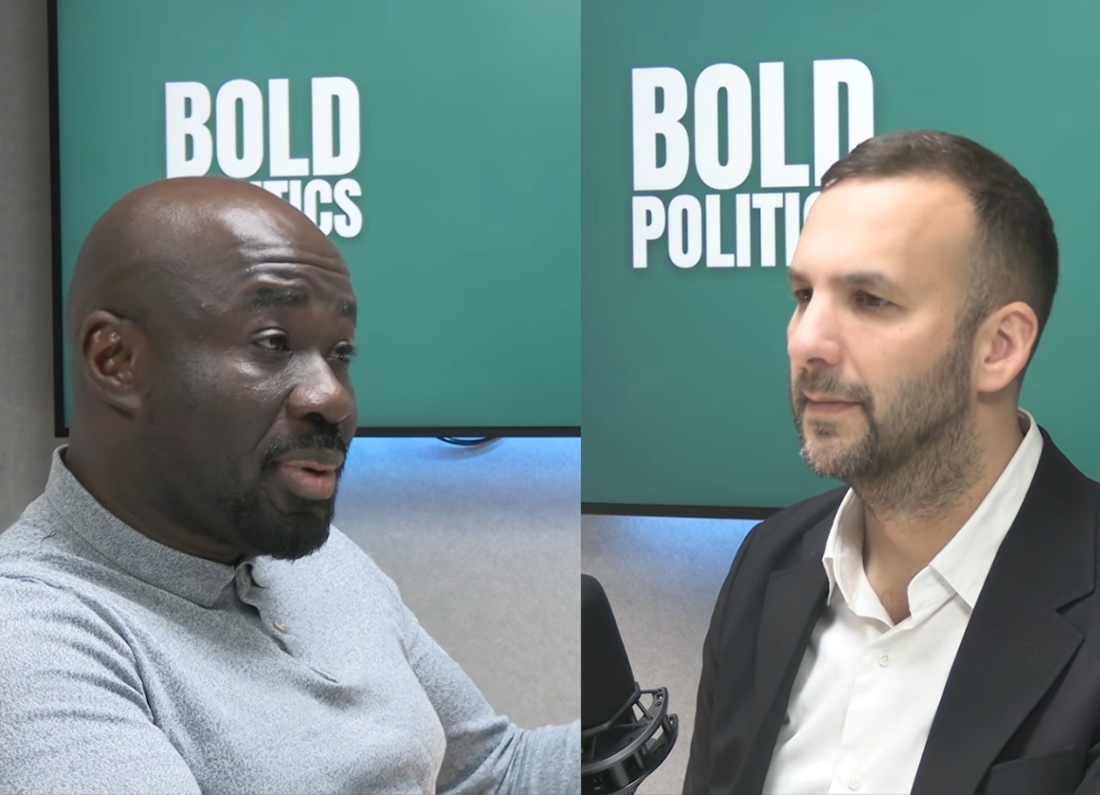
Zack Polanski used this week’s Bold Politics to revisit one of the more contentious lines of attack the Green Party faced during the Gorton and Denton byelection: Labour’s characterisation of the party’s drug legalisation and regulation policy. His guest was Kojo Koram, a professor of law and political economy at Birkbeck, University of London, and author of a new book on the global politics of drug reform.
The attack that prompted the conversation
Polanski opened by describing one of Labour’s campaign attack lines during the byelection, in which the party suggested he or Green candidate Hannah Spencer wanted to “sell crack to children in playgrounds.” Polanski said he accepted criticism as part of political life but found it “pretty disgusting to see a party of government trivializing and demonizing such an important issue,” particularly given the UK’s position as having one of the highest drug death rates in Europe.
The core argument: regulation is not the same as commercialisation
Koram’s central point was that much of the backlash to the Green policy relied on a conflation between regulation and mass commercialisation. “They were like, oh, the Green Party want crack cocaine to be sold in Tesco next to your crunchy nut cornflakes,” he said, arguing this misrepresents the range of regulatory models that exist internationally.
He pointed to Switzerland’s heroin prescription model, in which people with acute dependency issues receive the drug from state-based providers alongside support with housing, mental health or employment issues. He described a three-tiered legislative proposal considered in Colombia, treating coca tea as commercially available, cocaine through a prescription-pharmacist model, and crack cocaine through an overdose-prevention and treatment framework similar to the Swiss heroin model. He also contrasted the commercial dispensary approach seen in parts of the US with Germany’s 2024 cannabis legalisation, which permits home cultivation and “cannabis social clubs” rather than retail sale.
The historical case
Koram argued the modern framework of drug prohibition is roughly a century old, dating to the 1909 Shanghai Opium Commission, and represented a significant break from millennia of human drug use predating it. He noted that until the early 20th century, opium, cocoa and cannabis were treated as legitimate commercial commodities in Britain, pointing to institutions including HSBC and P&O that originated in the opium trade, and to Britain’s war with Qing dynasty China over the right to sell opium.
He argued the shift toward prohibition was substantially driven by the emergence of the United States as the dominant global power, tying it to a specific domestic moral panic at the turn of the 20th century that was then exported internationally through instruments including the 1912 Hague Opium Convention and the 1961 UN Single Convention on Narcotic Drugs, which the UK’s 1971 Misuse of Drugs Act implements domestically. Koram also highlighted the explicitly racialised language used to justify early prohibition in the US, citing period newspaper coverage linking cocaine use to Black communities and cannabis to Mexican communities.
The evidence on cannabis and mental health
Addressing a common public concern, Koram, who was careful to note he is not a scientist, said the relationship between cannabis and mental health remains genuinely contested in the research literature, particularly the question of correlation versus causation. He cited Colorado’s experience since 2012, referencing an Oregon study finding roughly a 4% increase in use and a 2% increase in cannabis use disorders following legalisation, alongside falling youth use, a pattern also observed in Canada and Uruguay, attributed to dispensaries enforcing ID checks more consistently than illicit sellers. He noted 71% of Colorado residents rated legalisation positively after a decade.
The commercialisation risk
Koram’s clearest warning concerned the risk of moving from mass criminalisation directly to mass commercialisation without addressing who benefits. He pointed to the UK’s 2018 medicinal cannabis legalisation, driven by campaigning mothers of children with severe epilepsy, which has not translated into wide NHS availability, leaving a costly private industry to fill the gap. He contrasted this with social equity models in US states such as Illinois and New York, which direct licensing priority and tax revenue, in New York’s case a stated 80% commitment, toward communities most affected by enforcement of the war on drugs, alongside expungement of past convictions.
The political hypocrisy argument
Koram argued the loudest political opposition to reform often comes from figures with their own history of drug use, citing a Conservative leadership contest in which multiple candidates had disclosed past use while campaigning on tough enforcement rhetoric. He also pointed to former US House Speaker John Boehner’s subsequent involvement in cannabis businesses after years opposing reform as evidence of a pattern in which politicians shift from criminalisation rhetoric to commercial involvement once legal.
Where this sits in the broader debate
Drug policy reform remains a genuinely contested area of public policy, and Koram’s position, that regulation reduces net harm relative to prohibition, is one side of an active and ongoing debate among researchers, clinicians and policymakers. Others argue that legalisation risks normalising use and increasing overall consumption even where individual harm indicators improve, and that the social equity models Koram highlights remain unproven at scale over the longer term. The Green Party’s position puts it at odds with the current Labour government’s approach, and with the broader UK political consensus, which has historically favoured enforcement-led drug policy regardless of governing party.
Polanski has faced sustained media scrutiny on other fronts recently, including a dispute with the Telegraph over quotes he says were fabricated, part of a broader pattern of press coverage the Green leader has argued misrepresents his party’s positions, a claim that echoes directly the argument Koram makes about drug policy coverage specifically.
Koram’s book, The Next Fix: The Winners and Losers in the Future of Drugs, is out now. He is a professor at Birkbeck, University of London.











Leave a Reply