

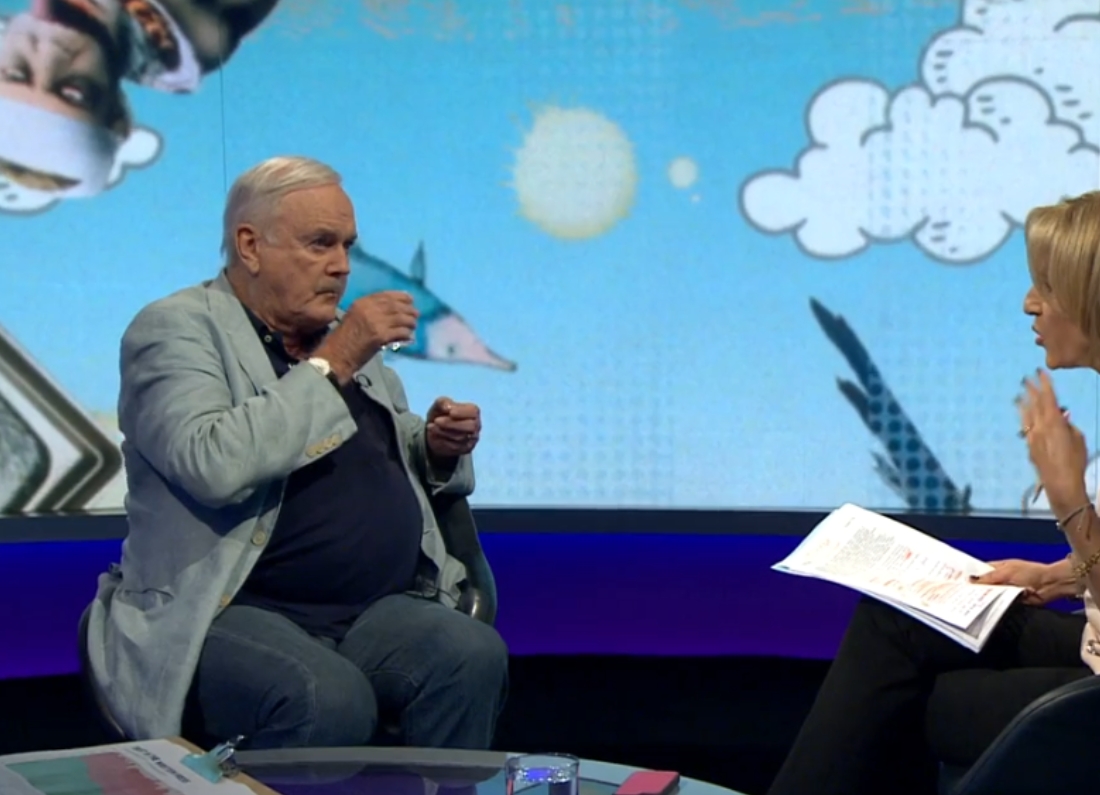
It’s almost painful to write this sentence, but here it is: John Cleese shared a made-up story about Muslims calling for a ban on eating bacon in public and added the caption “Respect is not a one-way street.”
The post he amplified came from an account called Hope X, @Xmusknewsx, and read: “Muslims in the UK are calling for a BAN of people eating Bacon in public during Praying hours. They argue that seeing people eating Bacon is untidy to their faith. What’s your message to them?”
This is not real. Muslims in the UK have not called for a ban on eating bacon in public. No credible source exists for this claim because the claim is invented. It is, as the source article that first documented it puts it, “nonsense.” This particular flavour of Islamophobic disinformation is a recurring format online, sometimes featuring dogs rather than bacon, and the accounts that push it rely on people not checking before they share.
Cleese did not check. Instead he amplified it to his followers with a comment about mutual respect. The post gathered 25,400 likes and 943 replies.
Dom Joly saw it. “Imagine thinking this was real – embarrassing,” he posted. One user wrote: “It’s truly amazing how such an intelligent and well educated person can fall for this nonsense.” Another offered: “This post is brought to you by The Ministry of Silly Talks, The Dishonourable Shadow of his Former Self John Cleese.”
That last one landed.
This was not an isolated moment of carelessness from a busy public figure. It sits within a pattern that has been building for a few years now – a pattern that his fans have watched with a mixture of sadness and frustration.
The same week the bacon post went up, the Financial Times reported that Tommy Robinson had been detained at Heathrow under counter-terrorism legislation, as we reported in our Robinson Heathrow piece. Cleese’s response to the FT’s reporting: “Did he stab someone?”
The tweet got 64,300 likes.
He also responded to a GB News story about Greens proposing a ban on circumcision – a story raising genuine concerns from Jewish groups about religious freedom – with: “What about a ban on beheading?”
Beheading, like all murder, is already illegal. It has been for some time. The “What about beheading?” angle is a well-worn piece of online anti-Muslim dog-whistling that relies on the reader not thinking about it for more than three seconds. Cleese deployed it with 25,800 likes.
None of this is especially surprising in the current online environment. Social media has an extraordinary ability to rewire smart people’s pattern recognition. The format of the bacon post – the all-caps BAN, the loaded “What’s your message to them?”, the juxtaposition of a Muslim crowd and a bacon sandwich – is designed to trigger a response before any verification happens. It works because it targets existing anxieties and asks for a reaction rather than a thought.
What makes it particularly dispiriting in Cleese’s case is the specific quality of intelligence he built his career on. The comedy that made him famous – Fawlty Towers, Monty Python, A Fish Called Wanda – was built on a kind of forensic scepticism about authority, pomposity and self-deception. It was comedy for people who noticed when the emperor had no clothes.
Now he is amplifying content from an account called Xmusknewsx to 25,000 likes without asking whether it might be nonsense.
The answer, for the avoidance of doubt, is that it is nonsense. Muslims have not called for a ban on eating bacon in public. They have also not, while we’re here, called for a ban on dogs – which is the other recurring format this type of account uses when they run out of bacon material.
The accounts that produce this content exist to generate engagement, collect followers, and push a specific set of anxieties about Islam in Britain. They do not require John Cleese specifically. But when a famous, credible name with hundreds of thousands of followers shares their content uncritically, they get something considerably more valuable than the original post could ever generate on its own: the appearance of legitimate concern from a trusted source.
That is what the grift is. Cleese handed it to them for free.
Dom Joly’s “Imagine thinking this was real – embarrassing” will probably be the line that travels furthest. It is succinct, it is accurate, and it does not require much additional commentary. But maybe just a little…
What it does not capture is the specific sadness of watching someone who spent decades puncturing exactly this kind of lazy thinking now participating in it enthusiastically, one like at a time.



Leave a Reply