

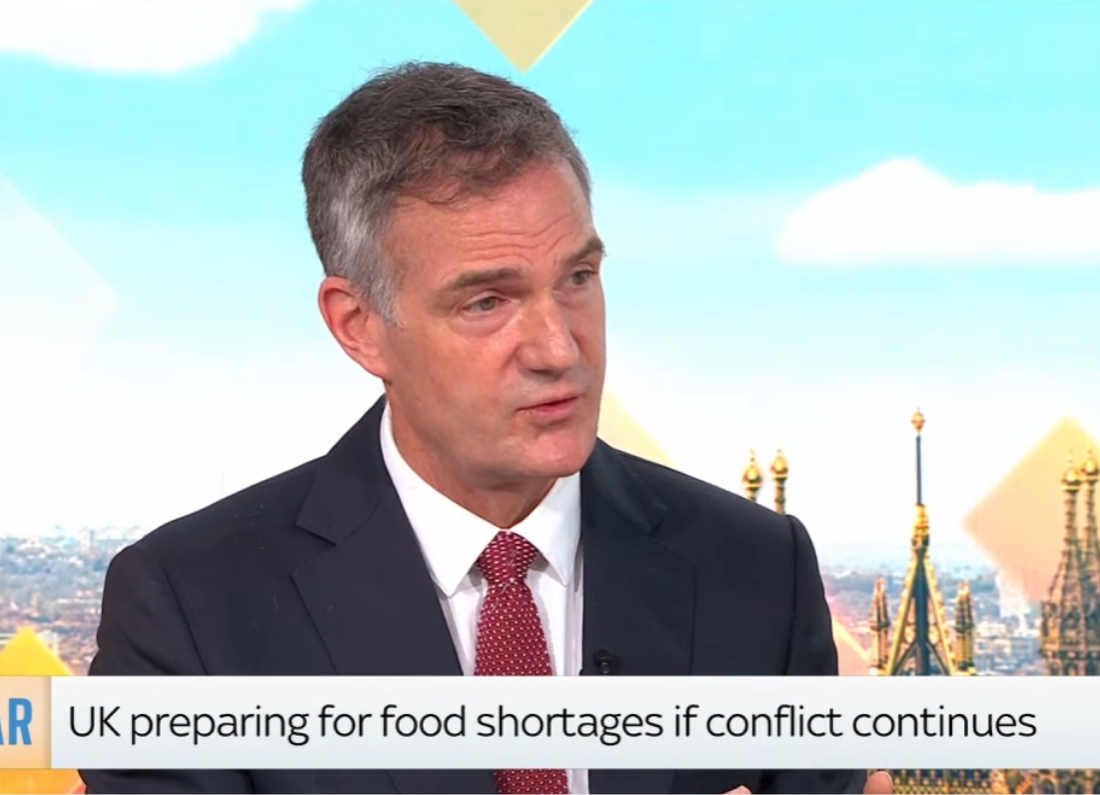
The government has been secretly planning for food shortages this summer as the Iran war’s closure of the Strait of Hormuz puts pressure on Britain’s carbon dioxide supply – with officials conducting a classified exercise called “Exercise Turnstone” that modelled what would happen if the waterway remained shut and no peace deal had been reached by June 2026.
Business and trade secretary Peter Kyle confirmed on Tuesday that ministers were engaged in “scenario planning” for potential disruptions to food supplies. His remarks followed a report in the Times that the UK could face shortages of chicken, pork and other supermarket goods in the coming months as a consequence of a collapse in CO2 supplies – a gas that plays a far wider role in the British food chain than most people realise.
Kyle sought to reassure the public, saying that CO2 shortages were “not a concern for our economy” at the moment and urging people to continue “enjoying beer, enjoying their meats, enjoying all the salads.” But the existence of the planning itself – and the specific detail of what officials have been modelling – tells a more uncomfortable story about how seriously the government is taking the risk.
Why CO2 matters so much
Carbon dioxide is not just the gas in a fizzy drink. It sits at almost every stage of the British food supply chain and, crucially, in healthcare and civil infrastructure too.
In food production, CO2 is used in the stunning and slaughter of pigs and most chickens – meaning a shortage directly limits how much meat can be processed. It is used to extend the shelf life of packaged meats, salads and baked goods by replacing oxygen in packaging. It chills and freezes food in transit. It makes soft drinks, beer and sparkling water fizzy.
Beyond food, CO2 in dry ice form is essential for cold storage of blood, organs and vaccines in the NHS. It plays a role in Britain’s civil nuclear sector. A severe shortage would not just mean fewer options on supermarket shelves – it would cause disruption across healthcare, hospitality, brewing, farming and national energy infrastructure simultaneously.
The Times reported that in a “reasonable worst-case scenario,” CO2 levels could fall to just 18% of current levels if a key UK plant faced a mechanical fault at the same time as high gas costs triggered a fall in ammonia and fertiliser production – both of which generate CO2 as a by-product.
Exercise Turnstone – the classified rehearsal
The most striking element of the reporting is the existence of “Exercise Turnstone” – a classified simulation in which officials from No.10, the Treasury and the Ministry of Defence rehearsed the government’s response to a CO2 shortage. The exercise was run on the specific assumption that the Strait of Hormuz remained closed and no permanent peace deal had been agreed by June 2026.
The modelling of a scenario stretching to June suggests the government does not believe a resolution to the Hormuz crisis is guaranteed in the near future – even as Trump claims the war is “very close to over.” The ceasefire expires on April 21. If it collapses and the blockade resumes, the supply chain pressures the government has been quietly preparing for could begin to materialise much more rapidly.
What the government has already done
Kyle pointed to one specific pre-emptive action the government has taken. In the early days of the Iran conflict, he used his ministerial powers to “unmothball” Ensus – a North East company that produces CO2 as a by-product of bioethanol production – after it had been facing bankruptcy.
“In the first couple of days of the conflict erupting in the Middle East, I unmothballed Ensus,” Kyle told Times Radio. “And I can tell you that it is now back up to full operation producing CO2.”
He contrasted the government’s approach to Boris Johnson’s handling of the early days of Covid, when Johnson missed five COBRA meetings before the pandemic hit. “I can tell you, because I’m in these meetings, the prime minister has been there since the very start and he is going through personally and driving deep dives into lots of areas of resilience throughout our economy,” Kyle said.
A No.10 spokesperson said the government is “stress testing a wide range of scenarios, however unlikely they may be, to make sure that our supply chains and the economy are always protected.”
Public confidence – and the broader context
The planning comes against a backdrop of wider public anxiety about the country’s preparedness. YouGov polling found that seven in ten Britons – 69% – think the country is poorly prepared for a major conflict. That figure will not be reassured by the knowledge that officials are privately modelling scenarios in which CO2 falls to 18% of current levels.
Food supplies are not expected to reach critical levels, and Kyle insisted there was no immediate cause for alarm. But the confirmation that “scenario planning” is underway – and that it covers everything from the supermarket shelves to blood storage in NHS hospitals – is itself a significant indicator of how seriously the government is treating the risk that the Iran ceasefire could collapse or that supply chain damage already done may yet feed through into the British economy.
The Times reported that the government had concluded the “reasonable worst-case scenario” involved not just a shuttered Strait of Hormuz but a mechanical failure at a key domestic CO2 plant hitting at the same time as high gas prices reduce ammonia production. In other words, the scenario the government has modelled is not the most catastrophic possible outcome – it is the one they consider most plausible if things go wrong.
That is the context in which Peter Kyle’s reassurances – that people should go on “enjoying beer, enjoying their meats, enjoying all the salads” – should be read.
You may also like: Revealed: Mandelson failed security vetting but Foreign Office overruled decision to make him US ambassador






Leave a Reply