

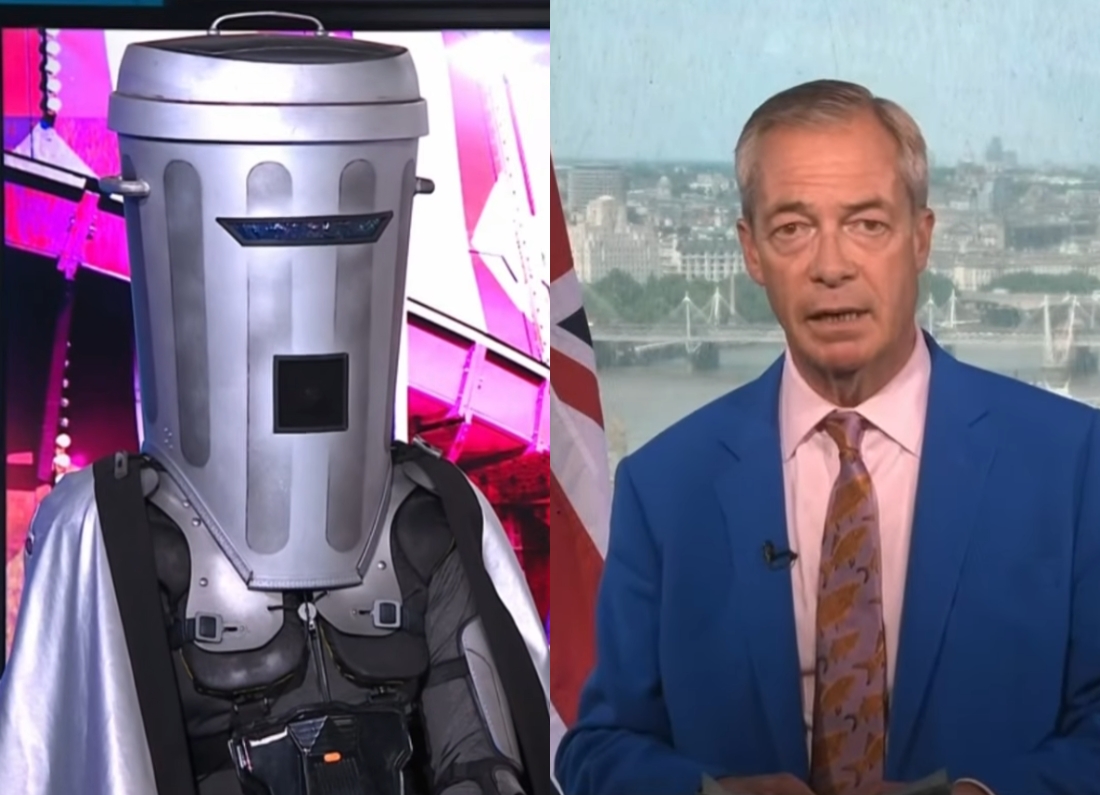
There are many ways to respond to Count Binface.
You can laugh. You can roll your eyes. You can quietly admire the fact that a man dressed as an intergalactic waste receptacle has somehow become one of the more coherent voices in the Clacton by-election.
Or, if you are Daniel Hannan, you can write an entire Telegraph column treating the whole thing as a grave economic warning about Britain’s refusal to live within its means.
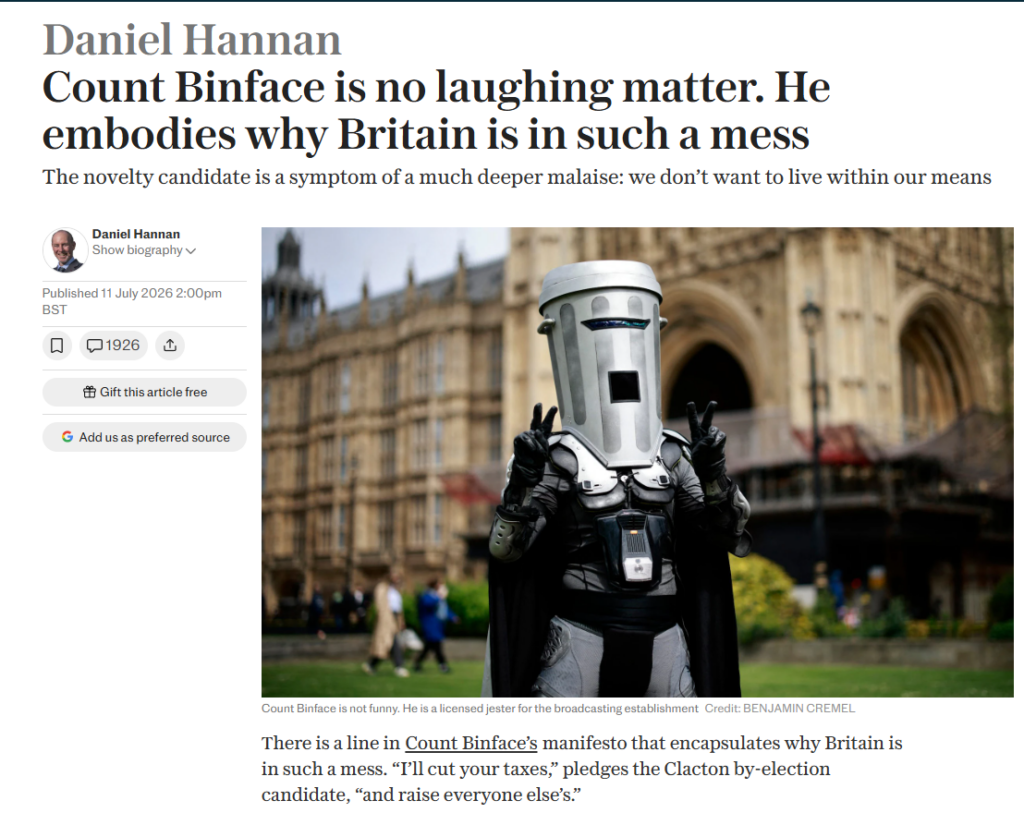
Which is a choice.
Hannan, now Lord Hannan, used his column to argue that Count Binface is “no laughing matter” and “embodies the sad state of our country”. The novelty candidate, he said, is not just a harmless joke but a symptom of something deeper: voters wanting impossible promises, politicians refusing to be honest, and Britain demanding Scandinavian public services without accepting the bill.
Fair enough, you might think. A peer who helped sell Brexit warning the country about fantasy economics is certainly a rich enough premise to work with.
But then came the problem.
The kebab that doesn’t exist
Hannan attacked Count Binface for wanting to cap the price of “Wigan kebabs”. Except Count Binface’s current Clacton manifesto does not appear to include a policy to cap the price of kebabs.
It includes restoring the price of a 99 Flake to 99p. It includes nationalising Adele. It includes bringing back Ceefax. It includes building “at least one affordable house”. It includes moving the hand dryer in the gents’ toilet at the Crown and Treaty pub in Uxbridge to a more sensible position, which Binface has correctly identified as a national issue.
A Wigan kebab, for anyone south of the pie belt, is a pie in a bread roll. Or a barm. Or a cob. Or whatever term you use if you wish to start a civil war in the comments section.
It was a Count Binface manifesto pledge in Makerfield, not Clacton. So Hannan appears to have got himself worked up about the wrong campaign, in the wrong constituency, over a policy that was already a joke in the first place.
And then he decided this was proof that Britain was doomed.
The Telegraph took the bin seriously
The column was shared by Harry Phibbs, who quoted Hannan’s line about Binface’s tax pledge: “I’ll cut your taxes and raise everyone else’s.”
Hannan argued that this was not really satire at all, but the logic of modern politics. Every party, he said, wants to make someone else pay. He warned against wealth taxes, mansion taxes, exit taxes, food price caps, energy bill interventions and anything else he believes allows voters to imagine they can get public spending without personal sacrifice.
There is a serious argument in there somewhere about public spending, taxation and the size of the state. There usually is, in fairness to Hannan. He is not stupid.
The problem is that he chose to hang it all on Count Binface. And not only Count Binface, but a Count Binface policy that does not seem to exist in the by-election Hannan was writing about.
That was where the internet got involved.
Ben Kentish summed up the absurdity neatly, writing: “The Telegraph has published a lengthy opinion piece attacking, seemingly entirely seriously, Count Binface’s economic policies.”
Liz Webster went further, saying: “THEY’RE RATTLED BY THE BIN,” before adding: “Daniel Hannan helped sell Britain Brexit. Now he’s written an entire page explaining why Count Binface ‘is no laughing matter’ and embodies ‘the sad state of our country’.” Her conclusion was sharper still: “No Daniel. The Bin is the response to the absurdity you helped create.”
ApeAge had a simpler objection to Hannan’s economics: “Sorry but I’m a single issue voter and I really want to nationalize Adele.” Paul Himself wrote: “You’re attacking the economic policies of a bin because you’re so afraid he’ll beat Farage.” And Brexitshambles captured the broader disbelief: “With a straight face, as the tragedy of Farage becomes farce, Brexiter Daniel Hannan criticises the Count’s manifesto in The Telegraph.”
That is the trouble with writing a serious column about a man whose stated policies include Adele nationalisation. People may notice.
The real target was not Binface
The slightly stranger thing is that Hannan’s column is not really about Count Binface at all. It is about Nigel Farage.
Or at least, it is about the political moment in which Farage, having triggered a by-election in Clacton after coming under scrutiny over gifts and wealthy backers, now finds himself being challenged by the country’s most famous bin-headed candidate while major parties stand aside.
Farage wanted a dramatic “people versus the establishment” contest. Instead, the whole thing has become a national joke, then an international one. MSNBC has already explained the race to American viewers by asking whether Nigel Farage is “better than a trash can”.
The satire works because it punctures the grandiosity of the moment. Farage presents himself as the great outsider, but he is a wealthy, privately educated, former City trader turned long-term professional politician, now under scrutiny over his finances and political backers. Count Binface, meanwhile, is a literal joke candidate who has somehow managed to ask the obvious questions without pretending the whole thing is a constitutional epic.
That is why Hannan’s column feels so odd. He sees Binface as a symbol of unserious politics, but the by-election itself only exists because Farage chose to resign and re-stand in an attempt to turn an investigation into a public mandate. If Britain’s politics has become ridiculous, the man in the bin costume did not start it.
He just dressed appropriately.
Hannan’s Brexit problem
The other reason the reaction was so sharp is that Hannan is not just any Telegraph columnist. He was one of the most prominent intellectual advocates for Brexit. He famously said that “absolutely nobody is talking about threatening our place in the single market,” a line that has followed him around ever since for obvious reasons.
He has also been mocked over past claims and comments, including his optimistic predictions about Brexit disruption and his habit of recasting deeply contested political outcomes as obvious common sense after the event.
So when Hannan lectures Britain about fantasy economics, magical thinking and voters believing in painless routes to prosperity, people notice the history.
That is why the Binface column landed so badly online. It was not merely that a peer wrote hundreds of words about the fiscal implications of novelty manifesto pledges. It was that one of the people most associated with selling Britain a dream of painless national renewal was now warning the public about easy answers.
For many readers, the irony was not subtle.
The joke is doing a serious job
Hannan’s central complaint is that Count Binface is not really funny because he reflects a broken politics. But that is precisely why the joke works.
Binface’s manifesto is absurd because British politics is absurd. The point of promising to build “at least one affordable house” is not that voters seriously believe a space warrior with a bin for a head will solve the housing crisis. It is that the country has spent years listening to professional politicians promise to fix housing and then fail to build enough of it.
The point of nationalising Adele is not that the Treasury should immediately prepare a takeover bid for one of Britain’s most successful singers. It is that the language of nationalisation, ownership and national pride is already flung around in ways that often have more emotional power than policy detail.
The point of the 99 Flake pledge is not that dairy supply chains can be solved by intergalactic decree. It is that everyone understands the joke because everyone understands the feeling that ordinary treats have become pointlessly expensive while politicians argue over graphs.
Satire does not need to be a fully costed manifesto. It needs to reveal something true by exaggerating it.
And right now, Count Binface is revealing that a lot of Britain’s very serious politics looks ridiculous when you place it next to an actual joke.
The fear beneath the laughter
The interesting thing about Hannan’s article is that, beneath the sneering, there is something like fear.
Not fear that Count Binface will actually nationalise Adele. Not fear that a Wigan kebab price cap will destroy the pie-based economy of Greater Manchester.
Fear that the joke candidate is landing because the supposedly serious candidates have exhausted public patience.
Hannan himself admits that Farage, once sold as the ultimate anti-establishment figure, is now being portrayed as a wealthy insider trying to avoid questions about his money. That is the real story. Not the bin. Not the manifesto gag. Not the imaginary kebab intervention.
The real story is that Farage’s attempt to force a grand moral reckoning in Clacton has created a situation where a joke candidate can make him look pompous simply by existing.
That is why the Telegraph column feels less like a takedown of Count Binface and more like a cry for the old order to be taken seriously again.
Unfortunately for Hannan, the public seems rather busy laughing.
And when a peer who helped sell Brexit ends up solemnly warning the nation about the economic dangers of a bin-headed space warrior’s non-existent kebab policy, it is hard not to conclude that Count Binface may have already won the argument.





Leave a Reply