

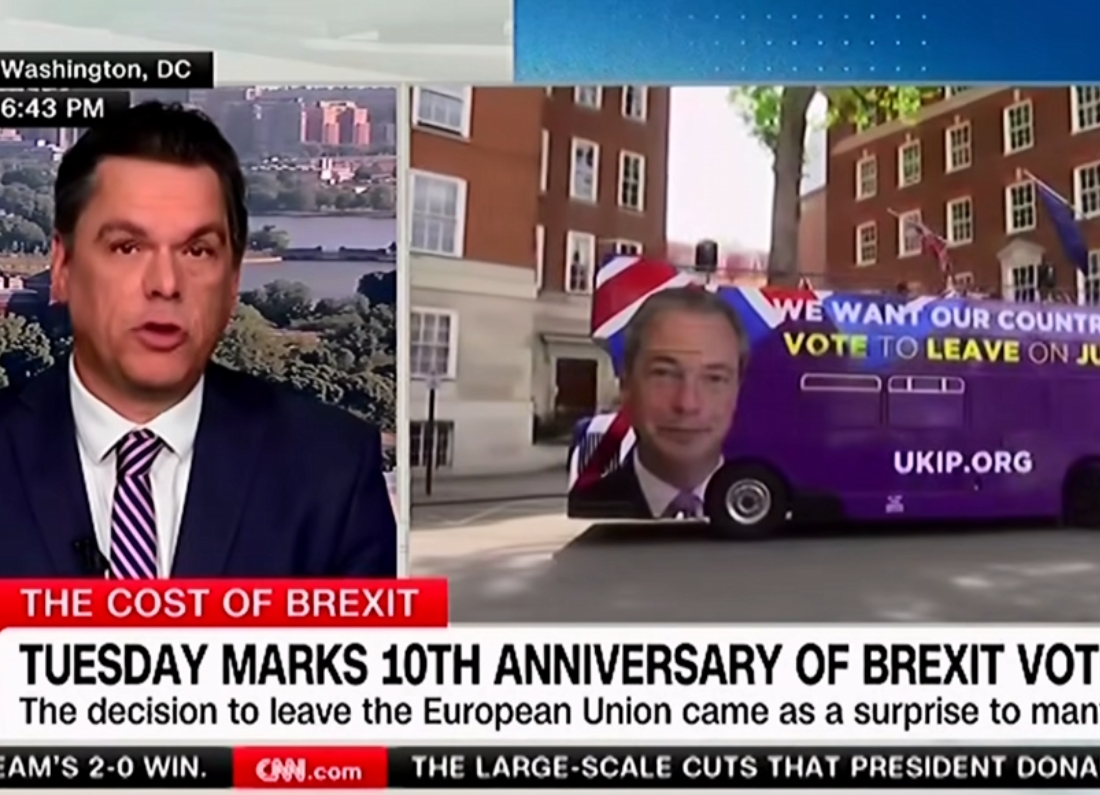
Last month marked ten years since 17,410,742 people decided the United Kingdom’s future should lie outside its greatest trading partner, the European Union. Since then, we’ve had a decade of chaos which has resulted in an almost-universal consensus that Brexit has been a disaster.
A majority of people now think this, and many want another referendum on the matter. As the years have gone on since 2016, a number of nations have looked on in bafflement at the UK’s decision, or, as Finland’s president put it earlier this year, “amputating your leg for no reason.”
The CNN segment
The latest example of this bafflement has come from the US, where CNN managed to sum up what has effectively become a lost decade for Britain. In a devastating four-minute segment filmed in the wake of Keir Starmer’s resignation, CNN said the prime minister had been “knocked down and out by the seemingly unmanageable politics Brexit spawned.”
The channel’s presenter said Brexit “fired the starting gun on a wave of populism that swept the Western world.” But the segment focused primarily on the buyer’s remorse that has developed since the vote, with polls showing a growing majority of Britons now want to return to the EU.
What Hastings actually said
CNN reporter Anna Coober travelled to Hastings, a Leave-voting town on the south coast, to ask residents how they felt about the decision a decade on. One fisherman, who said he voted to see “Great Britain great again,” was asked to describe Brexit in a single word. His answer: “Failure.” He pointed specifically to the increase in paperwork he now faces and the growing difficulty of exporting fish, a sector Brexit’s architects had specifically promised would benefit from leaving the EU’s Common Fisheries Policy.
The most telling line in the entire segment, however, came from another Leave voter, who said simply: “I think I would have voted differently if I’d known what it is today.”
The wider reaction
X user Liz Webster captured the significance of the clip in a widely shared post: “CNN sums up Britain’s lost decade thanks to Brexit. Six PMs in ten years. Years of instability. A fractured electorate. And in Hastings, a town that voted Leave, fishermen describing Brexit as a ‘failure’ because of more paperwork, harder exports and broken promises. The most telling line came from a Leave voter: ‘I think I would have voted differently if I’d known what it is today.’ Britain wasn’t broken by one event alone, but Brexit has been the defining political and economic force of the last decade. Polls: up to 2/3 now say it was a mistake. Sovereignty delivered. Economic delivery? Still waiting.”
Why this particular clip lands differently
There have been plenty of domestic retrospectives on Brexit’s tenth anniversary, including a full breakdown of what was promised, what actually happened, and who has faced accountability for the gap between the two. But there is something particularly pointed about hearing the same verdict delivered by an American broadcaster, speaking to voters in a town that actually voted Leave, rather than filtered through the usual domestic political framing where every Brexit retrospective risks being read as simply Remainer commentary dressed up as journalism.
The fisherman’s specific complaint, about paperwork and export difficulty, is a particularly sharp illustration of the gap between promise and delivery. Fishing was one of the most symbolically potent issues in the entire referendum campaign, repeatedly used by Leave campaigners as proof that EU membership had disadvantaged British industry. A decade on, a fisherman in a Leave-voting town summarising the actual outcome in one word, “failure,” is about as clean a piece of evidence against that promise as journalism is likely to produce.
Not an isolated finding
This CNN segment lands the same week the Daily Mail’s own readership poll found 84% support for rejoining the EU, a result the paper appeared to present using some rather generous graphical choices given its own historic editorial position on Brexit. Taken together with the polling showing up to two-thirds of Britons now consider Brexit a mistake, and the six prime ministers Britain has cycled through since the vote, the picture assembling itself from multiple independent sources, international broadcasters, domestic pollsters, and even traditionally pro-Brexit newspapers’ own readers, is remarkably consistent.
Sovereignty was delivered, in the narrow technical sense of Parliament regaining formal legal authority over areas previously governed jointly with the EU. Whether that sovereignty has translated into the economic and practical benefits promised during the campaign remains, ten years on, an open and increasingly one-sidedly answered question.
You can watch the full clip below:



Leave a Reply