

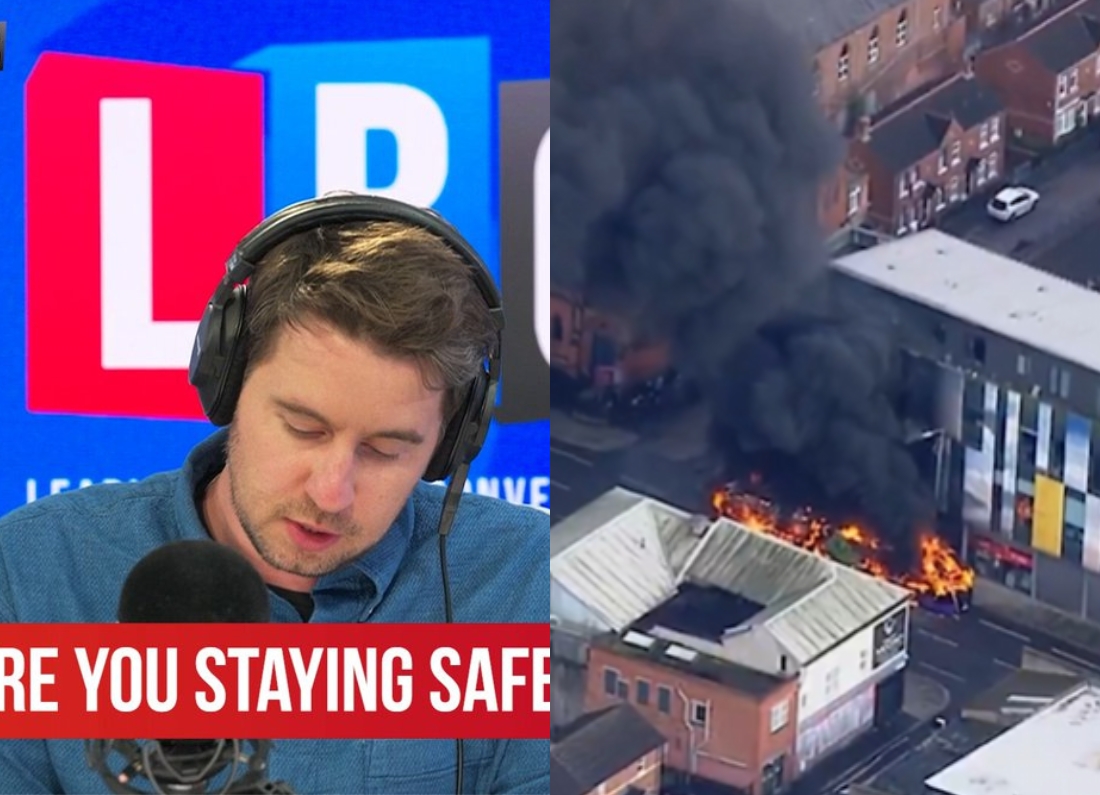
A Belfast resident named Mark called in to LBC during the second consecutive night of rioting in the city to tell presenter Ben Kentish exactly what he thought was happening. When Kentish asked if he was safe, Mark said he was – but gave a reason that cut through everything else being said about the riots. “I’m safe enough, because I’m white,” he said. “That’s the way we are in this horrible world. If I was a person of colour, I would be absolutely terrified.” He then raised a question about 30 women murdered in Northern Ireland in the last six years that nobody else had asked.
What he said
Mark’s call was short, direct and covered three things.
First, the question of who the riots were safe for. He answered it without hesitation. White people were safe. People of colour were not. He was not theorising about the general character of the disorder – he was describing what it felt like to be in Belfast during it, as someone who could walk the streets without fear because of the colour of his skin.
Second, the comparison that has not been widely made. “Thirty women have been murdered in the north in the last six years,” Mark said. “Not one road was closed. Not one protest. What was the connection? They were all murdered by white locals.”
The BBC has reported on the scale of violence against women in Northern Ireland. Thirty murders in six years. No riots. No road closures. No far-right mobilisation. No calls from Elon Musk or Tommy Robinson for answers about immigration status. As we reported in our Hasan Musk piece, Mehdi Hasan told Newsnight that Musk “is obsessed with finding these cases where he can then amplify far right voices.” The 30 women murdered by white men in Northern Ireland did not produce that amplification. The criteria for which cases get amplified, Mark was pointing out, is not the violence itself.
Third, he named who was rioting. The disorder had largely been carried out by “pro-British, Protestant people” in Northern Ireland. This is a specific observation about the demographics of the riots in a city with a specific and complex relationship between community identity and political allegiance – and it complicates the framing of the violence as a spontaneous expression of public anger about immigration.
The context
As we reported in our Polanski Yusuf piece, Claire Hanna, the Belfast MP and SDLP leader, described the riots as a “race-based pogrom.” Zack Polanski said Zia Yusuf’s “some cultures are MUCH better than others” post was “the kind of thing that was said about the Jews in the 1930s.” As we reported in our Hasan Musk piece, Musk and Tommy Robinson both amplified the attack from safe distances – Musk from his US home, Robinson from a luxury hotel in Russia with Musk’s father.
Hadi Alodid, the man charged with the attack, was in the UK legally. He had been granted refugee status through a Sunak-era fast-track scheme, as we reported in our asylum scheme piece. Robert Jenrick was Immigration Minister. Suella Braverman was Home Secretary. Both are now in Reform calling it “treacherous Tory and Labour immigration policy.”
Mark, in a three-minute LBC call, said more about what was actually happening than much of the political and media coverage managed across two days.
Why the 30 women matter
The specific statistic Mark cited – 30 women murdered in Northern Ireland in six years, all by white locals, producing no protests – is not a peripheral point. It is the central test of the claim that the riots were motivated by concern about public safety.
If the riots were about safety, the 30 women should have produced the same response. They did not. If the riots were about violence in communities, domestic violence should have filled the streets with protesters. It did not. The difference between the Alodid case and the 30 women is not the violence. It is the ethnicity of the perpetrator.
As Mehdi Hasan put it on Newsnight, the algorithm – and the political figures who exploit it – selects specific cases and amplifies them. The cases selected share a specific characteristic. As @AnnaSchurer asked about the attacks on Hannah Spencer’s clothes at PMQs: “How many male MPs are commonly attacked on what they wear? Thought so.”
The same structural question applies here. Which violent crimes produce riots? Thought so.
You can watch it below:






Leave a Reply