

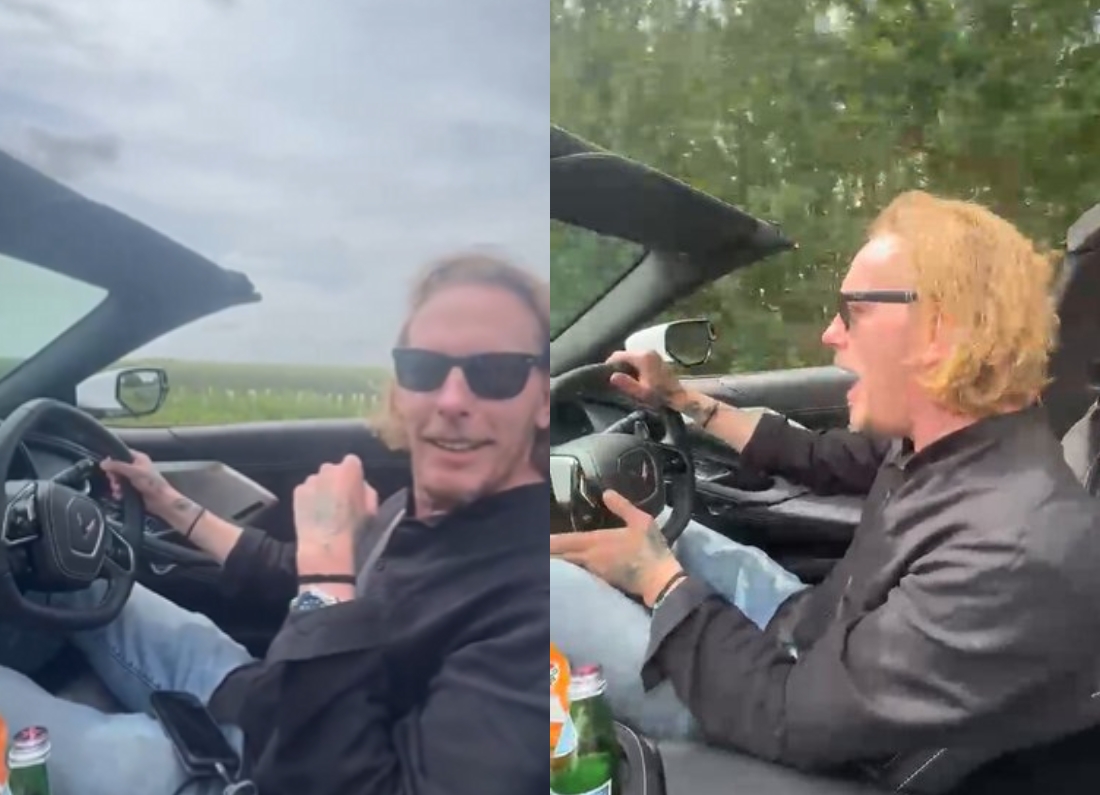
There are many ways to respond to one of the most controversial debates of the year. Laurence Fox chose to post himself driving home in a large sports car while singing for the camera, with a caption referencing potential points on his licence. It did not go especially well.
Fox had appeared at the Oxford Union debate on the motion “This house believes the West is right to be suspicious of Islam”, alongside Tommy Robinson, Jacob Rees-Mogg and Calvin Robinson. The debate had attracted enormous controversy before it began. The Bishop of Oxford and Imam Monawar Hussain said they were “disturbed and saddened” by the invitation to Robinson. More than 500 masked anti-fascist protesters blockaded the venue, leaving many attendees and some union officials unable to get inside. The motion ultimately failed, defeated by a 20-year-old Palestinian Muslim president who had invited Robinson in the first place and then beat him in open debate.
Fox left all of this behind and posted a video from his car.
The post
“Me and the Mrs. @CaliforniaFrizz have finally escaped the Oxford be kind nazis in the 6.2 litre V8 penguin killer,” he wrote. “Lovely journey home to be fair. May have some points on the licence…”
The video appeared to show Fox driving while being filmed from the passenger seat, singing and performing for the camera. It is not possible from the clip alone to confirm whether any specific driving offence was committed. But when someone posts a driving video with “may have some points on the licence” in the caption, the question was always going to be asked. Under UK law, drivers can receive six penalty points and a £200 fine for holding and using a phone or device while driving, and three points for not having a full view of the road or not being in proper control of the vehicle.
One viewer asked directly: “Why do you have your hands on an electronic device whilst driving?”
The reaction
Most people, however, were less focused on the road safety angle and more interested in the general spectacle. The tone of the replies was consistent: here was a man trying very hard to look like he did not care what anyone thought, and succeeding mainly in looking like he cared enormously.
El Crabbito asked: “Why is this clown always acting like he’s just got one up on someone?” George Koch wrote: “Can’t imagine what a sad conversation you have with the wife that leads to her filming you like this so you can post this on Twitter.” Olly put it simply: “‘Film me while I drive and sing love’ – social media has warped some middle-aged men’s minds.”
Lord Runcible was not buying the rebel act: “The truly sad thing is that these monumental fannies actually think this makes them look like a couple of cool renegades. Tragic, really.” He later added: “This is what happens when an unemployed layabout like Fox is bankrolled by a billionaire. Idle rich personified.” John Hurlston agreed: “Must be great spending someone else’s money. Rebel my arse.”
Dr Johnny Bananas kept it pithy: “Didn’t realise you could get points for singing.” Brenda Pritchard was less measured. Mental Dave added: “You really like attention don’t you? It must be the wannabe actor in you.” Inevitable Justin McKenzie went for the car itself: “Making up for the lack of packaging in the trouser department I see.”
Telford Man kept it the shortest of all: “I’m not impressed.”
The contradiction at the heart of it
The mockery worked because of a fairly obvious tension the post contained. Fox was using the language of the persecuted outsider – “escaped”, “be kind nazis”, the pointed reference to potential driving points – while simultaneously posting from inside a 6.2-litre V8 sports car after an evening at the Oxford Union. The aesthetics of victimhood and the aesthetics of comfort do not sit naturally together, and the replies noticed.
The “penguin killer” line was presumably a knowing joke about emissions. But it also managed to simultaneously annoy environmentalists and make the whole thing sound even more like someone deliberately trying to wind up the people he imagines are watching. That is a lot of work for a caption about a drive home from Oxfordshire.
Fox has spent several years positioning himself as Britain’s most put-upon rebel – dropped from acting work, deplatformed, misunderstood, fighting the establishment from the front seat of a large car. The culture war circuit runs on exactly this kind of content: provocation wrapped in grievance, packaged for people who feel the same way. The Oxford Union debate was billed as a serious free speech confrontation. Fox’s post-debate content looked more like the afterparty version of it, produced by someone who had decided the drive home was also part of the performance.
What actually happened at the debate
For what it is worth, Fox’s own contribution inside the Oxford Union was memorable for different reasons. He spent much of his speech building to a dramatic reveal of what he implied was a controversial cartoon of the Prophet Muhammad, producing a large envelope with considerable ceremony while Jacob Rees-Mogg intervened to note that props were against union rules. Fox opened the envelope. Inside was a cartoon of Rees-Mogg. The room laughed. It was, at least, funny.
Outside, the motion had failed 41 votes to 57. The debate that hundreds had protested, that a no-confidence vote had been called over, that the Bishop of Oxford had condemned – ended with the anti-Islam motion losing in front of a partial audience, beaten in part by a speech from the 20-year-old Palestinian president whose invitation had caused the whole controversy in the first place.
Fox got in his car and drove home. He posted the video. The internet told him what it thought.
Most people just thought he looked ridiculous.






Leave a Reply