


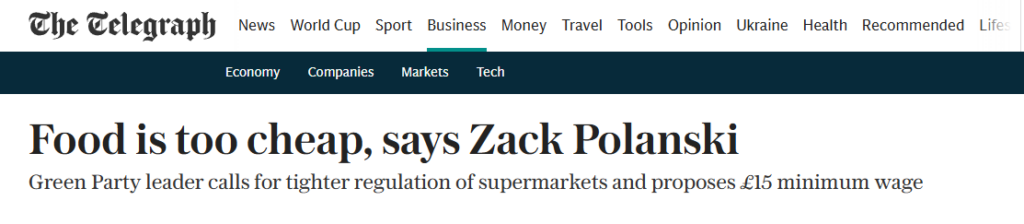
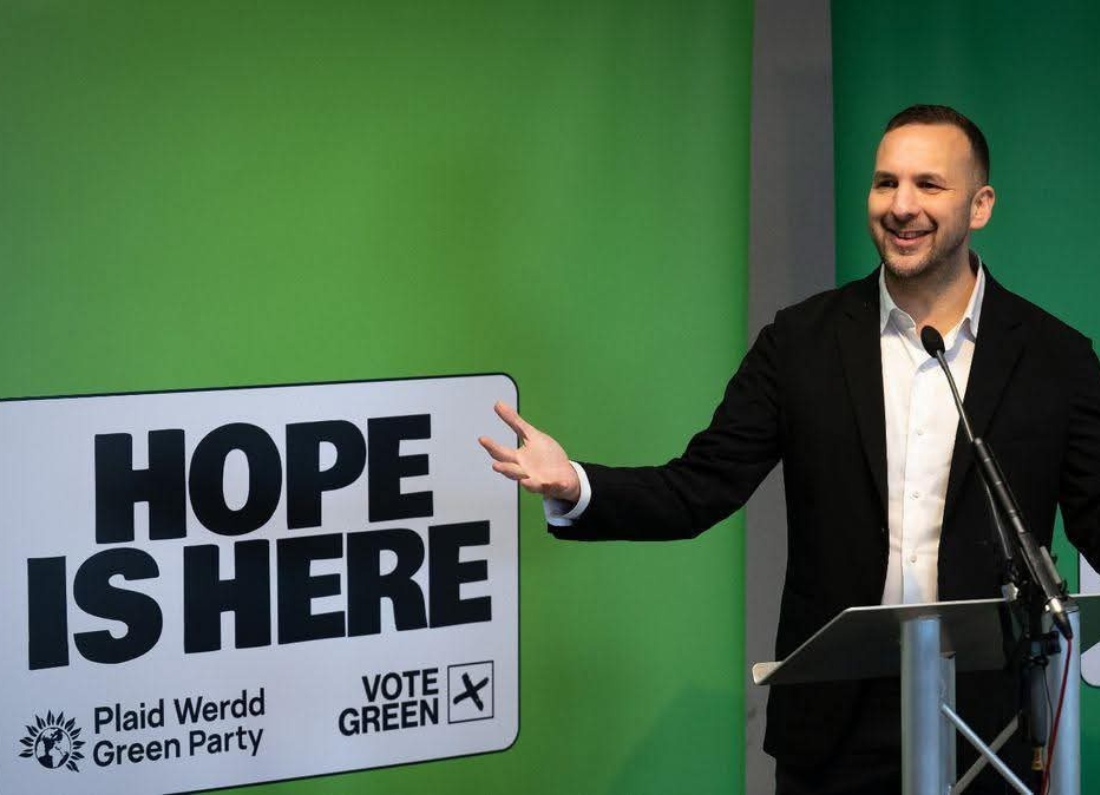
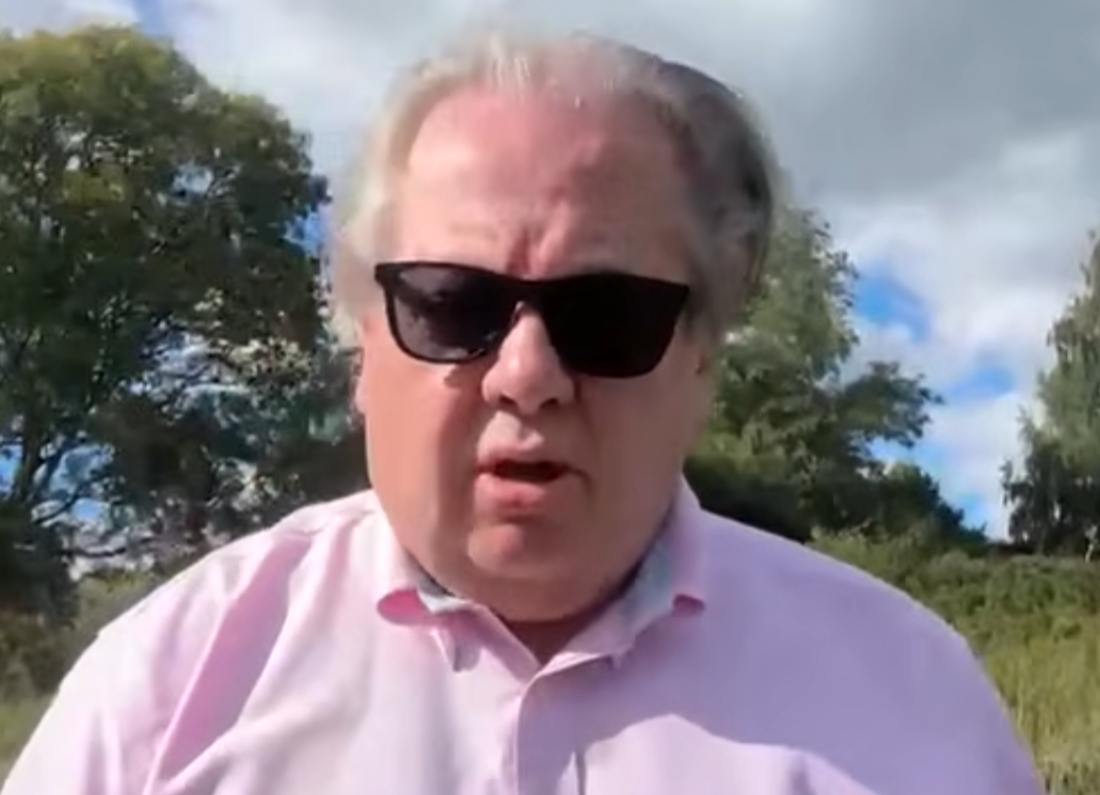
Green Party leader and London Assembly member Zack Polanski has accused The Daily Telegraph of fabricating a quote after the paper published a headline stating “Zack Polanski: Food is too cheap.” Polanski said he had made no such claim – he had told the Bakers, Food and Allied Workers’ Union that vegetables being sold for 7p in supermarkets was a sign that “someone is being exploited somewhere.” He said the resulting coverage was “absolute bullshit” from outlets that were “literally lying and making up things that have never been said.” The Spectator then called his original remarks “economically illiterate” and accused him of wanting food to cost more. They were based on the Telegraph’s version of events.
What Polanski actually said
The context is specific. Polanski was speaking to the Bakers, Food and Allied Workers’ Union – not to a general press conference, not in response to a budget question, not making a statement about the cost of living in general. He was talking about supply chain exploitation: the gap between what supermarkets charge for goods, what they pay workers and what they pay the farmers and agricultural producers who supply them.
His words: “That is not a sign of a healthy system. Someone is being exploited somewhere, and if you’re paying 7p for vegetables, then something is not right. It is those supermarket bosses who are taking record profits … meanwhile paying their workers poverty wages. We cannot go on like this.”
He called for tighter regulation of supermarkets, arguing the sector has “not been regulated enough” and is exploiting “both the workers in the supermarkets and the farmers and agricultural workers.” He supports a £15 minimum wage and a 10-to-one pay ratio capping how much more senior executives can earn compared with their lowest-paid employees.
At no point did he say food was too cheap. He said that certain products being available at exceptionally low prices was a symptom of exploitation elsewhere in the chain – exploitation of workers, farmers and producers. These are different arguments.
What the Telegraph said
The Telegraph’s headline: “Zack Polanski: Food is too cheap.”
The article itself then went on to accurately describe what Polanski had said about 7p vegetables and supply chain exploitation. The headline, however, was the point at which the factual reporting and the characterisation diverged.
There is a technical defence available to the Telegraph: the headline used single quotation marks, which in UK press convention indicates a paraphrase rather than a direct quote. But as the source material notes, “many readers may not appreciate that distinction.” A headline that says a politician thinks “food is too cheap” – at a time when food insecurity is a major issue and millions of households are struggling with the cost of living – will be read as a direct statement of political intent by the overwhelming majority of people who see it.
The Telegraph’s own article undercut the headline. But by the time readers reach paragraph two, the damage done by the headline has already shaped their interpretation.
The Spectator’s follow-up
The Spectator, working from the Telegraph’s framing, ran with the headline: “Polanski pushes price hikes.” Its columnist wrote: “The Green leader has made a series of economically illiterate suggestions about how he would bring down prices for struggling Brits and improve the dire state of the economy. Which makes his intervention on food prices today all the more bizarre. The intrepid Green leader, in all his glory, has called for the cost of supermarket goods to rise.”
He had not called for the cost of supermarket goods to rise. He had said that 7p vegetables suggested exploitation in the supply chain and called for tighter regulation of supermarkets. Whether one agrees with that analysis or not, it is a different argument from “food should cost more.”
This is the cascade effect of a misleading headline. The Telegraph mischaracterised the remark. The Spectator built on the mischaracterisation. By the time the Spectator’s column reached readers, the original context was three removes away and “Polanski says food is too cheap” had become established fact.
Polanski’s response
Polanski did not let it pass. On social media, he said: “We’re at the point where the Telegraph are literally making up quotes. I said when veg is sold for pennies in supermarkets, it’s a sign someone’s not being paid properly. Farmers being paid a pittance for their produce. Workers on less than a living wage in supermarkets.”
He was direct about what he thought was happening: “Sections of the media are just absolute bullshit. They’ve always been a problem – but now they’re literally lying and making up things that have never been said. The only way to defeat the billionaire media is to organise around them.”
That final sentence is where the political argument becomes interesting. As we reported in our Heseltine Brexit piece, Lord Heseltine described “the fear of the extreme right” acting as “a ball and chain on our political classes,” enabled in part by the media environment those political classes operate in.
Polanski’s “organise around them” is his version of the same analysis. The billionaire press cannot be reformed from within. It can be worked around.
The broader pattern
This is not the first time Polanski has been on the receiving end of a hostile media cycle. As we reported in our Polanski Musk piece, Elon Musk called him “a scumbag and a traitor” for asking for calm during the Belfast riots. As we reported in our Polanski Yusuf piece, he was one of the few political figures to directly call out both Yusuf’s “some cultures are MUCH better than others” post and Reform’s silence as Belfast burned.
A politician who calls out billionaire interference in democracy, describes Reform’s language as comparable to 1930s antisemitism and tells Elon Musk to “pipe down” is not going to receive sympathetic coverage in the Telegraph or the Spectator. The food prices smear is the latest iteration of a pattern: take a remark, strip the context, write the headline, let the cascade follow.
What Polanski said was clear. What appeared in the headlines was something else entirely.








Leave a Reply