


Reform UK has removed a series of attack advertisements featuring illustrator Stanley Chow’s portrait of Andy Burnham after Chow’s lawyers threatened legal action for copyright infringement, alleging the party used his work without permission in an AI-generated ad that placed the portrait on a boat of migrants alongside “Vote Andy” placards. Chow, a second-generation immigrant from Manchester whose distinctive portrait has featured prominently in Burnham’s Makerfield byelection campaign, said his work had been used “to push agendas, including an anti-immigration message” that fundamentally misrepresents everything it was created to represent.
Reform maintains its use “amounts to fair use” and that “this legal action is politically motivated.” The party said it had removed the posts “in good faith and without any admission of liability.” The deadline set by Chow’s lawyers at Brabners for undertakings to be accepted before formal court proceedings were launched was 2pm on Monday.
What the ads showed – and why the artist objects
The images, reportedly generated using artificial intelligence, depicted individuals in a small boat crossing the Channel, holding placards emblazoned with “Vote Andy” and Chow’s portrait of Burnham. The specific combination – Chow’s recognisable illustration, Burnham’s face, a migrant boat – was designed to associate Burnham with illegal Channel crossings.
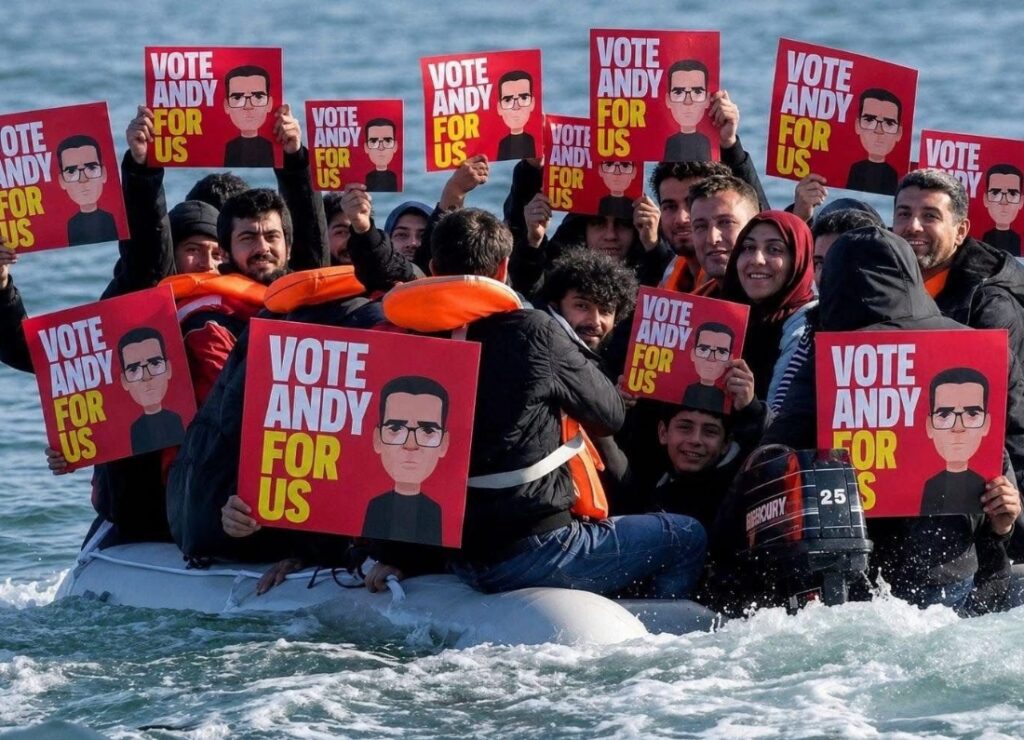
Chow’s original portrait was not created for this purpose. It was commissioned as part of Burnham’s campaign material for the Makerfield byelection. Chow created it to represent, in his own words, “something positive about Manchester and Andy’s vision for the city.”
His response to seeing it repurposed was unequivocal: “My work has been used without permission to share a message that I fundamentally disagree with. To see my portrait, created to represent something positive about Manchester and Andy’s vision for the city, being used without my permission to push agendas, including an anti-immigration message, is fundamentally unfair and wrong.”
The specific dimension the story carries is that Chow is a second-generation immigrant from Manchester. The ad used the work of a second-generation immigrant from Manchester without his permission to push an anti-immigration message. This is not an incidental irony – it is the specific reason Chow described the use as something he “fundamentally disagrees with.”
The legal position
Brabners, the law firm representing Chow, was direct. Colin Bell, partner at Brabners: “This is a clear case of copyright infringement. An artist’s work, created with care and intention, has been used and edited without permission and without acknowledgement or remuneration. That’s not acceptable.”
The letter of claim sent to Reform UK’s party headquarters set out what Chow was seeking: an injunction or undertakings to cease and desist; the takedown of all allegedly infringing works; at least £5,000 in damages; and a public statement acknowledging his rights and the alleged infringing activity, to be published on Reform’s social media channels and website.
Reform’s position – that the use “amounts to fair use” – invokes a defence more commonly associated with US copyright law. UK copyright law does not use the “fair use” doctrine; it provides a narrower “fair dealing” exception that applies to specific circumstances including reporting current events, criticism, review and parody. Whether an AI-generated party political attack ad using an artist’s commercial portrait without permission falls within any of these exceptions is the legal question Reform would have had to contest in court.
The party did not contest it. It removed the posts.
Reform’s second bad attack ad in two weeks
This is the second Reform attack ad in the Makerfield campaign to generate significant negative coverage for misuse of another person’s material. As we reported in our Peston and Jenrick piece, Robert Peston told Jenrick live on ITV that a Reform attack ad on Kemi Badenoch was “a travesty” of her position, using her words “completely out of context” to imply she had endorsed Black Lives Matter when she had explicitly rejected it. Peston: “There is no world in which she is endorsing Black Lives Matter.”
The pattern is specific. The Badenoch ad misrepresented a Tory rival’s words. The Chow ad used an artist’s work without permission to push a message diametrically opposed to the reasons it was created. Both generated more media coverage of Reform’s conduct than of any damage to their intended targets.
The Makerfield byelection is on 18 June. As we reported in our Burnham Newsnight interview piece, Burnham is focused on the constituency rather than the leadership contest and has described the race as “tight.” The Stanley Chow portrait at the centre of the copyright dispute has been one of the most visible pieces of visual branding in his campaign.
What Chow said
Chow’s public statement combined the personal and the political with clarity. “For me, this is straightforward – my work has been used without permission to share a message that I fundamentally disagree with.”
The word “straightforward” is doing specific work. He is not characterising this as a complex question of political interpretation or fair use doctrine. He is describing the simple fact that his property was used, without his permission, to say something he disagrees with. The law firm’s description – “a clear case of copyright infringement” – uses the same register.
Whether Reform’s “fair use” claim, if it had been tested in court, would have survived is now a hypothetical question. What is not hypothetical is that a second-generation immigrant from Manchester created a portrait for a positive political campaign, that portrait was used without his permission in an anti-immigration attack ad, and the party that used it chose to remove it rather than defend it.




Leave a Reply