

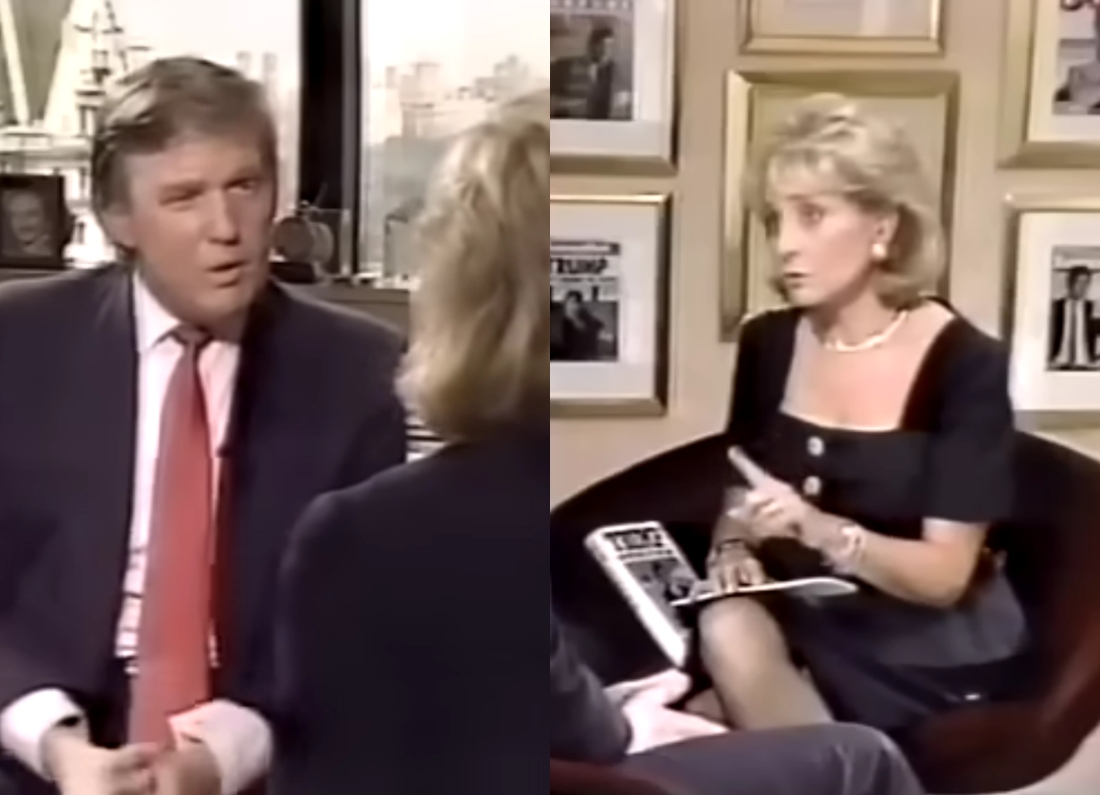
A 1990 ABC 20/20 interview in which Barbara Walters systematically dismantled Donald Trump’s claims about his business record – using his own bankers’ testimony, reading his own book back to him and refusing to be intimidated when he tried to talk over her – has resurfaced on TikTok and X and gone viral for the second time in a year, resonating with audiences who have been watching Trump call reporters “dummies” for the past decade and wondering when someone will simply refuse to accept it.
The interview was conducted on 17 August 1990, shortly after the publication of Trump: Surviving at the Top – a book whose title Walters immediately challenged. It is eighteen minutes of television journalism that has aged considerably better than its subject.
What Walters said – and how Trump responded
Trump opened with a statement that has since become his most recognisable rhetorical tic. “I hope the general public understands how inherently dishonest the press in this country is,” he told Walters.
Walters’ response was delivered with the unhurried calm of someone who had been interviewing world leaders since before Trump had developed his first business plan. “As a member of the press, let me try to clear up some of the things which you say are untrue,” she said.
She then opened his book and read him a passage he had written himself. “My bankers and I worked out a terrific deal that allows me to come out stronger than ever. I see the deal as a great victory.”
Then she looked up: “Being on the verge of bankruptcy, being bailed out by the banks, skating on thin ice and almost drowning? That’s a businessman to be admired?”
Trump, who had been attempting to interrupt throughout, offered a denial. Walters produced the four most deflating words available to any journalist who has done their homework: “I talked to your bankers.”
“Well, that’s fine. And what do they say? I mean, you know, depending on which banker you’re talking to—”
“Several,” Walters replied.
The exchange then moved to the Plaza Hotel. Trump had bought the New York City landmark in 1988 for slightly more than $400 million – an extraordinary sum for a hotel at the time, and one that contributed directly to the $3 billion in debt he was carrying by the time Walters sat down with him. Walters told him his bankers had said the best way out of his debt position was to sell the Plaza.
“Well, I don’t know what the bankers have said, but the Plaza is a very valuable property,” Trump said. “Everybody told me, ‘Oh, you paid too much. You paid too much.’ Now they’re all saying, ‘What a great deal he made.'”
Walters’ response has four words and no caveats: “No, they’re not.”
She was correct. Trump’s banks eventually took ownership of the Plaza and sold it in 1995 for a deal valued around $325 million – none of which went to Trump.
The Hitler speeches, parenting and “dummy”
The Plaza exchange is the most-shared section but the interview covered considerably more ground. Walters asked Trump about a copy of Adolf Hitler’s speeches that his then-wife Ivana had told reporters he kept in a cabinet by his bed. She pressed him on his parenting – he was in the process of a very public separation from Ivana during his affair with Marla Maples, and had young children. She challenged him on how he perceived himself versus how others perceived him.
At various points Trump called Walters a “dummy” – generating the tweet from @mmpadellan that has since reached 20,000 likes: “I feel compelled to post this banger of a clip showing Barbara Walters humiliate Trump to his face, as a reminder to reporters: YOU DON’T HAVE TO ACCEPT HIM CALLING YOU ‘DUMMY.'”
Walters did not accept it. She did not panic or fold. She continued asking the same questions she had been asking before he attempted the deflection.
@AnatolijUkraine wrote beneath the clip: “Back when journalists still understood their job wasn’t to flatter powerful narcissists. Barbara Walters didn’t panic. Didn’t fold. Didn’t start apologizing for asking basic questions. She just calmly held up the mirror — and Trump instantly became defensive, insecure.”
Why it’s going viral now
The clip has been circulating periodically since TikTok got hold of an edited version. Its appeal is the specific nature of what Walters did that current political journalism sometimes does not: she came with receipts. Not opinions about Trump’s business record. The specific testimony of multiple named bankers. A direct reading of his own claims. A knowledge of the specific asset – the Plaza – whose eventual fate she predicted accurately in the interview.
The “inherently dishonest press” line with which Trump opened the interview is identical in structure to what he says about the press today. The specific attempt to talk over the interviewer and question her sources – “well, depending on which banker” – is identical to responses he gives to challenging questions in 2026. As one TikToker put it, with the economy of expression that the platform rewards: “he’s always been exactly who he is.”
@simonateba’s caption on the clip, which reached 10,100 likes, summarised the exchange: “She tells Trump can you just drop the mask and stop pretending you’re a billionaire? You don’t have any money and the bankers just told me you’re deep in debt. Can you drop the facade?”
Trump did not drop the facade. He wrote a book called Surviving at the Top. He told Walters the bankers were wrong about the Plaza. He described the deal as “a great victory.” He called her a dummy.
The banks took the Plaza in 1992. It sold in 1995 for less than he paid. None of the proceeds went to him.
After Walters
The irony the viral cycle always returns to is that Trump and Walters were, by most accounts, genuinely friendly. They ran in the same New York circles. He was interviewed by her multiple times over the following decades. When Walters died in December 2022, Trump wrote on Truth Social: “She was the greatest of them all, by far. I knew her well, was interviewed by her many times, and there was nobody like the legendary Barbara Walters – And never will be!”
He was not wrong about the last part. The specific combination of preparation, composure and refusal to be deflected that the 1990 interview demonstrates has become rarer in the intervening thirty-six years – not because journalists lack talent but because the specific context in which Walters operated, where a powerful subject would sit for eighteen minutes and could not simply walk away or post on X afterwards, has changed beyond recognition.
What has not changed, as the clip’s enduring virality demonstrates, is that the audience still knows what good journalism looks like when they see it.




Leave a Reply