Keir Starmer has admitted his government made “unnecessary mistakes” in its first two years but rejected calls to resign from a growing number of his own MPs – appointing Gordon Brown as special envoy on global finance and Harriet Harman as adviser on women and girls in a Saturday reset operation, as a poll found 45% of Labour members want him to stand down and 42% prefer Andy Burnham as the party’s next leader.
The Prime Minister spoke in south London on Saturday afternoon, his language carefully chosen to acknowledge the scale of Thursday’s losses without conceding the calls for his departure that have come from more than 40 Labour backbenchers since the results began coming in overnight.
“I’m not going to walk away from this – that would plunge the country into chaos,” Starmer said. “But that doesn’t mean we don’t need to respond. It doesn’t mean we don’t need to rebuild. It doesn’t mean that we don’t need to set out the path ahead.”
The mistakes Starmer admitted
The Prime Minister was specific about what he considered the central failure of his first two years. “We, rightly in my view, levelled with the public about the challenges that we face as a country both on the finances and internationally – but what we didn’t do is enough to convince them about the change that would impact them, how their lives would be better,” he said.
“The hope wasn’t there enough in the first two years of this government.”
He said the task now was to “set out where hope resides” and promised to set out “with clarity the convictions and values that drive me” in the coming days.
The framing is a significant implicit acknowledgment: the government has been too focused on telling people how difficult things are and not enough on telling them why things will get better. Whether that diagnosis is complete – whether the problems run deeper than communications – is precisely the argument being made by those calling for his departure.
Brown and Harman – the appointments
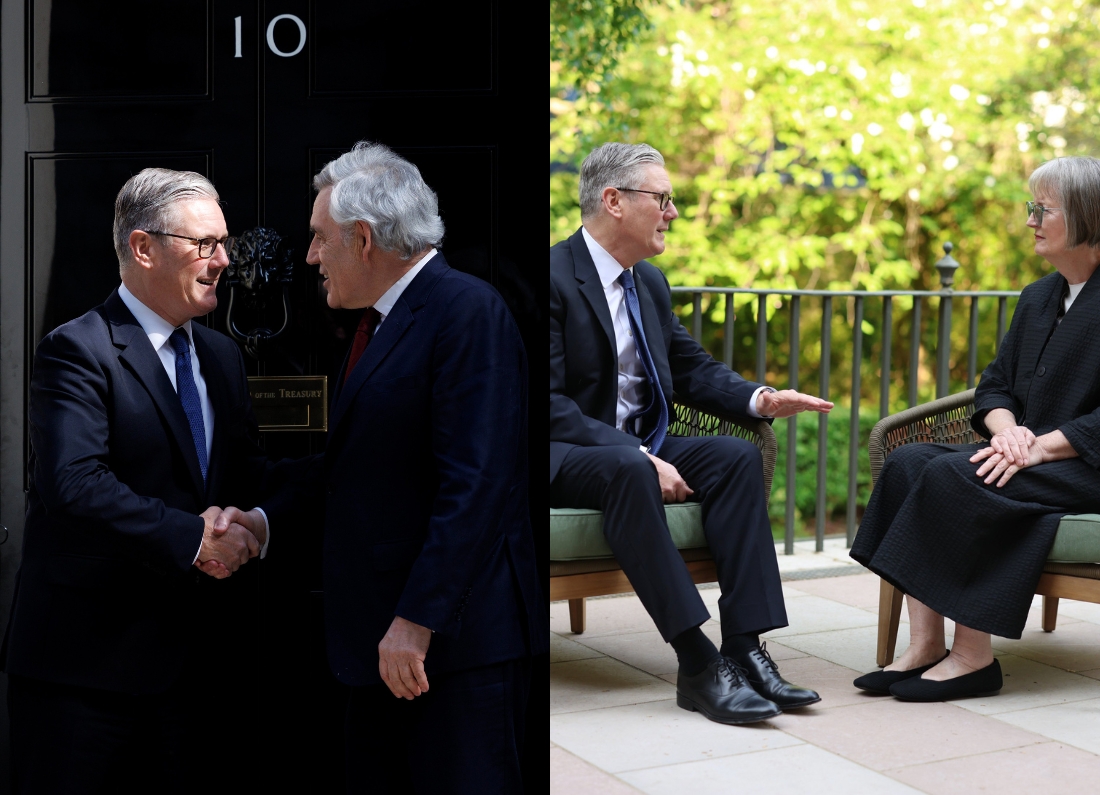
Downing Street released images of Starmer’s Saturday morning meetings with Gordon Brown and Harriet Harman alongside the announcement of their new roles.
Brown, the former Prime Minister who served between 2007 and 2010, has been appointed as special envoy on global finance. He will advise the government on how global financial cooperation can help boost UK security and resilience, with a particular focus on how international finance partnerships can support defence and security-related investment. The role will form part of Labour’s broader push to strengthen its relationship with Europe.
Brown has been broadly supportive of Starmer in recent months. In February, following the Mandelson revelations, he told the BBC that Starmer was “a man of integrity” who “wants to do the right things,” while adding: “Perhaps he’s been too slow to do the right things, but he must do the right things now.”
Harman, the former deputy Labour leader who served between 2007 and 2015 and now sits in the Lords, has been appointed as Starmer’s adviser on women and girls. She will work with ministers to bring in measures to tackle violence against women and girls and increase women’s representation in politics and public life. The role is part-time and unpaid.
Harman’s appointment carries a specific political edge. She has been critical of Starmer’s handling of the Mandelson scandal – warning previously that it could “finish him off” – while also making clear that she believes he should remain as Prime Minister provided meaningful changes are made to the government’s direction. Speaking on Sky News on Friday, she said: “More of the same is not acceptable. The country is entitled to a government and a prime minister who gives them a sense of direction of where the country’s going and hope for the future.”
The MPs calling for a timetable
The number of Labour MPs publicly calling for Starmer to set a departure timetable has now exceeded 40. Saturday’s additions included Terry Jermy, the MP for South West Norfolk – Liz Truss’s former constituency – who said Starmer “needs to consider whether he is the right person to take the party and the government forward.”
Clive Lewis, the MP for Norwich South, was more direct. Labour had just lost control of Norwich city council to the Greens – as we reported in our election night coverage. “This will not be fixed by another speech, another comms reset, or another reshuffle,” Lewis said. “The prime minister has reached the point where the question is no longer whether he can recover. It is whether, by staying on, he does lasting damage to Labour’s ability to govern, rebuild trust and stop the advance of the right. That is why a timetable for his departure is now necessary.”
Among the MPs who have called for a departure timetable are former transport secretary Louise Haigh, women and equalities select committee chair Sarah Owen, and several MPs from the 2024 intake including Jonathan Brash, Simon Opher and Connor Naismith.
What Labour members think
A poll of more than 1,000 Labour party members, conducted by Compass think tank just before Thursday’s elections and published Saturday, found the scale of internal dissatisfaction. 51% of Labour members do not believe Starmer can turn around the party’s polls. 45% say he should step down. 36% had considered cancelling their Labour membership.
Andy Burnham was the first preference for 42% of members asked to rank their preferred successor. The mayor of Greater Manchester has a net favourability of 72% among members – a figure that suggests he would win any leadership contest he was allowed to enter.
As we reported in our earlier coverage of Labour’s leadership crisis ahead of May 7, Burnham was blocked by the NEC from standing at the Gorton and Denton byelection in February. Members of the NEC have told the Guardian their position will not change unless Starmer’s mind changes – which is described as “highly unlikely.”
Lena Swedlow, the deputy director of Compass, said: “Voters made their displeasure with Starmer’s leadership heard on Thursday and now Labour members have too. There is a clear desire for change in both the politics and personnel of this government.”
The full picture of Thursday’s results
As we reported in our updated national results article, Labour lost more than 1,100 English council seats. Reform won more than 1,400. The Greens achieved their best ever local election results, winning Hackney’s mayoralty – as we covered in our Zoe Garbett article – and making breakthroughs in Exeter, Chorley, Lincoln, Salford and Ealing.
In Wales, Plaid Cymru ended a century of Labour dominance, unseating first minister Eluned Morgan. In Scotland, the SNP claimed a fifth consecutive Holyrood victory. In Coventry, as we detailed in our final results piece, Labour lost its council majority for the first time since 2010, with Reform winning 20 seats and no party holding an overall majority.
As we also reported, a YouGov poll conducted ahead of the results found that 53% of Britons would want a snap general election if Starmer is removed.
What happens now
The question is whether the Brown and Harman appointments, the admission of mistakes and the promise of a coming “clarity” about his convictions are sufficient to hold off the growing pressure – or whether they represent the kind of “comms reset” that Clive Lewis said explicitly would not be enough.
The 40-plus MPs calling for a departure timetable do not have a mechanism to force one. Labour’s rules require either a voluntary departure or a formal leadership challenge requiring 20% of the parliamentary party – a threshold Streeting has already crossed in terms of declared support. Whether that trigger is pulled depends on whether individual MPs calculate that a challenge or a continued pressure campaign is more likely to produce the outcome they want.
Starmer’s position is that he was elected for five years, he is staying and he will demonstrate through action rather than departure why he deserves to continue. His opponents’ position is that staying is itself the damage. The argument will not be settled by a Saturday press conference or two new appointments. It will be settled – if not now, then over the summer – by which MPs move, when, and whether the numbers hold.