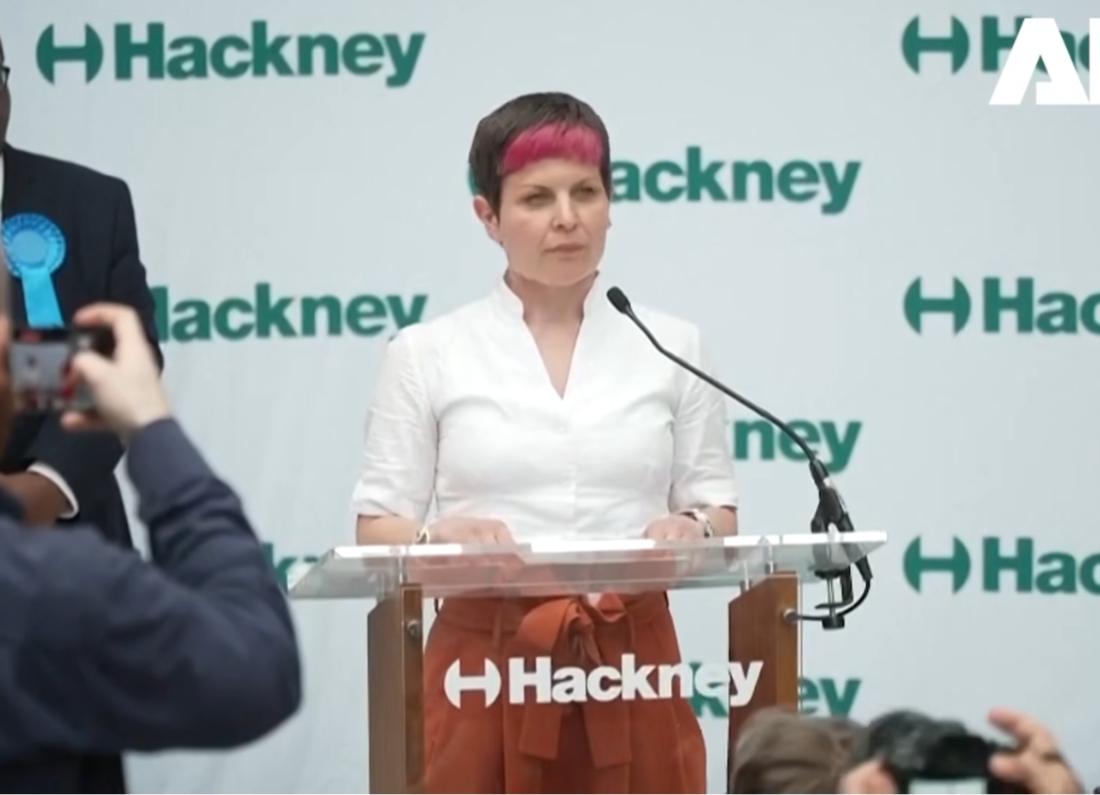
Zoe Garbett has been elected as the Mayor of Hackney, becoming the Green Party’s first ever directly elected mayor in British political history, after beating Labour by nearly 9,000 votes in one of the party’s most significant London strongholds – as Green leader Zack Polanski declared that “two-party politics is no longer dying – it is dead.”
Garbett, who previously stood as a candidate for London mayor, secured 35,720 votes. Labour received 26,865. The Conservatives took 6,345, Reform UK 4,013 and the Liberal Democrats 2,731. The margin – nearly 9,000 votes – was not a close-run thing. It was a statement.
What Garbett said
Speaking in her victory speech, Garbett framed the result in terms that will resonate far beyond Hackney’s boundaries.
“People have made it clear they are desperate for an alternative to this failing Labour government,” she said. “It’s not old politics parties versus new parties. This is about a system of fear versus a movement of hope.”
She added: “Today we start a fightback. In this election, over and over, people kept telling me that they felt let down. People kept saying, ‘it’s hard for me and it’s hard for us.’ Council services are failing those who need them most and people are struggling to make ends meet.”
Garbett was clear that the win was larger than her party alone. “This campaign has never just been about the Green Party. Countless people, movements, organisations, parties and communities have come together to make this change possible.”
A result that would have seemed impossible five years ago
Hackney has been one of Labour’s safest London boroughs for decades. It is precisely the kind of inner-city, young, diverse, economically pressured but politically engaged community that Labour once took for granted. The fact that the Greens did not merely challenge here but won comfortably – with Reform trailing fourth on just 4,013 votes – tells its own story about the specific nature of Labour’s collapse in urban England.
This is not the same collapse that is happening in Wigan or Hartlepool or Tameside, where Reform is mopping up votes from communities that feel abandoned by a London-centric political establishment. In Hackney, the votes that left Labour went to the Greens – to a party led by a Jewish former plumber from Manchester, offering rent controls, public ownership and a politics of hope rather than management.
The two collapses are different in character and are happening simultaneously. Both are catastrophic for Labour.
The broader Green picture
Hackney is the headline but it is not the only story. As we previously reported in our coverage of Polanski’s rise and the Green Party’s surge in national polling, the party had been building toward this moment across multiple election cycles.
On Friday morning, Polanski confirmed gains far beyond what many had predicted. The Greens topped the poll in Exeter. They have had breakthrough wins in Chorley, Lincoln, Salford and Ealing – a range that stretches from northern Labour towns to outer west London. Results are still coming in across England and Wales.
Polanski’s reaction to the Hackney result and the broader picture was characteristically direct: “These results are already our best ever and they are still coming in. Across England and Wales voters are putting their trust in us as never before. Two-party politics is no longer dying – it is dead. This is a historic victory for the Green Party.”
He added: “In Hackney and across England and Wales, we’re electing Greens who have only two vested interests – serving their communities and protecting the planet.”
Polanski claimed the Greens are “the only party with real plans to cut bills, reduce rents and provide genuinely affordable homes” – a message that has clearly landed in communities where the cost of housing is the defining political pressure of everyday life.
What this means for the leadership picture
As we reported in our coverage of the leadership crisis building around Starmer, Polanski had already called on the Prime Minister to resign ahead of the results. With Hackney confirmed and broader Green gains across England becoming clearer, his position as the most credible voice of Labour’s left-wing former voters is now materially stronger.
The specific geometry matters. Burnham, Streeting and Rayner are competing for the Labour leadership with arguments about who can best win back Reform voters in the Midlands and the North. None of them is primarily focused on winning back the Green voters in Hackney, Ealing and Salford who have also now left. Labour needs a strategy for both coalitions simultaneously. It is not obvious that any single candidate has one.
As Polanski said himself, the Greens are not positioning themselves as a pressure group within Labour’s orbit. They are positioning themselves as Labour’s replacement on the left – and tonight’s results in Hackney are the strongest evidence yet that this is not just rhetoric.
What Garbett’s victory means in practice
As Mayor of Hackney, Garbett will have executive control over one of London’s most complex and pressured local authorities – housing waiting lists, council services, planning decisions, local transport and the day-to-day governance of a borough of more than 280,000 people. The mayoralty is a directly elected executive role with real powers.
Hackney has some of the highest private rents in London, one of the longest social housing waiting lists in the capital and some of the sharpest contrasts between extreme wealth and acute poverty of any borough in England. If the Greens can govern it well – delivering on the housing, services and community promises that won them the mayoralty – it becomes a proof of concept for a party that is now seriously bidding to govern far more than a protest movement could.
“I’m going to change the system,” Garbett said in her victory speech. “That’s why you’ve elected me, to lead the fightback here in Hackney.”
The fightback has started. The question is whether the system agrees to be changed.