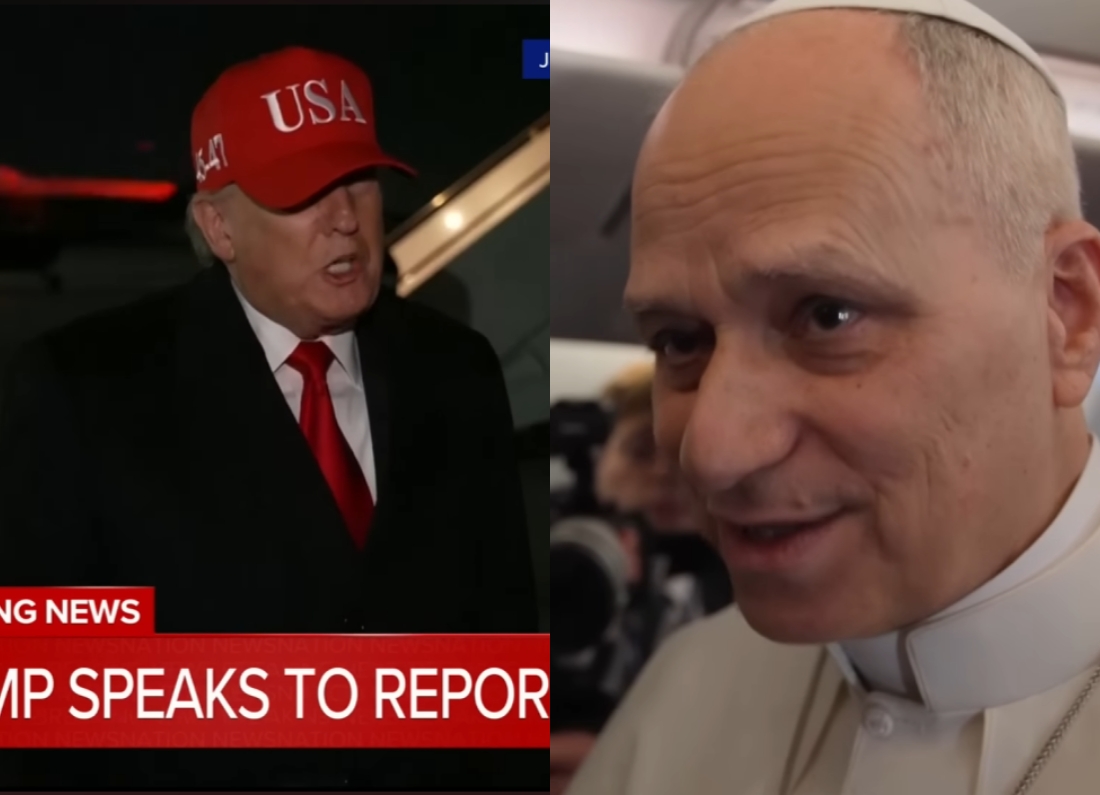
Donald Trump has accused Pope Leo XIV of “endangering a lot of Catholics” by supposedly believing “it’s fine for Iran to have a nuclear weapon” – a claim that has no basis in anything the Chicago-born pontiff has actually said – days before Secretary of State Marco Rubio travels to the Vatican in an attempt to repair relations between Washington and the Holy See.
The remarks were made during an interview with Hugh Hewitt on the Salem News Network, a prominent conservative radio platform. Trump said the pope “would rather talk about the fact that it’s OK for Iran to have a nuclear weapon, and I don’t think that’s very good. I think he’s endangering a lot of Catholics and a lot of people. But I guess if it’s up to the pope, he thinks it’s just fine for Iran to have a nuclear weapon.”
Pope Leo has never said that Iran should have nuclear weapons. What he has done is repeatedly oppose the US-Israeli war on Iran, call for ceasefires and dialogue, condemn the escalation of conflict in Lebanon and the wider Middle East, and carry a photograph of a Lebanese Muslim child killed in Israeli strikes during his recent tour of Africa. None of these positions constitute support for Iranian nuclear proliferation.
The full context of Trump’s attacks on Leo
The latest broadside is not the first. Earlier this year, Trump called Leo “weak” and said he was not doing “a very good job” as pontiff – remarks that prompted an unusually sharp public response from Leo, who told reporters he had “no fear” when asked about the President’s criticism.
Trump also shared an AI-generated image depicting himself as a Christ-like figure in April before deleting it and claiming it had actually been a portrayal of him as a doctor. The image drew criticism from Catholic leaders including Leo’s allies, and is understood to have been one of several sources of tension between the White House and the Vatican.
JD Vance – a Catholic convert who attended Leo’s inauguration alongside Rubio and had a private audience with him the day after – has also criticised the Pope, saying the Vatican should “stick to matters of morality” and that Leo should be “careful when it came to talking about theology and war.” The Vice-President’s instruction to the head of his own church about what subjects he is permitted to address did not pass without comment among senior Catholic figures.
The Rubio mission
Marco Rubio is travelling to Rome on Thursday specifically to repair the damage created by these repeated attacks. He will meet Leo at the Apostolic Palace for what the US Ambassador to the Holy See, Brian Burch, described in advance as a “frank” conversation.
“Nations have disagreements, and I think one of the ways that you work through those is through fraternity and authentic dialogue,” Burch told reporters. “I think Rubio is coming in that spirit, to have a frank conversation about US policy, to engage in dialogue.”
Burch sought to minimise the significance of the public dispute, saying he did not accept that there was “some deep rift” between the US and the Vatican. That framing will be tested against the reality that the President, in the same week as Rubio’s visit, publicly accused the Pope of endangering Catholics and supporting nuclear proliferation.
Rubio will also meet Vatican Secretary of State Pietro Parolin and then travel to meet Italian Prime Minister Giorgia Meloni and Foreign Minister Antonio Tajani on Friday. The Italian government visit adds another layer of diplomatic repair work. Trump had previously berated Meloni – previously described as one of his closest European allies – for criticising his remarks against Leo and threatening to withdraw US troops from Italy in response.
Why the Pope’s Iran position is what it is
Leo’s opposition to the Iran war is consistent with decades of Catholic social teaching on just war theory and the duty to pursue peace. He has not endorsed Iran’s government, its nuclear ambitions or its regional proxy forces. He has called for an end to a war that has killed large numbers of civilians, displaced millions and – as the Iranian ceasefire negotiations drag on – threatens to resume at any moment.
His advocacy is particularly uncomfortable for Trump because it comes from a fellow American. Leo was born Robert Francis Prevost in Chicago and spent decades in mission work in Peru before rising through the Church. He is the first American-born pope in history. His criticisms of US policy carry a different weight than those of a European or developing-world pontiff, and his approval rating – at +34 in polling conducted in Catholic-majority countries – significantly exceeds Trump’s in comparable surveys.
The trip to Africa – during which Leo carried the photograph of the Lebanese child and called for peace in the Middle East – generated global media coverage that placed the Pope’s moral authority in direct contrast to the administration’s approach. Trump’s response, characteristically, has been to attack the messenger rather than engage with the message.
What Leo actually said
Leo has consistently called for a ceasefire, dialogue and the protection of civilians. He condemned the attack on Iran at the start of the conflict. He has called on all parties to respect international humanitarian law. He has prayed publicly for the victims on all sides of the conflict. He has said explicitly that “no peace is possible through weapons” – a position that is in line with centuries of Catholic teaching on war and peace.
At no point has he expressed any view on Iran’s nuclear programme, positively or negatively. The specific claim that he “thinks it’s fine for Iran to have a nuclear weapon” is not sourced to any statement the Pope has made and appears to be Trump’s own characterisation of a position Leo has never expressed.
The broader pattern
Trump’s attacks on Leo follow a broader pattern of his relationship with the Catholic Church, which has become complicated since Leo’s election. Leo’s emphasis on migrants, the poor, peace and multilateral institutions sits in fundamental tension with the Trump administration’s approach to all of those issues.
The Vatican is not a diplomatic irrelevance. It has diplomatic relations with 183 countries, runs the largest non-governmental humanitarian operation in the world, and has a history of effective quiet diplomacy in conflicts from the Cold War to the Northern Ireland peace process. Leo’s potential role as a mediator in the Iran conflict – which Pakistan and Turkey have both attempted and which the second round of talks has so far failed to advance – is one that the Trump administration cannot afford to foreclose by continuing to publicly antagonise the pontiff.
Whether Rubio’s Vatican visit succeeds in repairing the relationship will depend partly on whether Trump continues to attack Leo publicly in the days after the secretary of state lands in Rome. His remarks to Hewitt suggest he has not yet decided to stop.
You may also like: ‘If it wasn’t for us, you’d be speaking French’: King Charles roasts Trump at White House state dinner