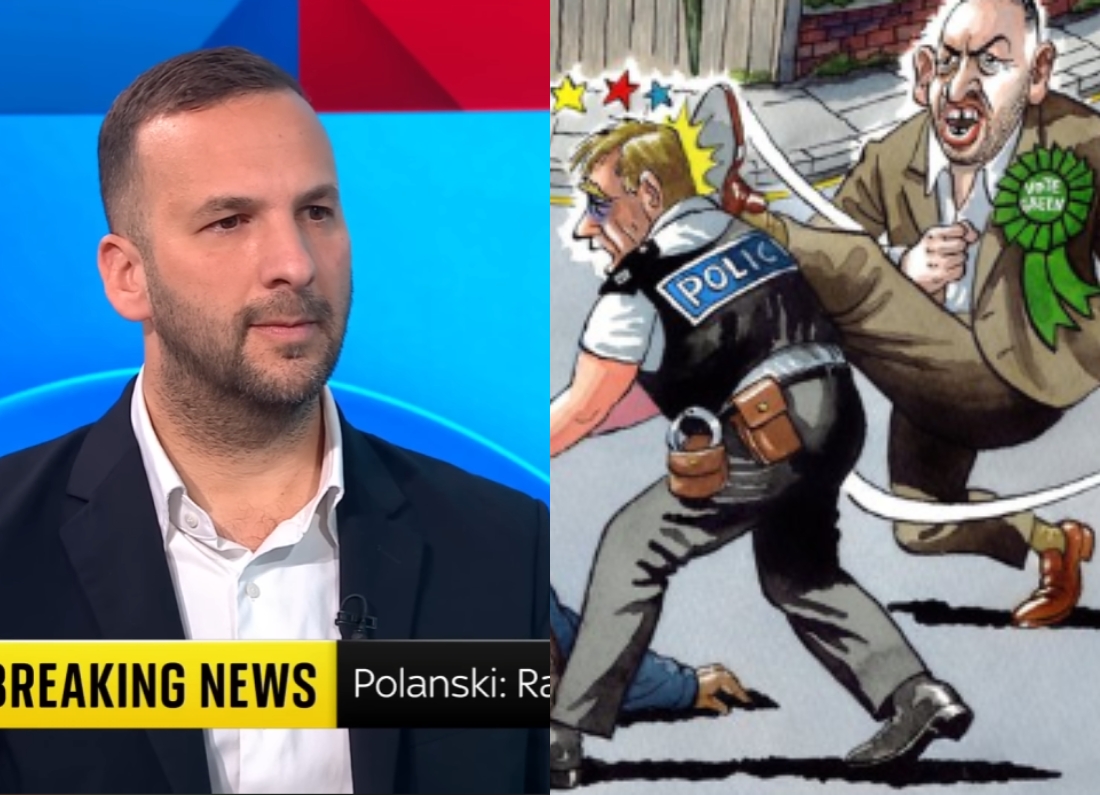
The Green Party has demanded a formal apology from The Times after a cartoon by staff cartoonist Peter Brookes was accused of using antisemitic tropes in its depiction of Zack Polanski – as the Green leader revealed that two people have been arrested in relation to antisemitic actions directed at him in the past six weeks alone, and accused the media of applying double standards to antisemitism depending on who the target is.
The cartoon, published in The Times on Saturday, depicts Polanski kicking a police officer during the arrest of Golders Green attack suspect Essa Suleiman – a reference to the controversy over Polanski sharing a social media post critical of police conduct after footage of the arrest circulated online. Polanski has since apologised for sharing the post “in haste.” The Green Party’s objection is not to the political criticism contained in the cartoon but to the manner in which Polanski is depicted, with critics alleging that Brookes has exaggerated certain facial features in ways that echo longstanding antisemitic visual stereotypes.
The Green Party’s statement
The party issued a formal statement condemning the cartoon and calling for an apology from The Times.
“It is astonishing that amongst a rising climate of antisemitism in the UK, a national newspaper has chosen to publish a cartoon of the only Jewish political leader in the country using tropes so clearly associated with antisemitic depictions of Jewish people,” the statement read.
“Zack faces daily antisemitism. The words used by both politicians and the media this week, directing further attacks towards Zack in the wake of a violent attack on his community, are deeply irresponsible.”
The party described The Times as having been “deeply irresponsible” in its portrayal of the incident given the context of rising antisemitism across the country.
Polanski’s own words
Polanski appeared on Sky News on Sunday morning to make the case directly, calling the cartoon “vile” and confirming the party had written to The Times requesting an apology.
“Antisemitism and Jewish safety is not some abstract concept for me,” he said. “In fact, in the last six weeks alone, two people have been arrested in relation to antisemitic actions towards me – and yesterday The Times newspaper published a vile antisemitic cartoon, which we’ve asked them to apologise for.”
He connected the cartoon to what he described as a pattern of media double standards on antisemitism. “I don’t believe that we make Jewish safety better by escalating tensions. I think we recognise how scary it is at the moment for certain communities. We saw three people stabbed this week and it’s important to de-escalate tensions as leaders.”
The double standards argument
Polanski’s wider argument this week has been that antisemitism is being treated differently depending on who the target is and which political direction the abuse comes from.
The week has produced three separate incidents that bear on this argument directly. A Reform supporter performed three Nazi salutes at Polanski’s Hastings rally while right-wing media commentators who had spent the week attacking him over the Golders Green debate said nothing. Labour transport secretary Heidi Alexander told broadcasters Polanski was “not fit to lead a political party” over a retweet he subsequently apologised for. And a national newspaper published a cartoon of the only Jewish leader of a major British political party that his own party describes as using antisemitic visual tropes.
Polanski is the only Jewish leader of a major British political party. He says he suffers antisemitic abuse daily. Two people have been arrested for antisemitic behaviour toward him in the past six weeks. And in the same week that a Jewish community in north London was attacked by a man with a knife, Polanski has been subjected to Nazi salutes at his rally, declared unfit for office by a cabinet minister and depicted in a cartoon his own party describes as antisemitic.
The question he is raising – about whether the same standards are applied to antisemitism against him as would be applied to antisemitism from his direction – is one that the media institutions involved have not answered.
The cartoon’s political context
The Brookes cartoon sits within a week of sustained political pressure on Polanski over his response to the Golders Green attack. The sequence of events is as follows: Polanski shared a social media post critical of police conduct in the arrest of Essa Suleiman, who has been charged with two counts of attempted murder. Metropolitan Police Commissioner Mark Rowley publicly criticised Polanski for the retweet. Polanski apologised. Heidi Alexander said he was “not fit to lead a party.” The Times published the cartoon. The Green Party demanded an apology.
Political cartoons have always pushed boundaries and the depiction of politicians in unflattering ways is a legitimate and ancient form of commentary. The specific allegation against the Brookes cartoon is not that it criticises Polanski – that is entirely fair – but that the manner of the depiction invokes visual conventions associated with centuries of antisemitic caricature. Whether that specific allegation is sustained is a judgement that requires seeing the cartoon itself, which The Times has not removed. The Green Party’s formal letter requesting an apology has not yet received a public response from the newspaper.
The broader context
The timing of the cartoon – published in the same week as the Golders Green attack, four days before the local elections and during a period of heightened fear in the Jewish community – has amplified the reaction to it. The Green Party’s argument is not simply that a cartoon was offensive but that a national newspaper chose this specific week, depicting this specific person in this specific way, while Jewish communities were frightened and a Jewish party leader was under sustained political attack.
The Times has not responded publicly to the Green Party’s request for an apology at the time of publication.
You may also like: ‘So tweeting something stupid is disqualifying – but appointing a friend of Epstein is not?’ LBC presenter delivers the question Labour couldn’t answer