

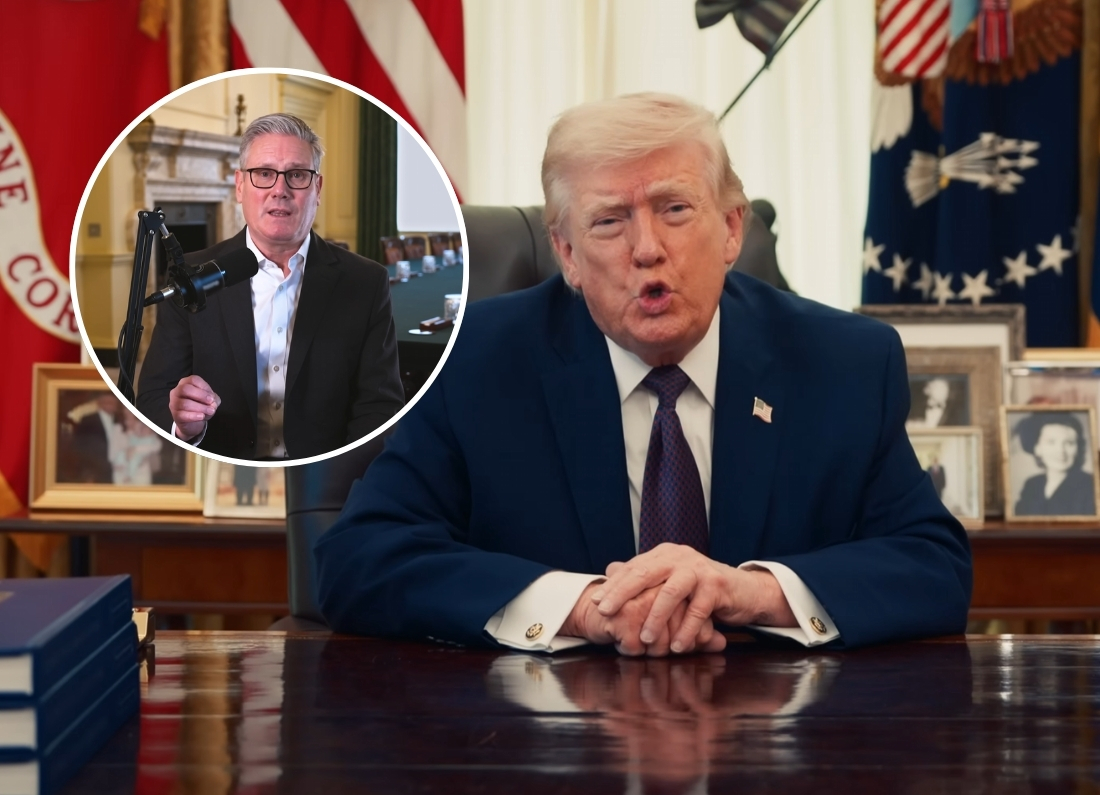
Keir Starmer has compared Donald Trump to Vladimir Putin over the economic damage inflicted on British families by the Iran war, in his most pointed personal attack yet on the US president – as he simultaneously distances Britain from Trump’s most extreme rhetoric, insists the UK will not be “dragged into this war,” and declares that the country cannot return to the status quo that preceded the crisis.
Speaking to ITV News political editor Robert Peston during a visit to the Middle East to support ceasefire negotiations, Starmer made an explicit comparison between the disruption caused by Trump’s Iran war and the chaos caused by Putin’s invasion of Ukraine in 2022 – drawing a direct line between the actions of both leaders and the impact on British households.
The Trump-Putin comparison
The comparison landed with considerable force. In the context of the strained UK-US special relationship – with Trump having compared Starmer to Neville Chamberlain, mocked the Royal Navy, imitated the Prime Minister’s voice in a speech, and repeatedly accused Britain of being “not our best” ally – Starmer’s decision to place Trump in the same sentence as Putin represents a significant escalation in the rhetorical temperature between London and Washington.
“I’m fed up with the fact that families across the country see their bills go up and down on energy, businesses’ bills go up and down on energy because of the actions of Putin or Trump across the world,” Starmer said, “and saying to families across the country, saying to businesses across the country: ‘We’ve just got to be, we’ve got to put up with being on the international market.'”
The comparison is precise in its intent. It does not equate Trump with Putin morally – Starmer is not suggesting Trump is a war criminal or an authoritarian in the style of the Russian president. What it does is place both leaders in the same category as sources of external economic shock: men whose decisions, taken without Britain’s consent and without regard for Britain’s interests, have direct and painful consequences for British households. In that limited but politically potent sense, Starmer is saying: Trump’s war has done to British energy bills what Putin’s war did before it. Britain cannot go on being a passive victim of other leaders’ choices.
Distancing from Trump’s language
Starmer was equally direct in distancing himself from Trump’s most inflammatory statements about Iran – including the US president’s threats to bomb civilian infrastructure and his Truth Social posts calling Iranian leaders “crazy bastards” and threatening to “end a civilisation.”
“Let me be really clear about this – they are not words I would use, ever use, because I come at this with our British values and principles,” he said. “They’re not language I would use. Use those words, a language like that myself, very important that I’m clear that for the United Kingdom, we have our principles, we have our values. We will be guided by them in everything that we do.”
He also put on record his view on Israel’s strikes on Lebanon during the ceasefire period – another area where he split from the US position. While he stopped short of declaring the strikes a formal breach of the ceasefire, citing limited access to the precise terms of the agreement, he was unambiguous on the principle: “That shouldn’t be happening. That should stop. That’s my strong view.” He added: “In a sense, my argument would be it should be included in the ceasefire, and that’s the important part, the overall approach. This one is actually a matter of principles as far as I’m concerned.”
Defending the Iraq lesson
Throughout the Iran conflict, Starmer has been subjected to sustained personal attack from Trump, and faced domestic pressure from the Conservatives and Reform to show greater solidarity with the American military operation. His consistent response has been to frame British restraint not as weakness but as principled adherence to international law – explicitly invoking the lessons of the Iraq War as a reason not to commit British forces without a clear legal basis.
He returned to that framing in the Peston interview: “From the get-go we’ve been monitoring this situation so I’m pretty clear in my own mind about what we’ve agreed and what the use of the bases are and that is a really important point of principle because we have to learn the lessons of Iraq. We need to be clear where we stand as a country and I’m the British Prime Minister, I make decisions on what’s in the British national interest and that is my focus. And notwithstanding the noise and the pressure and the rhetoric, that has been my firm focus throughout this.”
The “noise and the pressure and the rhetoric” he refers to is Trump’s sustained public campaign of criticism – the Neville Chamberlain comparison, the “not Winston Churchill” remark, the Saturday Night Live skit posted on Truth Social, the mockery of British aircraft carriers. Starmer’s framing presents his steadiness in the face of that pressure as evidence of principled leadership rather than weakness.
No going back to normal
Beyond the immediate politics of the Iran war, Starmer used the Peston interview to set out a broader argument about the moment Britain is in – and why the pre-crisis status quo is not something to aspire to return to.
“I firmly believe that when we had the global shock of the 2008 global financial crash, when we had the shock of Covid, the response was the wrong response. What I mean by that is there was a rush to get back to normal, to get back to the status quo. And never to change things fundamentally,” he said.
“And the normal and the status quo weren’t working for 20 years. They haven’t worked – living standards haven’t improved, public services have been decimated and people have felt more distant from politics. We can’t aspire or want to get back to the normal. We have to change that. We need to respond with strength in a number of important fields.”
He acknowledged that the consequences of the Iran war would be “long felt” and that Britain could not “immunise ourselves” from the economic impact of the Strait of Hormuz closure. But he framed that acknowledgement not as a counsel of despair but as an argument for structural change – including moving faster on energy independence through renewables, and getting closer to the EU to reduce trade friction and rebuild economic resilience.
The political context
The interview represents a careful recalibration of Starmer’s public posture towards Trump. Throughout the war, the Prime Minister has chosen restraint over confrontation – declining to match Trump’s personal attacks, maintaining diplomatic channels, and sending King Charles to Washington as a soft power bridge. That strategy has attracted criticism from those who argue Britain has been too deferential in the face of consistent public humiliation.
The Trump-Putin comparison suggests Starmer has concluded that the ceasefire – and Trump’s evident desire to declare victory and move on – gives Britain a window to be more forthright about the costs the war has imposed on this country. The comparison is calibrated: pointed enough to land, careful enough not to permanently destroy a relationship that Britain still needs.
Whether Trump notices, or cares, or retaliates with another social media post, remains to be seen. What is clear is that the Prime Minister who was compared to Neville Chamberlain has decided to stop absorbing the blows in silence – and has returned fire, in his own measured way, by placing the American president in the same category as the man whose invasion of Ukraine first sent British energy bills spiralling.
You may also like: Reform UK polling falls to lowest level in over a year as Kinnock brands it a ‘posh boys club’





Leave a Reply