

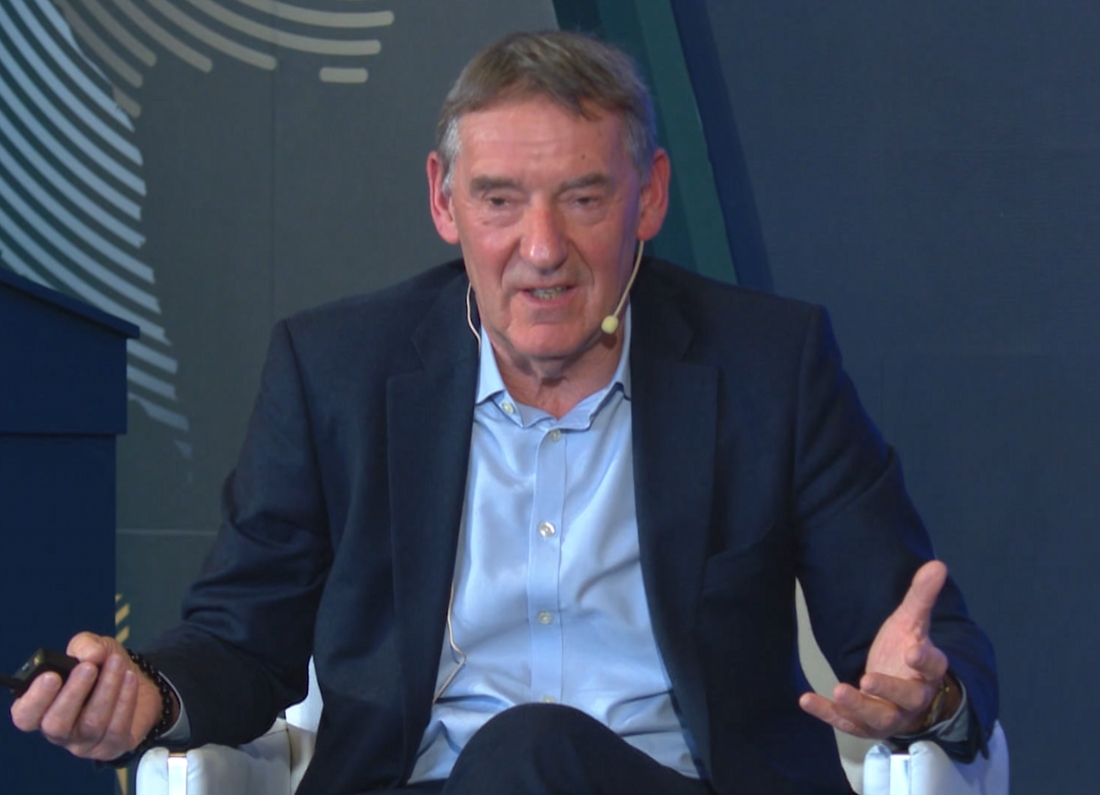
Lord Jim O’Neill, the former chief economist at Goldman Sachs and former Conservative Treasury minister, has delivered one of the most forthright assessments of Brexit’s economic legacy heard from a figure of his stature – describing it as a “colossal economic shock” that is causing “more permanent damage” to the British economy than the Iran war energy crisis is likely to produce.
O’Neill made the remarks during an appearance on LBC, where he had been asked to assess the likely economic impact of the ongoing Middle East conflict and the disruption to oil and gas supplies caused by Iran’s blockade of the Strait of Hormuz. His answer was notable for how quickly he redirected the conversation towards what he regards as the deeper, more lasting wound in the British economy.
What O’Neill said
The intervention is significant not simply because of what was said, but who is saying it. O’Neill is not a figure associated with Remain campaigning or left-wing politics. He is a life peer who sits in the House of Lords, coined the term BRIC to describe the emerging economies of Brazil, Russia, India and China, ran Goldman Sachs Asset Management with over $800 billion in assets under management, and served as a minister in David Cameron’s Conservative government. He is, in other words, an impeccably credentialled member of the British economic establishment – and his assessment of Brexit is damning.
“One of the reasons why we’re having so many problems over the past decade is because we’re still living from the colossal economic shock of Brexit,” he said, “which is causing more permanent damage than this energy price shock is likely to do.”
That is a striking comparative judgment. The Iran war has driven oil prices to over $116 a barrel, energy bills are set to rise sharply again in July, and economists have warned of a stagflationary shock that could tip parts of Europe into recession. O’Neill is not dismissing the severity of the current crisis – but he is saying that Brexit’s damage runs deeper and will last longer.
On productivity – the measure of economic output per hour worked, and one of the central challenges in British economic policy for over a decade – O’Neill was equally direct. He acknowledged the importance of improving productivity for long-term growth, but said that challenge had only been “exaggerated by our rather odd decision to leave the EU.”
The single market prediction
Perhaps the most politically charged part of O’Neill’s intervention was his assessment of where Labour’s thinking on Brexit actually sits – and where it is likely to end up.
He suggested that Keir Starmer and senior Labour figures privately wish the UK were still in the EU single market, but cannot say so publicly because of the politics of immigration. Freedom of movement – the right of EU citizens to live and work in any member state – was the most contentious element of the Brexit debate for many Leave voters, and Labour’s sensitivity on immigration makes any explicit advocacy for single market membership politically difficult.
But O’Neill went further, predicting that this position will not hold indefinitely. He forecast that Labour would put a pledge to rejoin the single market on their manifesto at the next general election, in order to win over younger voters who, in his assessment, simply cannot understand why Britain left the EU in the first place.
That is a bold prediction that goes well beyond anything Starmer has been willing to contemplate publicly. The Prime Minister has explicitly and repeatedly ruled out rejoining the single market, and his EU reset – announced this week – is framed in terms of a closer partnership rather than reintegration. But O’Neill’s reading of the political logic is not without foundation.
What the economic evidence shows
O’Neill’s assessment is consistent with a growing body of independent economic analysis on the impact of Brexit. Goldman Sachs itself has found that the UK has “significantly underperformed” other advanced economies since the 2016 referendum, with the economy estimated to be around 5% smaller than it would have been had the UK remained in the EU. Consumer prices have risen by 31% in the UK since 2016, compared with 24% in the Eurozone and 27% in the US – a divergence that Goldman Sachs attributes in significant part to increased friction in trade caused by leaving the single market.
The Office for Budget Responsibility has previously estimated that Brexit has reduced UK trade intensity by around 15% compared to what would otherwise have been expected. The independent Institute for Fiscal Studies and multiple academic research teams have reached broadly similar conclusions: Brexit has made Britain poorer than it would otherwise have been, and the damage compounds over time.
The productivity problem O’Neill highlighted is real and long-running. UK productivity growth has lagged behind comparable economies for over a decade, and economists have consistently pointed to the uncertainty and trade friction created by Brexit as contributing factors – making it harder for businesses to invest, expand, and integrate into European supply chains.
The public mood – and the politics
O’Neill’s intervention arrives at a moment when public opinion on Brexit has shifted far more dramatically than the political debate would suggest. New YouGov polling shows that 63% of Britons would vote to rejoin the EU if a referendum were held today – a near-complete reversal of the 52-48% result in 2016. Among 18 to 25-year-olds, that figure rises to 86%. Even among retired voters – the demographic that delivered the Leave majority – 60% would now vote to rejoin.
YouGov has also found that 61% of Britons consider Brexit to have been more of a failure than a success, with only 13% describing it as a success. Of those who see it as a failure, 88% blame the Conservative Party and 84% blame Boris Johnson specifically.
And yet no major party is currently campaigning for EU membership or single market rejoining. Starmer has explicitly ruled both out. The Conservatives and Reform are, if anything, pushing in the opposite direction. The Liberal Democrats are the most pro-European of the established parties but have stopped short of explicitly campaigning for membership.
O’Neill’s prediction – that Labour will eventually move towards the single market in response to younger voters – may therefore be more of a medium-term forecast than an imminent policy shift. But the polling and the economic evidence both suggest the direction of travel is clear.
Why it matters that a former Tory minister is saying this
The significance of O’Neill’s remarks is partly a function of who he is. Criticism of Brexit from politicians who campaigned for Remain, or from academics and journalists associated with progressive politics, is easy to dismiss as ideologically motivated. O’Neill does not fit that template.
He is a former Goldman Sachs chief economist – an institution not typically associated with left-wing economic analysis. He is a Conservative peer. He served in a Conservative government. He has spent his career in markets and finance, not political advocacy.
When someone with that biography describes Brexit as a “colossal economic shock” causing more permanent damage than the worst oil supply disruption in the history of the global market, it carries a different weight than the same argument made by someone on the Remain side of the political spectrum. It is, in a sense, the Establishment’s verdict on itself.
As Britain approaches the tenth anniversary of the 2016 referendum in June, and as Keir Starmer pushes for the most ambitious EU reset of any post-Brexit British prime minister, the economic reckoning that O’Neill articulated on LBC is becoming harder for the political class to continue deferring.
You may also like: The two poll findings that could reshape British politics – Greens lead under-65s and beat Reform 42-27







Leave a Reply