

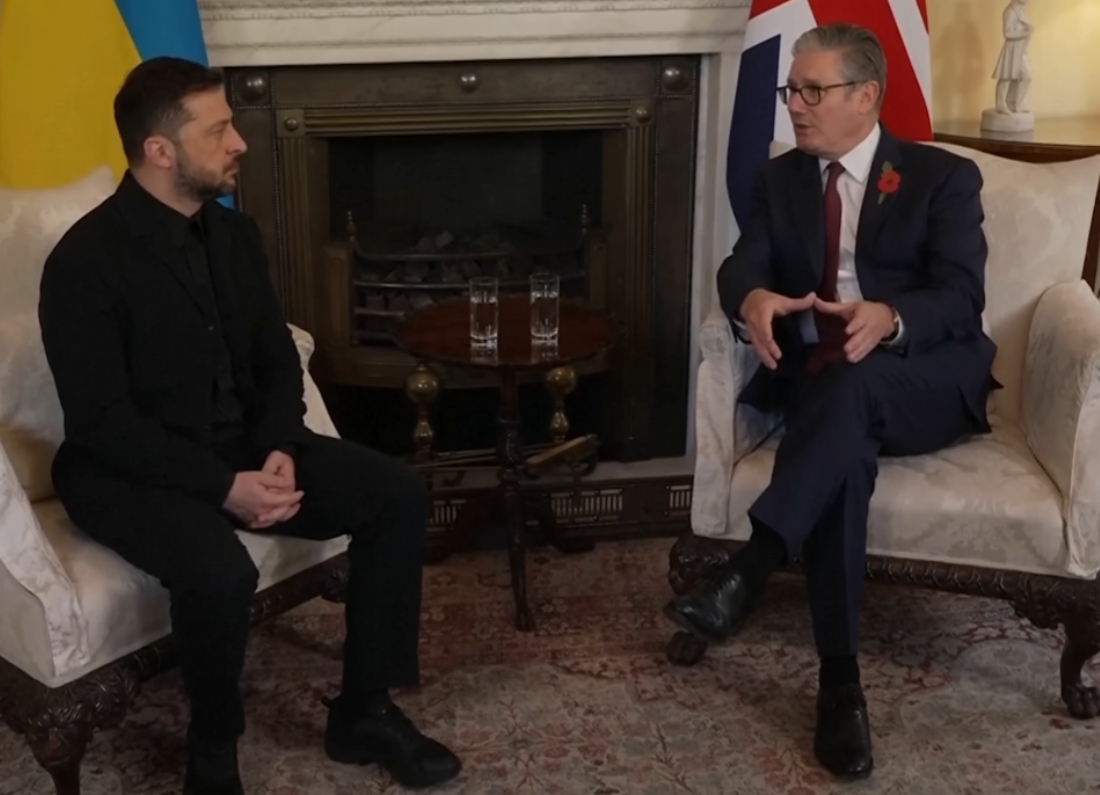
Ukrainian President Volodymyr Zelensky has called on the United Kingdom to rejoin the European Union alongside Ukraine, Turkey and Norway – arguing that the combined military forces of those four countries within the EU would give Europe the capability to defend itself if the United States ever withdrew from NATO.
The appeal, made in an interview with The Rest is Politics podcast and subsequently posted on social media, adds a significant new voice to the growing debate in Britain about the country’s relationship with the EU – and frames Brexit not merely as an economic question but as a matter of continental security at a moment of acute geopolitical tension.
What Zelensky said
The Ukrainian president described the UK, Ukraine, Turkey and Norway as “four strong countries” whose inclusion in the EU would transform Europe’s security architecture. He was direct about the military dimension: “The UK, Ukraine, and Türkiye have armies that are stronger than Russia’s army.”
He set out the strategic logic of EU membership for each: “If you have the military forces of the UK, Ukraine and Turkey in the EU, you can wrest control of the seas, have secure skies and the largest land forces.”
His argument rested on a specific threat assessment: Russia’s declared intention to build an army of 2.5 million people by 2030. “When Russia makes the decision to have an army of 2.5 million people by 2030, Europe has to think about security and how to preserve its independence,” he said.
The crucial pivot in Zelensky’s argument was the conditional removal of the United States. “If the United States were to withdraw from NATO in the future,” he argued, “the security of Europe will be based solely on the European Union.” In that scenario, the military weight of the UK, Ukraine and Turkey inside the EU would not be an optional enhancement – it would be an existential necessity.
The acknowledgement of obstacles
Zelensky was not naive about the practical and political obstacles. He acknowledged that Britain’s departure from the EU was not simply reversible, and that Turkey’s longstanding candidacy for EU membership has been complicated by concerns ranging from agriculture to democracy. But he argued that those concerns are manageable when set against the security imperative.
“The UK once was a member of the EU,” he said. “There are concerns about agriculture when it comes to Türkiye. But you can manage all of this if you have a really great economy. But security comes first, economy second. Not vice versa.”
That formulation – security first, economy second – is a deliberate inversion of how Brexit was largely debated in Britain, where economic arguments dominated on both sides. Zelensky is suggesting that in the current security environment, with Russia arming for potential conflict and American commitment to NATO uncertain under Trump, that calculus has fundamentally changed.
Why this matters for British politics
Zelensky’s call arrives at a moment of unusual openness in British politics about the country’s relationship with the EU. A YouGov poll earlier this year found that 63% of Britons would vote to rejoin the EU if a referendum were held today. Lord Jim O’Neill, the former Goldman Sachs chief economist and Conservative minister, has predicted that Labour will eventually put single market rejoining on their manifesto to win over younger voters. The Iranian war energy crisis – which Britain experienced acutely because of its dependence on global fossil fuel markets – has strengthened the arguments for closer European economic integration.
But Zelensky’s argument goes further than any of those voices. He is not making an economic case for closer UK-EU ties. He is making a security case for full EU membership – arguing that the geopolitical environment created by Russian expansionism and American unpredictability makes it a strategic necessity.
For a British political class that has spent a decade treating Brexit as primarily an economic and immigration debate, that reframing is significant. It echoes arguments made by senior military figures and foreign policy analysts who have warned that the UK’s post-Brexit position – outside the EU’s defence structures, dependent on a US security guarantee that may no longer be reliable, and with a bilateral relationship with Washington that has been publicly strained by the Iran war – leaves Britain exposed in ways that were not fully anticipated in 2016.
The NATO question
Central to Zelensky’s argument is a scenario that would have seemed almost unthinkable two years ago but that the Trump administration has made a live political question: the potential withdrawal of the United States from NATO or a significant reduction in American commitment to European defence.
Trump has repeatedly questioned NATO’s value, threatened to abandon allies who do not meet the 2% GDP defence spending threshold, and made clear during the Iran war that he expects European partners to shoulder more of the burden of their own security. His suggestions that the US might be willing to leave European nations to manage their own defence affairs have alarmed governments across the continent.
Zelensky’s logic is straightforward: if American withdrawal from NATO becomes a realistic possibility rather than a theoretical one, then Europe needs the military capability to defend itself without US support. In that scenario, the absence of the UK – with its nuclear deterrent, its expeditionary military capability, its intelligence assets and its naval power – from the EU’s security structures represents a significant hole in European defence.
The Turkish and Norwegian dimension
The inclusion of Turkey and Norway alongside Ukraine and the UK in Zelensky’s proposal is notable. Turkey, a NATO member with the second largest army in the alliance, has long been a formal EU candidate whose membership has been suspended in practice for years over concerns about democratic backsliding and agricultural policy. Norway, which is not an EU member but participates in the single market through the European Economic Area, has close ties with both the EU and NATO.
Zelensky’s framing suggests he is thinking about a potential enlarged EU that is explicitly designed around military capability and continental security rather than primarily around economic integration – a different kind of European project from the one that has dominated since the 1950s, reshaped for the security environment of the 2020s and beyond.
Whether that vision is realistic – given the domestic political obstacles in each of the four countries, the complexity of EU institutional reform, and the opposition that explicit EU enlargement for security purposes would face in several member states – is a separate question from whether Zelensky is correct about the underlying security logic.
What it means for Britain
For British audiences, the most striking aspect of Zelensky’s intervention is who is saying it. This is not a Remain campaigner, a Brussels bureaucrat or a European federalist. This is the leader of a country that is fighting for its survival against Russian aggression, who has spent three years building and commanding the military resistance that has prevented Ukraine from being overrun, and who has a specific and concrete understanding of what Russian military power means in practice.
His assessment is that Europe is not secure without Britain inside the EU, and that Britain is not secure outside it – particularly if America’s commitment to European defence continues to weaken. That judgment, from that source, in this geopolitical moment, lands differently from the same argument made by a British politician.
Whether it moves British public opinion, or shifts the calculations of British politicians who have so far treated EU membership as politically off the table, is another matter. But as Britain approaches the tenth anniversary of the Brexit referendum in June 2026, Zelensky has added a new and powerful dimension to a debate that may be less settled than it appeared.
You may also like: Starmer compares Trump to Putin and vows Britain will never go ‘back to normal’




Leave a Reply