

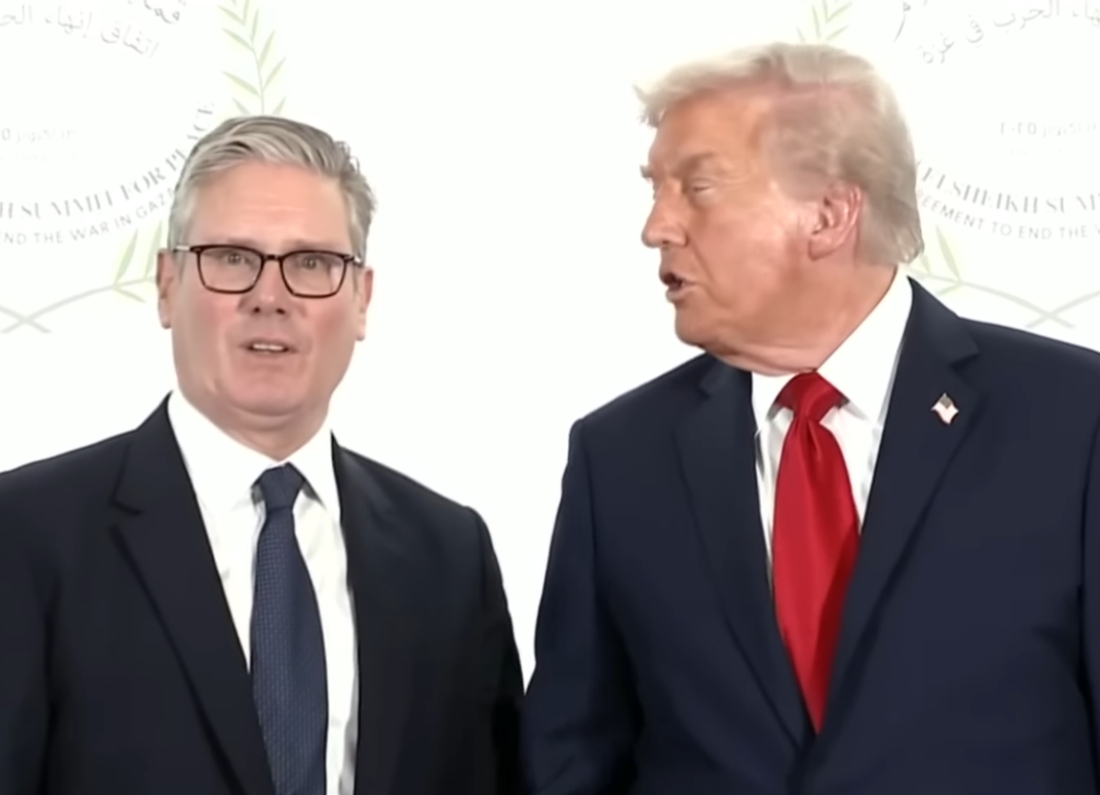
The UK government has been forced to shelve its legislation to hand the Chagos Islands back to Mauritius, after the United States withdrew support for the agreement – dealing a significant blow to one of Keir Starmer’s flagship foreign policy commitments and laying bare the degree to which the Iran war has poisoned the UK’s relationship with Washington.
Officials acknowledged on Friday that they had run out of time to pass legislation within the current parliamentary session. The bill will not be included in next month’s King’s Speech, preventing it from being introduced before the session ends. A government spokesperson said the deal would only proceed with US support and that securing the long-term future of the Diego Garcia base was “the entire reason for the deal.”
What the deal involved
The agreement, signed in principle in May 2025, would have seen the UK cede sovereignty of the Chagos Islands to Mauritius while securing a 99-year lease on the largest island, Diego Garcia, allowing both Britain and the United States to continue operating their joint military base there.
Under the deal, the UK would pay Mauritius an annual average of £101 million for 99 years in 2025-26 prices, totalling around £3.4 billion – though critics have put the figure substantially higher, with some estimates reaching £35 billion when all costs are included. The arrangement was designed to resolve a long-running legal dispute over sovereignty that had placed the base’s future in doubt.
The Chagos Islands were designated as British Indian Ocean Territory in 1965, when Britain detached them from Mauritius – then still a British colony – specifically to establish the military base at Diego Garcia. Mauritius gained independence in 1968 without the islands. The base, strategically located roughly halfway between Africa and Asia, aids in surveillance of the Middle East and has been critical to operations in the Iran conflict and previous wars in Iraq and Afghanistan.
The legal pressure behind the deal
The government has consistently argued that the deal was not a choice but a necessity driven by mounting legal pressure. In 2019, after a campaign by Mauritius in the UN General Assembly, the International Court of Justice found that the UK’s retention of the Chagos Islands as a colony was unlawful, and that it was obliged to end the colonisation “as rapidly as possible.” UK ministers responded that they did not consider the decision binding as it was only an advisory opinion – but the consequences started to bite.
Mauritius has threatened legal action against the UK over the delay, and ministers have raised concerns about potential legal challenges that could affect access to waters around Diego Garcia. The government’s position has been that a negotiated settlement was preferable to losing a series of court cases that could ultimately make the base inoperable.
How Trump killed the deal
The United States had initially endorsed the agreement, but US President Donald Trump reversed his position and called the deal an “act of great stupidity” and “total weakness” that harms national security and benefits rivals like China and Russia. On 18 February 2026, Trump posted on Truth Social that Keir Starmer was “making a big mistake by entering a 100 Year Lease” and wrote in capital letters: “DO NOT GIVE AWAY DIEGO GARCIA!”
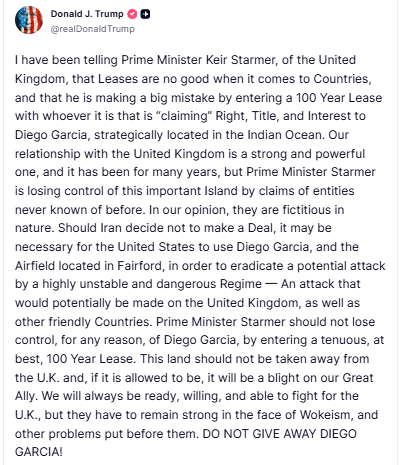
Trump’s change of position appears to have been prompted by Keir Starmer’s reluctance to let the US use Diego Garcia for pre-emptive strikes against Iran. The UK had previously pledged to only allow the base to be used for defensive operations in the Iran conflict – a position that created significant friction with Washington throughout the war.
The immediate practical obstacle was that the US had not formally exchanged the letters needed to amend a 1966 British-American treaty on the islands – an exchange that was a legal prerequisite for the bill to proceed through Parliament. Without that exchange, the UK government’s legal advisers concluded the legislation could not proceed.
Parliament is expected to be prorogued between 29 April and 6 May 2026. If the legislation is not passed before prorogation it will fall entirely, meaning the government would be forced to reintroduce the bill in the next parliamentary session, starting the legislative process again from the very beginning.
The political reaction
Kemi Badenoch, the Conservative leader, said the time Labour had taken to drop the bill was “another damning indictment of a prime minister, who fought to hand over British sovereign territory and pay £35bn to use a crucial military base which was already ours.”
Nigel Farage welcomed the shelving, calling it “great news” – the Reform leader has long been among the deal’s most vocal opponents, framing it as a surrender of British sovereignty to a country with close ties to China.
A government spokesperson sought to maintain that the deal remained the right approach: “We continue to believe the agreement is the best way to protect the long-term future of the base, but we have always said we would only proceed with the deal if it has US support.” Ministers are understood to be frustrated that Washington reversed its position after initially backing the agreement, with a government source saying they would seek to persuade Trump to reconsider.
The Chagossians – the people forgotten again
Lost in the political debate between London and Washington is the human story at the heart of the Chagos issue – the Chagossian people themselves, thousands of whom were forcibly removed from the islands in the 1960s and early 1970s to make way for the military base, and who have been fighting for the right to return ever since.
Many Chagossians opposed the deal on the grounds that they had been insufficiently consulted and that it did not adequately address their right of return. No UK government has ever taken concrete steps to facilitate resettlement for the Chagossians. The Conservative party’s vocal support for their cause has been noted by observers as opportunistic, given that successive Conservative governments showed no interest in the matter when in power.
Last week, the Supreme Court of the Chagos Archipelago overturned the ban on Chagossians living on the outer islands – a legal development that has added fresh complexity to the already fraught situation.
What happens next
The immediate practical consequence is that the Chagos bill will not appear in the King’s Speech in May, meaning the current legislative process has effectively ended. The government will need to decide whether to bring forward a new bill in the next parliamentary session – which would require starting the entire process again – or to wait for a change in Washington’s position.
A government source said Britain would not proceed without US backing and would seek to persuade Trump to reconsider. Whether that persuasion is possible – given the state of UK-US relations following the Iran war, Trump’s public contempt for Starmer, and the broader deterioration of the special relationship – is a question that has no obvious answer.
For Starmer, the Chagos setback is one more item in a long list of foreign policy frustrations. He has been publicly compared to Neville Chamberlain by the US president. He has been mocked in a Saturday Night Live skit shared by Trump on Truth Social. He has been forced to justify the use of British bases for American bombing raids while simultaneously insisting Britain is not a party to the war. And now his flagship decolonisation commitment – the one foreign policy area where the government seemed to have built a principled and legally coherent position – has been effectively vetoed by a man who, just months earlier, endorsed it at a state dinner at Chequers.
The Chagos Islands were stolen from their people 60 years ago. The deal to return them has now been shelved. And the people most affected – the Chagossians – remain, as they have always been, the last consideration in a dispute that has always been about military power rather than justice.




Leave a Reply