

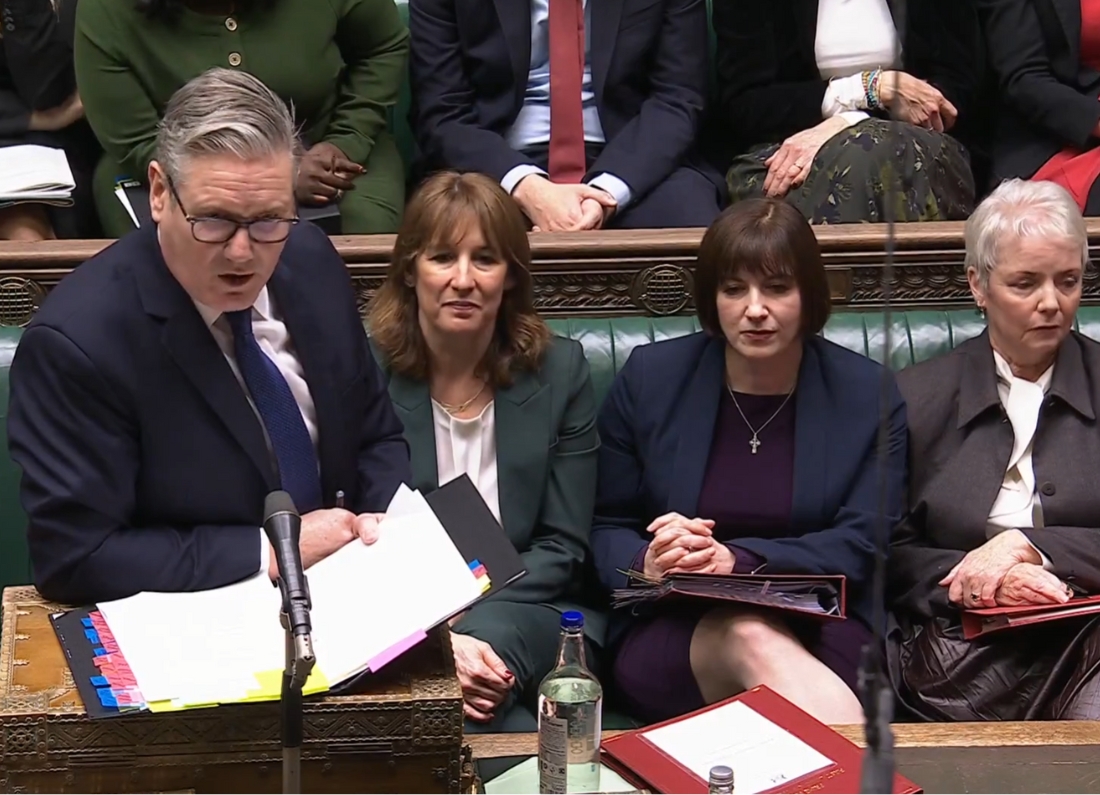
Business confidence slipped at the start of 2026, in a setback for Labour’s message that the economy is turning a corner and that firms are regaining their appetite to invest and hire.
The latest monthly Lloyds Bank Business Barometer showed an overall decline in confidence in January, driven mainly by a sharp fall in optimism about the wider economy. The survey is closely watched in Westminster and the City, and has been frequently cited by Prime Minister Sir Keir Starmer and Chancellor Rachel Reeves as a sign of improving sentiment among employers.
The barometer’s headline measure fell to a net balance of +44 in January, down from +47 in December, according to Reuters. The drop came as economic optimism fell 14 points to +28, the weakest reading in a year.
Even so, there were some brighter signals within the same data. Firms reported stronger expectations for their own activity, hiring intentions improved, and pay growth expectations ticked up, suggesting many businesses still see opportunities this year even as the macro picture looks more uncertain.
What the Lloyds barometer is measuring
The Lloyds Bank Business Barometer is a long-running monthly survey of around 1,200 UK companies, designed to capture sentiment about trading conditions, future activity, staffing plans and the wider economy. It is widely used because it provides consistent monthly readings and covers businesses across sectors.
The distinction between confidence about a firm’s own prospects and confidence about the broader economy matters. Businesses can feel reasonably upbeat about their own order books while still worrying about national growth, consumer demand, global shocks or policy uncertainty. That appears to be the pattern emerging in January’s figures.
Confidence dipped, but firms still see scope to grow
In the Reuters report on the data, Lloyds’ senior economist Hann-Ju Ho said firms were reporting confidence in their own trading prospects “despite a slight softening of wider economic optimism”, adding that it points to an ability to manage external risks and focus on growth opportunities.
Hiring intentions were a notable bright spot. Reuters said business expectations for their own activity climbed to a three-month high, while hiring plans improved and more than a fifth of firms expected salaries to rise by 4% or more.
Taken together, that mix suggests a more complicated picture than a simple “confidence collapse”. Employers are not uniformly pulling back, but they are becoming more cautious about the economy around them.
Why the wider outlook has soured
The fall in economic optimism is likely to be read through the lens of three pressures that have been building over recent months: interest rates, costs, and uncertainty about the external environment.
Interest rates have been falling from their recent peaks, which can support borrowers over time, but the transition can be uncomfortable for parts of the economy, and it often coincides with weaker growth expectations. For banks, the shift can also affect credit conditions and the appetite to lend, even if activity remains steady.
The Lloyds survey results also come amid heightened global concerns. Reuters reported that the drop in optimism was linked to worries about the world economy, and referenced trade tensions as part of the backdrop affecting sentiment.
The political context is also hard to separate from the economic one. Governments of all stripes closely track business confidence because it is tied to investment, hiring and growth. A soft patch in sentiment, even if limited, makes it harder to argue that the economic narrative is moving decisively in the right direction.
The May elections add political pressure
The timing is awkward for Labour because the country is heading towards a heavy election day on Thursday 7 May 2026, with local government elections alongside contests in Scotland and Wales, and mayoral elections in England.
However, not all local elections will go ahead as originally expected. The Institute for Government has noted that ministers intend to delay elections in a number of areas undergoing local government reorganisation, reducing the total number of councillors up for election compared with earlier expectations.
For Downing Street, those May results will be closely watched as a mid-term test of voter mood. While local elections are shaped heavily by local issues, a narrative that business confidence is sliding can feed into a broader argument from opponents that Labour’s growth push is not yet cutting through.
A counterpoint from the ONS: business creations are up
Alongside the Lloyds barometer, new official statistics offered a more upbeat view of business churn. The Office for National Statistics said the number of business creations added to the Inter-Departmental Business Register in the final quarter of 2025 was 71,935, up 10% on the same quarter a year earlier.
The ONS also reported that business creations rose in 15 out of 16 main industrial groups, with the biggest increases coming from transport and storage, and information and communication.
These numbers do not cancel out the confidence dip, but they do add context. A rise in business creations can signal entrepreneurial activity and resilience, even when broader sentiment softens. It can also reflect restructuring, new market opportunities, and sector-specific growth that is not always captured in top-line confidence readings.
What to watch next
The key question over the next few months is whether January’s dip becomes a trend or remains a one-month wobble.
If economic optimism continues to weaken, it could affect decisions about investment and expansion, particularly for firms facing tight margins or uncertain demand. If, instead, hiring intentions and activity expectations hold up, it may suggest that businesses are adapting to a tougher external environment rather than retreating from growth plans.
For Labour, the political challenge is that confidence surveys are often used in speeches as proof points. When the same tracker begins to move the “wrong” way, it is quickly framed as a verdict on government strategy, even if the underlying data is mixed.
For businesses, the practical issue is less about the politics and more about predictability. Firms can cope with a range of policy settings, but they struggle when costs rise sharply, demand is uncertain, or global shocks create sudden changes in trading conditions.
January’s numbers do not point to panic, but they do underline a cautious mood at the start of the year: many employers still feel able to grow, yet fewer are convinced that the broader economy is about to accelerate.
You may also like: Lloyds lifts dividend and launches new buyback after 2025 profit jump






Leave a Reply