

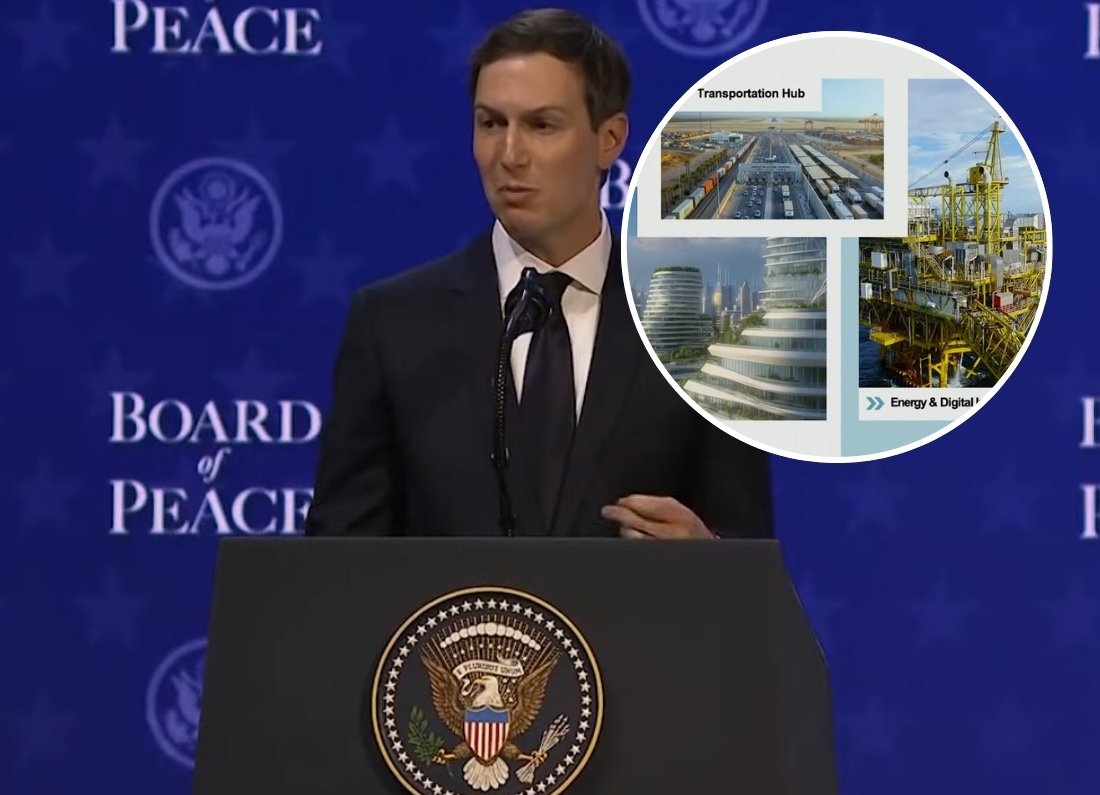
Donald Trump has unveiled a glossy “New Gaza” vision featuring luxury apartments, coastal tourism and data centres – a headline-grabbing pitch delivered on the sidelines of the World Economic Forum in Davos as the US president pushed his new “Board of Peace” initiative.
The plans were presented during a signing ceremony for the Board of Peace charter, a Trump-backed body he has suggested could rival – and potentially replace – parts of the United Nations system. While the White House has framed it as a vehicle for conflict mediation and post-war reconstruction, key European allies have so far stayed out, citing concerns about the project’s scope and the inclusion of Russia’s Vladimir Putin in the invitation list.
At the centre of Thursday’s spectacle was Jared Kushner, introduced in US coverage as a ceasefire negotiator and real estate investor, who used the moment to outline redevelopment ambitions for Gaza and argue the territory has “amazing potential.”
🏛️ The “Board of Peace” announcement – and why allies are wary
Trump used Davos to sell the Board of Peace as an elite-level forum that can “get a lot of work done that the United Nations should have done,” adding that it “might” replace the UN in some form.
But the initiative has landed with a thud among traditional US allies. ABC News reported that none of America’s major European allies had signed up at the point of the Davos ceremony, with countries such as France, Norway and Sweden declining or expressing significant reservations, while Germany, the UK and Italy were described as noncommittal.
In the UK’s case, Foreign Secretary Yvette Cooper explicitly pointed to Putin’s involvement as a core concern, saying Britain would not be among the signatories in Davos because of worries about “President Putin being part of something that’s talking about peace” while there were no signs of a genuine commitment to peace in Ukraine.
Reuters has also reported that, under a draft charter, member states would receive a three-year membership term – with an option for permanent membership for states contributing more than $1 billion in cash within the first year – an unusual structure that has intensified scepticism about what the body actually is and who it ultimately serves.
🏗️ “New Gaza” – luxury housing, tourism and a data-centre economy
Alongside the Board of Peace launch, Kushner presented “ways to redevelop Gaza,” suggesting the rebuild could be completed in “two, three years,” while describing the project as “for the people of Gaza.”
The vision has been widely characterised as a dramatic, masterplanned overhaul – the kind of redevelopment pitch more commonly seen in major investment prospectuses than in conflict diplomacy. Separate reporting described CGI-style “New Gaza” concepts featuring luxury apartments, large-scale housing, medical facilities, and zones set aside for industrial and tech development, including data centres and advanced manufacturing.
The problem, critics argue, is not just that the imagery looks like a sales brochure – it is that it risks treating a devastated territory as a blank canvas while sidestepping the hardest political questions: who governs, who guarantees security, how land is allocated, how residents participate in decision-making, and how rights are protected.
Even within US reporting, there are signs the plan is running ahead of the paperwork. ABC News noted that a charter draft reviewed by the outlet made clear the Board of Peace has a broad global mandate and that the charter itself “makes no direct reference to Gaza at all,” despite Gaza being used as a central selling point in the rollout.
🌍 Who’s in the room – and who’s pointedly not
The Board of Peace pitch has also become entangled in broader geopolitical controversy because Russia was extended an invitation, with the Kremlin confirming it. ABC News reported Putin’s comments to Russia’s Security Council that the proposal concerned the Middle East settlement and humanitarian problems in Gaza – a framing that underlines how differently various capitals interpret the project’s purpose.
At the same time, the list of participating countries highlighted by ABC included a mix of Middle Eastern, Eurasian and other states – but notably lacked the big European anchors of transatlantic diplomacy.
That absence matters because the Board of Peace is being pitched as a prestige body – Trump called it “the most prestigious board ever” in remarks reported by ABC – yet prestige in global diplomacy usually depends on breadth of buy-in, not just the optics of a signing ceremony.
⚖️ The politics behind the pictures
Trump’s Gaza imagery moment also echoed a pattern that has repeatedly defined his foreign-policy branding: theatrical announcements, maximal claims of quick wins, and a preference for deal-shaped narratives that can be summarised in a few striking lines.
In Davos, he framed the initiative in sweeping terms about ending “decades of suffering” and forging “glorious peace.” Yet, even sympathetic observers note that rebuilding and stabilising Gaza is not simply an infrastructure task – it is inseparable from governance, security arrangements, and international law.
That is one reason why the optics of luxurious towers and coastal tourism can feel jarring: they signal certainty and inevitability where, in reality, the fundamentals are disputed and the timeline is unknowable.
And while Kushner presented the idea as practical and imminent, the most immediate “next steps” described in ABC coverage focused on humanitarian aid, infrastructure rehabilitation and rubble removal – a far more grounded (and far less glamorous) set of priorities than the rendered skyline.
🔎 What happens next
For now, Trump’s “New Gaza” is best understood as a political message wrapped in development language: a promise of transformation that plays well on a Davos stage, but which still faces profound diplomatic headwinds – including European reluctance, questions about Russia’s invited role, and uncertainty over whether the Board of Peace’s structure is designed for peacebuilding or for power projection.
What is clear is that the imagery has landed – and the debate over what it represents is only beginning.
You may also like: Elon Musk mocks Trump’s “Board of Peace” with Greenland land-grab pun at Davos




Leave a Reply