

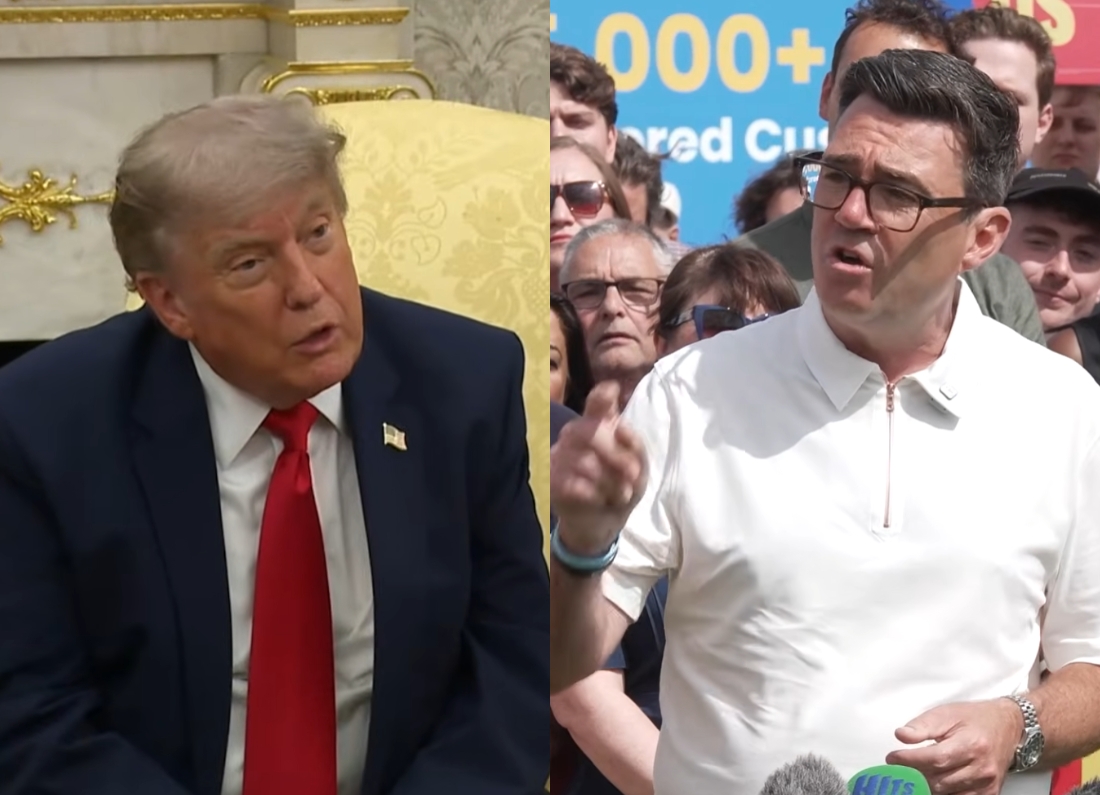
Donald Trump’s administration is considering withdrawing American support for Britain over the Falkland Islands as part of an extraordinary attempt to pressure Andy Burnham into spending more on defence.
Senior Pentagon officials are reportedly drawing up measures that could be used against NATO countries Washington believes are failing to provide credible plans for meeting the alliance’s new defence spending commitments.
Britain is expected to receive “special attention” from the United States because officials believe the UK has the economic and military potential to contribute considerably more.
One of the options under consideration could involve America changing its position on the Falkland Islands, according to The Telegraph.
A senior US official said that when it came to discussions over the islands, “nothing is being ruled out” as Washington considers ways of encouraging allies to increase defence spending.
The development threatens to open an extraordinary diplomatic confrontation between two of the world’s closest military allies.
It also comes at an especially difficult moment for Burnham.
His government is already facing questions over defence spending after Chancellor John Healey backed away from his previous demand for Britain to spend 3% of GDP on defence by 2030.
US puts pressure on Burnham
Washington is reviewing whether NATO members have credible plans for meeting the alliance’s new spending commitments.
A senior US official told The Telegraph: “I would expect the UK to receive special attention because it has so much potential.
“We will therefore continue efforts to incentivise and enable the UK to step up in a major way.”
Asked specifically whether America’s position on the Falklands could form part of those discussions, the official said conversations with Britain were “candid”.
They added: “Nothing is being ruled out as far as options for encouraging the sort of burden-sharing that we seek.”
No decision to change America’s position on the islands has been announced.
The proposal should therefore be treated as an option being considered within the Trump administration rather than established US policy.
But even raising the Falklands as potential leverage against Britain is highly unusual.
Sovereignty over the islands remains one of the most politically sensitive issues in British foreign policy more than four decades after the Falklands War.
Britain and Argentina still dispute the islands
The Falkland Islands are a British Overseas Territory in the South Atlantic, around 300 miles from the coast of Argentina.
Argentina claims sovereignty over the islands, which it calls Las Malvinas.
Britain maintains that the future of the Falklands should be determined by the people who live there.
The dispute led to war in 1982 after Argentina invaded the islands.
Margaret Thatcher sent a British task force to retake them, and Argentina surrendered following 74 days of fighting.
A total of 255 British military personnel, 649 Argentine personnel and three Falkland Islanders were killed.
Argentina has continued to claim sovereignty since the war but says the dispute should be resolved diplomatically.
The wishes of the islanders themselves are considerably less ambiguous.
In a referendum held in 2013, 99.8% voted to remain a British Overseas Territory, with turnout of around 92%.
Argentina rejected the referendum.
Where does America stand?
America’s formal position is more complicated than simply supporting Britain’s sovereignty claim.
The United States recognises British administration of the Falklands but has historically stopped short of formally taking a position on the underlying sovereignty dispute between Britain and Argentina.
During the 1982 war, the Reagan administration initially attempted to mediate between London and Buenos Aires.
Washington eventually provided Britain with crucial intelligence, military equipment and logistical support.
The Trump administration had already considered reassessing America’s position earlier this year.
In April, Reuters reported that an internal Pentagon email included reviewing Washington’s approach towards British territories such as the Falklands among potential ways of putting pressure on European allies following disagreements over the Iran war.
At the time, Britain insisted its position was unchanged.
The latest reporting suggests the Falklands question has resurfaced as Washington turns its attention towards NATO defence spending.
Burnham faces growing defence spending problem
The timing could hardly be more awkward for Burnham.
Britain currently plans to increase core defence spending from 2.3% of GDP in 2024 to around 2.7% by 2030.
The government remains committed to the broader NATO target of spending 5% of GDP on security by 2035, although that figure includes areas beyond conventional military spending.
Burnham said in June that reaching 3% of GDP on defence should be the “number one priority” at the next Spending Review.
But his government has declined to commit to reaching that level by 2030.
Healey is now expected to avoid setting a date for the 3% target when he delivers his first Budget in October.
That represents a particularly striking reversal for the Chancellor.
Healey resigned as defence secretary under Sir Keir Starmer after arguing that the previous government was not moving quickly enough on defence spending.
At the time, he insisted Britain should reach 3% by 2030.
Now responsible for balancing the Treasury’s books, Healey is expected to concentrate first on funding the existing Defence Investment Plan before committing billions more to reach the higher target.
Reaching 3% by 2030 could require approximately another £10 billion annually.
Pressure comes as Russia threatens Britain
The dispute is unfolding during an increasingly dangerous period for British foreign policy.
Burnham travelled to Kyiv this week on his first overseas trip as prime minister and announced deeper British military support for Ukraine.
Britain agreed to release classified information that could help Ukraine manufacture long-range SCALP missiles.
Russia responded angrily.
On Thursday, Russian Foreign Ministry spokeswoman Maria Zakharova warned that Moscow could strike British military targets if Ukraine used British-supplied long-range weapons against Russia.
The government is therefore facing pressure to spend more on defence at precisely the moment international threats against Britain are increasing.
Washington appears determined to make that pressure even greater.
For now, the Trump administration has not changed America’s position on the Falkland Islands.
But the possibility that one of Britain’s closest allies could use the sovereignty dispute as leverage over defence spending is itself an extraordinary development in the UK-US relationship.








Leave a Reply