


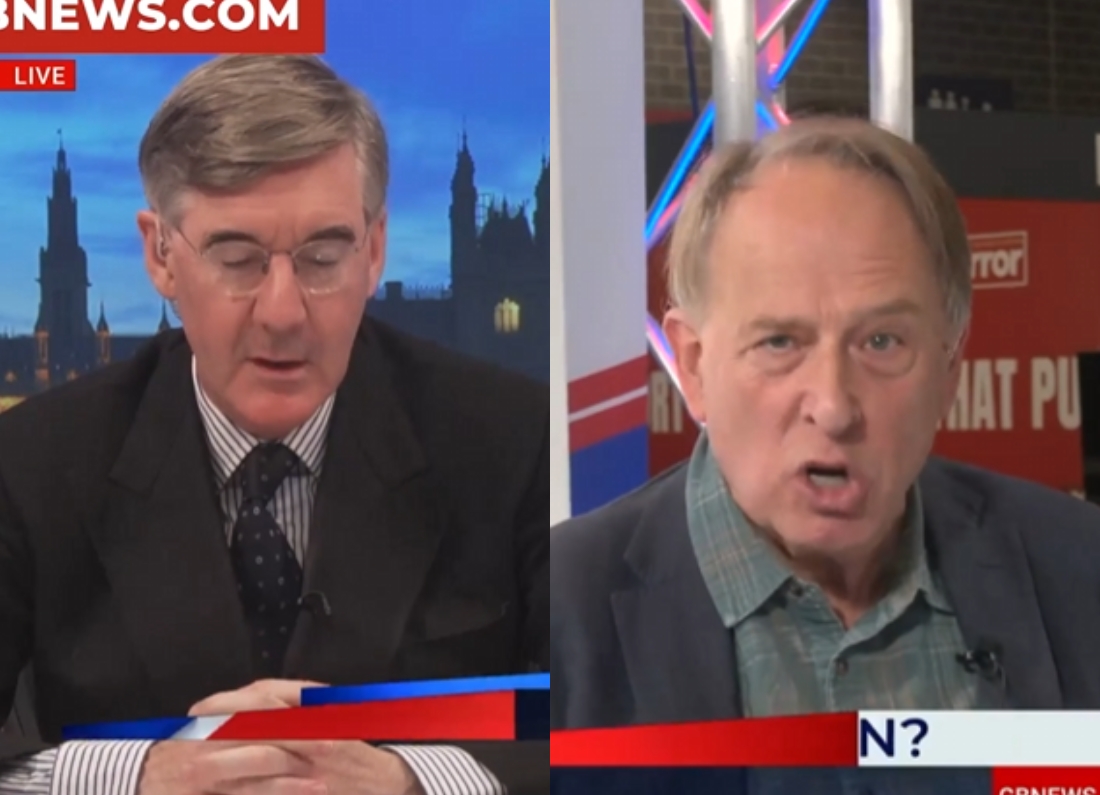
Julia Hartley-Brewer is not someone you normally look to for rigorous political analysis. But give credit where it’s due – her interview with Richard Tice on Talk TV over Trump’s approach to Ukraine was one of the more effective dismantling’s of Reform’s foreign policy position you’ll find anywhere on British television.
It took about thirty seconds.
The context: Donald Trump had announced that week he would begin peace negotiations with Vladimir Putin to end the war in Ukraine. His defence secretary Pete Hegseth had already signalled the terms – Russia gets to keep roughly a fifth of Ukraine’s territory, Ukraine doesn’t get to join NATO. Reform, which has cultivated a close relationship with the Trump administration, was defending the position. Tice was sent out to make the case.
Hartley-Brewer had a question.
“Which part of Britain would you give away if we were invaded and you wanted to negotiate a peace?”
Tice started to answer. “None at all -“
She didn’t wait. “Oh, so we wouldn’t give away any of Britain, but it’s OK for us to give away a bit of Ukraine?”
He tried to reframe it. It wasn’t us giving it away, he said, it was Ukraine. Hartley-Brewer pointed out that Ukraine doesn’t want to give it away. “Of course it doesn’t! But ultimately, it is Zelenskyy’s decision,” Tice replied. “Ultimately, we’ve got to stop killing people.”
From there it got worse.
She asked him to imagine Britain had been invaded, and that close allies in NATO had given just enough support to avoid losing but not enough to win. Would that leave Britain in a good position to negotiate? Tice said yes. Hartley-Brewer said that was exactly what the US was now doing – giving Ukraine just enough to not quite lose while the invader consolidated its gains.
Then came the Northern Ireland gambit.
Tice tried to draw a parallel with the peace process that ended the Troubles. “Ultimately in Northern Ireland, there was a negotiation to stop the killing. It involved horrendous compromises that lots of people didn’t want to make.”
Hartley-Brewer: “We didn’t give away territory to an invading force! That’s a ridiculous analogy.”
Tice held firm. She tried a different angle. “Sorry, who invaded Northern Ireland?”
There was no good answer to this because the answer is nobody. The Troubles were a conflict within a territory, not an external land grab by a neighbouring state. The analogy collapsed in real time.
“Wars stop when people stop killing people,” Tice offered.
“No,” said Hartley-Brewer. “Wars stop when one side is defeated. Have you heard of the Second World War? Did we negotiate the end of the Second World War?”
He argued there were other wars where negotiation was the answer. She acknowledged there would probably be a negotiated settlement eventually – but the reason, she suggested, was simply that “it’s not our problem.”
“Except it will be our problem,” she said, “when Vladimir Putin thinks he can take any territory of any country in Europe that he damn well pleases.”
Tice said the negotiation would stop Putin pushing further. Hartley-Brewer said Trump had already given Putin everything he wanted before negotiations had even begun properly.
The final exchange landed hardest. She asked how long he would fight for this country.
“Until I’m dead,” Tice replied.
“Well, exactly,” said Hartley-Brewer. “That’s what the Ukrainian people would ideally do if they were given support.”
This matters beyond the entertainment value of watching a Reform frontbencher struggle on a friendly network. The party’s position – that Trump is essentially right about Ukraine and that a peace deal should come at the cost of Ukrainian territory – is one that its leadership has largely been allowed to hold without serious challenge. Tice went on Talk TV presumably expecting a comfortable run-through. He got something different.
The fact that it was Hartley-Brewer asking these questions rather than a more conventional political journalist makes it harder, not easier, for Reform to dismiss. She’s not a liberal critic. She’s broadly sympathetic to the political space Reform occupies. When she tells Tice his analogy is ridiculous and asks him whether he’s heard of the Second World War, there’s no easy way to frame it as establishment bias.
Reform says it cares about national borders and security. Hartley-Brewer put it bluntly: “Just, apparently, not all of them.”
Tice had no answer to that either.
You can watch the clip below:
3 responses to “Richard Tice torn apart over Ukraine by Julia Hartley-Brewer in brutal Talk TV interview”
-
Tice appears to be another Russian Asset and traitor just like Farage. They need to be arrested and locked up.
-
Wow, what an idiot Tice is!😆
-
The space between his ears must be totally empty
-







Leave a Reply