

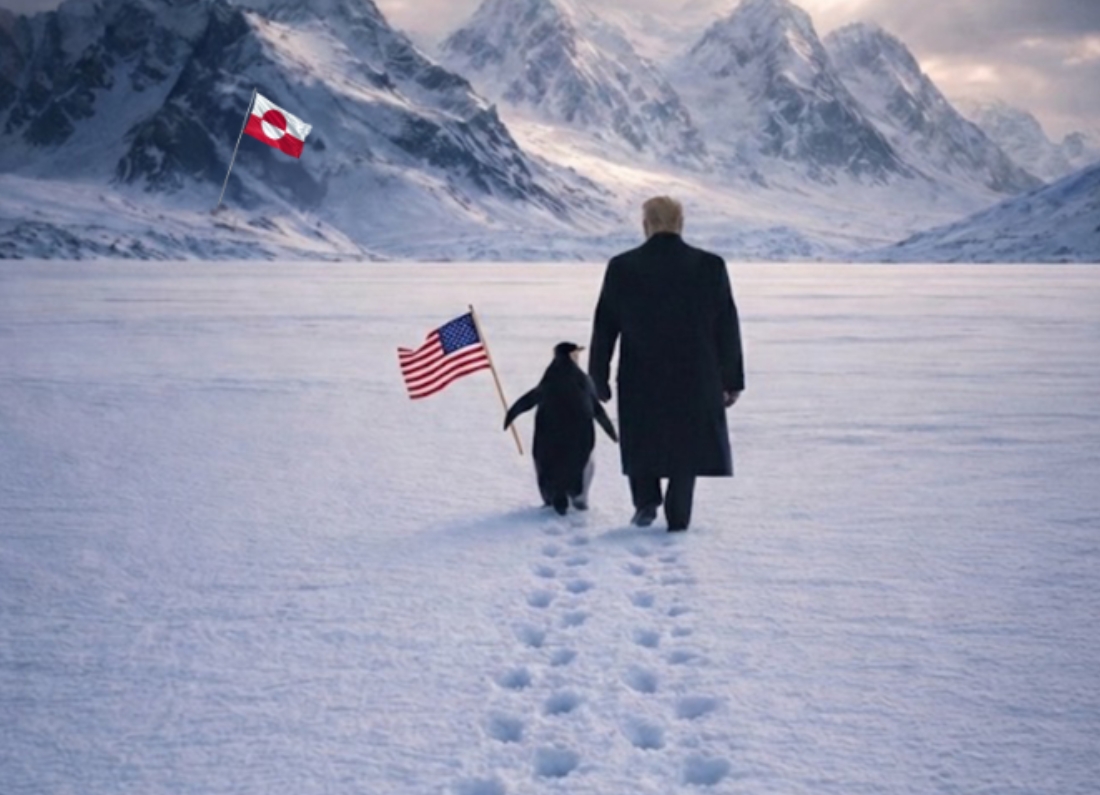
A Reform UK politician aiming to become London’s next mayor has echoed a viral White House meme featuring Donald Trump and a penguin, posting her own version of the image with snowy London landmarks and a Union Jack.
Laila Cunningham, a Westminster councillor who has been announced as Reform UK’s candidate for the 2028 London mayoral election, shared the edited image with the caption: “Choose a new path for London. Before it’s too late.”
The post landed amid a broader online wave of “nihilist penguin” memes and renewed scrutiny of the Trump administration’s messaging over Greenland, after the White House account shared an AI-generated picture of Trump walking alongside a penguin carrying a US flag, with a Greenland flag visible in the distance. The White House caption read: “Embrace the penguin.”
The White House post and why it went viral
The image shared by the White House leaned into a meme trend built around footage of a lone penguin walking away from its colony in Antarctica, which internet users have reinterpreted as a bleak, deadpan symbol of stubbornness or resignation.
The White House post attracted rapid pushback and ridicule online, including basic factual corrections. Penguins do not live in Greenland or anywhere in the Arctic, and Greenland does not have native penguin populations.
After the initial backlash, the White House doubled down with a follow-up line that was widely reposted: “The penguin does not concern himself with the opinions of those who cannot comprehend.”
The Greenland backdrop
The meme did not appear in a vacuum. It followed weeks of diplomatic noise around Greenland and the Arctic, after President Trump revived rhetoric about the United States acquiring Greenland and triggered alarm among allies.
In Davos, Trump met NATO Secretary General Mark Rutte, and later described a vague “framework of a future deal” relating to Greenland, framed as a step back from tariff threats and escalating language. Reuters reported that Rutte played a key role in steering NATO through the episode.
The “framework” language has been met with scepticism in some quarters, while European leaders and markets reacted to the sense that immediate tensions had cooled.
It is in that context that the White House’s “embrace the penguin” post was interpreted by many as either trolling, a deliberate nod to meme culture, or a political wink suggesting the Greenland story was not fully over.
Cunningham’s version and the UK political angle
Cunningham’s recreation of the image moved the meme from US political theatre into a UK campaign setting. Her edited version replaced the original backdrop with snow-covered London imagery and added a Union Jack. The framing was clearly campaign-style: she inserted her silhouette and positioned the slogan as a warning about London’s direction.
Reform UK has increasingly leaned into online-first campaigning and culture-war style messaging, particularly on issues it believes cut through on social media. Cunningham, in particular, has drawn national attention since being named as the party’s London mayoral pick, including controversy around comments on policing and how London handles identity and security issues.
Supporters of Cunningham’s approach argue that memes and viral formats are now just another political language, especially for reaching voters who do not follow formal press conferences or policy papers. Critics counter that importing a White House meme into a London mayoral message risks looking unserious, or at least confusing, when the image itself has no clear connection to transport, housing, policing, or City Hall powers.
Why memes have become political tools
Political parties have always tried to borrow the dominant media style of the day. What has changed is speed, and the fact that images can reach millions without the traditional gatekeepers of broadcasters or newspapers.
A White House post can now set a tone for online discourse within minutes, and political actors elsewhere can copy and localise it just as fast. Cunningham’s “London” penguin is a neat example of that: the same meme template, reworked to suggest a choice between two paths, with the candidate presenting herself as the alternative.
The risk, however, is that meme politics can blur into pure signalling. If a post is designed mainly to generate attention or to reassure a base that “we get the internet”, it may generate engagement without actually communicating anything testable or specific. That matters for mayoral politics, where voters are often looking for practical answers on crime, public services, planning, and the cost of living.
What to watch next
There are two separate stories now running in parallel.
The first is the US story: whether the Greenland “framework” settles anything in practice, or whether the issue resurfaces in a more confrontational form later.
The second is the UK political story: whether Cunningham’s campaign continues to mirror Trump-style online tactics, and whether that approach helps Reform UK broaden support in London, where the party has historically struggled compared with its performance in some other parts of England.
For now, the episode shows how quickly political messaging travels. A viral AI penguin posted by the White House has already been repurposed into a London mayoral campaign moment, proving that in modern politics, the distance between international diplomacy and local elections can sometimes be one meme away.
You may also like: UK by-elections explained: what happens when MPs defect



Leave a Reply