Nigel Farage’s bruising encounter with an American congressman has started circulating again more than a year after the Reform UK leader travelled to Washington to warn US lawmakers about what he called Britain’s increasingly authoritarian approach to free speech.
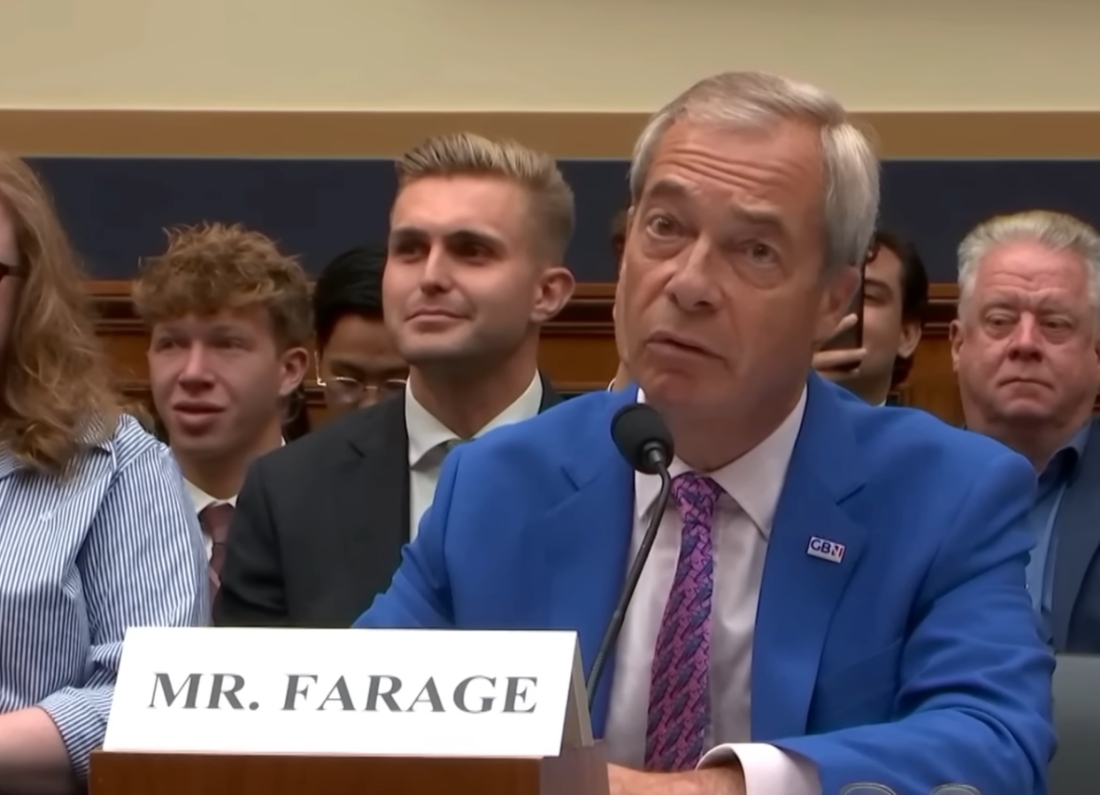
Farage appeared before the House Judiciary Committee on 3 September 2025 at a hearing titled Europe’s Threat to American Speech and Innovation, where he criticised the UK’s Online Safety Act and argued that British and European regulation risked restricting speech protected under the US Constitution.
The Republican-led hearing gave Farage an opportunity to make a case he has repeated frequently since: that Britain is heading in a dangerous direction on free expression and that American politicians and companies should pay attention.
But Democratic congressman Jamie Raskin had a rather different view of Farage’s credentials as a defender of liberty.
In an opening statement that has now gone viral again, Raskin described him as a:
“Putin-loving free speech impostor and Trump sycophant.”
He then urged British voters to look at what Donald Trump and the MAGA movement were doing in America before assuming Farage would protect their freedoms at home.
Raskin turned Farage’s free-speech argument back on him
Raskin’s attack was not simply an argument over the Online Safety Act. His broader case was that Farage’s record did not match the image of an uncompromising free-speech absolutist.
He pointed out that Farage was able to criticise the British government on television, attack existing laws and repeat controversial arguments about Russia without being prevented from doing so. He also questioned why the Reform leader had travelled to Washington to make his case while the British Parliament itself was sitting.
Later in the hearing, Raskin challenged Farage over his support for preventing a pro-Palestinian demonstration close to Remembrance Sunday.
Farage argued that the timing was particularly sensitive. Raskin’s response was to question how that fitted with a broad defence of offensive or unpopular speech, telling him that protecting expression people consider insensitive is precisely where free-speech principles become difficult.
The Democrat also raised reports that journalists from publications critical of Reform had been excluded from party events.
Farage denied personally banning journalists and said he could not remember excluding anyone during his political career, although he acknowledged that other people within the party may have made such decisions. On the same day, journalist James Ball said he had been informed he would not be allowed to attend Reform’s conference despite applying for accreditation months earlier.
Why did Raskin call him ‘Putin-loving’?
That description was Raskin’s political judgement, rather than a neutral statement of fact, but it drew on comments Farage has made repeatedly about Vladimir Putin and the war in Ukraine.
During a BBC Panorama interview in 2024, Farage said he disliked Putin personally but had previously admired him “as a political operator”. He also argued that the eastward expansion of NATO and the European Union had helped provoke Russia’s invasion of Ukraine.
Farage said:
“We provoked this war.”
He immediately added that the invasion was “of course” Putin’s fault and has rejected accusations that he is an apologist for the Russian president. His argument is that Western governments helped create the conditions Putin later used as justification for war, not that Russia was entitled to invade Ukraine.
That distinction has not stopped his opponents accusing him of repeating Kremlin talking points, and Raskin used it aggressively during the congressional hearing.
Farage’s relationship with Trump was an obvious target too
Farage has long had unusually close links to Donald Trump by the standards of a British political leader and has repeatedly appeared at events involving Trump and the American right.
That relationship was part of the reason his decision to take his free-speech argument to Washington attracted so much criticism back in Britain. Raskin’s accusation was essentially that Farage was warning Britain about authoritarianism while aligning himself with an American political movement that Democrats believe is itself eroding democratic freedoms.
Farage and his supporters would reject that completely. They argue that Trump has been targeted by political institutions and that the more immediate threat to freedom comes from governments regulating online speech, criminalising controversial expression and allowing police to investigate social-media posts.
The hearing therefore became something broader than an argument about one British law. It turned into a clash between two completely different definitions of what currently threatens free expression.
The clip has found a second life online
@reformexposed wrote:
“Richard Tice! Sarah Pochin! Andrea Jenkyns! David Bull! Darren Grimes can you hear me? Lee Anderson! Your boy took one hell of a beating!”
Richard Tice! Sarah Pochin! Andrea Jenkyns! David Bull! Darren Grimes can you hear me? Lee Anderson!
“This dude turned up with receipts. Nigel wasn’t counting on that, face like a slapped arse 🤣”
@JOwusuNepaul said:
“The most eloquent and passionate dismantling of the Farage project the world has heard since his election.”
And @DrMarianaClaire asked:
“Hey @Nigel_Farage, need some ointment for that burn ??”
Those reactions were originally posted when Farage appeared before Congress in September 2025 and have been recirculated alongside the video.
The argument looks even more relevant now
More than a year later, Farage is in a considerably more powerful political position than he was when Raskin addressed him.
Reform has become a major force in British politics, Farage remains one of the country’s most prominent advocates for changing speech laws, and his relationship with Trump’s political movement continues to distinguish him from the leaders of Britain’s other major parties.
At the same time, he is receiving far more scrutiny than he did when Reform was primarily a protest party. That includes questions over party funding, his own £5m personal gift and the gap between Reform’s anti-establishment positioning and the extraordinary sums now available to it from wealthy donors. Farage was questioned by Parliament’s standards commissioner over the gift earlier this month and denies wrongdoing.
Jordon Scott is a digital media specialist and editor at The Daily Britain. He focuses on political coverage, platform strategy, and ensuring journalism remains accessible without compromising editorial standards.
He oversees publication structure, reach, and transparency across the site.







Leave a Reply