

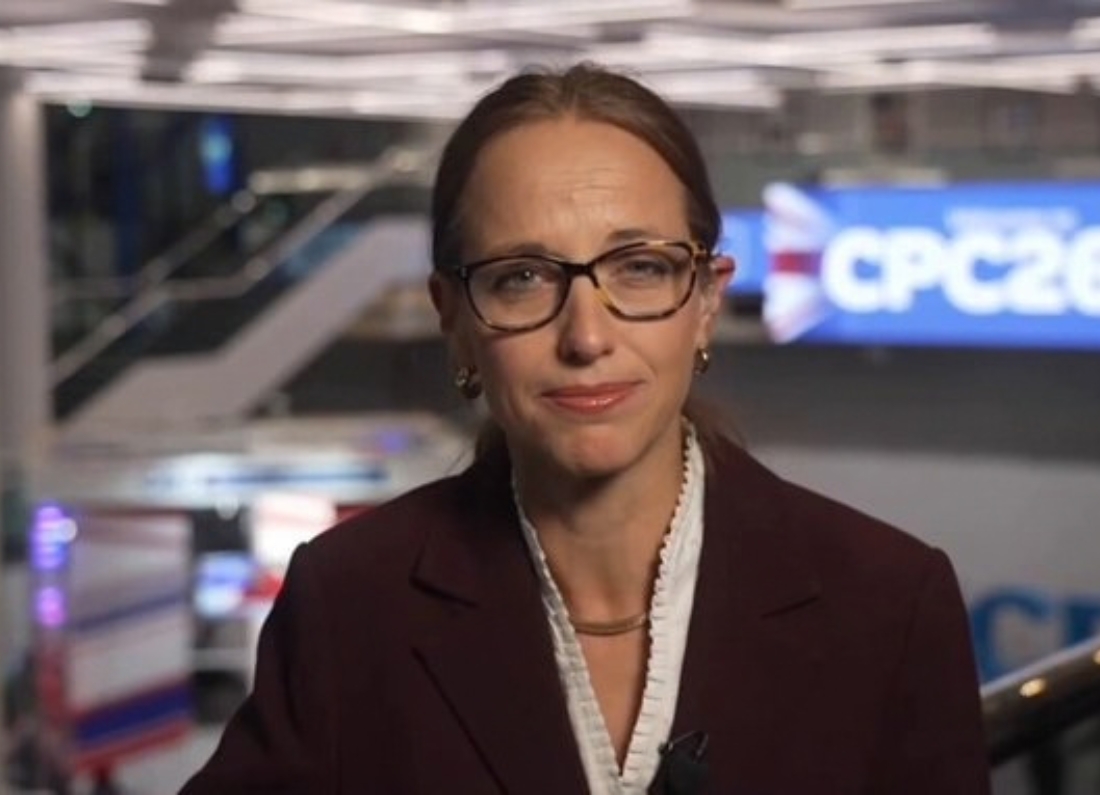
Krishnan Guru-Murthy left Helen Whately with an awkward question on Channel 4 News after the Conservative frontbencher tried to explain how Kemi Badenoch plans to diagnose what has gone wrong with Britain.
Whately, the shadow work and pensions secretary, was discussing Badenoch’s new political prospectus, The Right Way, as the Conservatives gathered for their annual conference in Birmingham. The document is Badenoch’s attempt to set out the intellectual case for a renewed Conservative government, arguing that Britain began taking the wrong path under Tony Blair rather than during Margaret Thatcher’s reforms of the 1980s.
But Guru-Murthy had a rather simpler question.
He asked:
“How long do you think its going to take for people to forget you ran the country for 14 years?”
Whately replied:
“Kemi has published an essay called The Right Way, really thinking about what’s gone wrong with the country.”
It was only 19 words from Guru-Murthy, but the exchange immediately spread online because it distilled one of the central problems facing the Conservatives into a single sentence.
You can watch the full interview here.
Badenoch wants voters to see a ‘new Conservative Party’
The Conservatives governed Britain continuously from 2010 until their heavy general election defeat in 2024, first under David Cameron and then Theresa May, Boris Johnson, Liz Truss and Rishi Sunak.
Badenoch is now trying to persuade voters that the party has changed enough to deserve another hearing.
Speaking as conference began, she said:
“We’re not the party that the public said no to in 2024. We are a new Conservative Party.”
Her pitch has mixed familiar Conservative themes around lower taxes, smaller government and personal responsibility with much tougher proposals on welfare, prisons, immigration and regulation. She has described herself as an “old-school conservative” and insisted that while policies may change, the party’s underlying principles do not.
The problem Guru-Murthy identified is that Conservatives cannot easily present themselves as detached observers diagnosing Britain’s problems when they spent more than a decade in charge of the country.
That does not mean every problem Britain faces was created between 2010 and 2024, nor does it mean Labour governments before or since bear no responsibility. But any argument about the state of public services, growth, housing, Brexit, taxation or government capacity inevitably runs into questions about decisions taken during those 14 years.
‘The Right Way’ looks back to Thatcher
Badenoch’s new document is deliberately framed as a Thatcherite intervention.
The Right Way echoes Margaret Thatcher’s 1976 policy document The Right Approach, and Badenoch has used conference to argue that the country needs a renewed commitment to private enterprise, deregulation and a smaller state.
That approach has already produced some striking policy proposals.
Shadow chancellor Andrew Griffith has announced plans to abolish Natural England and the Environment Agency, scrap a series of environmental and planning regulations and unwind net-zero requirements which Conservatives argue have pushed up costs and prevented development.
The party has also proposed cutting overseas aid dramatically to help fund tens of thousands of additional prison places, widening free childcare eligibility for high earners and taking a tougher approach to welfare spending.
Badenoch says these ideas demonstrate that the Conservatives have learned from defeat and are prepared to make difficult decisions.
Opponents have a much more obvious response: if the Conservative analysis of Britain’s decline is correct, how much responsibility does the Conservative Party itself accept for it?
That was essentially Guru-Murthy’s question to Whately.
The 14-year record remains difficult to escape
One example raised at Conservative conference illustrates the difficulty.
Badenoch’s party is promising 50,000 additional prison places, arguing that a dramatic expansion is needed to stop offenders being released early.
But during the Conservatives’ 14 years in office, England and Wales gained only around 500 prison places on a net basis, after 14,142 additional places were offset by 13,660 spaces being lost, largely because facilities became unusable or were closed.
The Conservatives can reasonably argue that the present leadership should not be held personally responsible for every decision made by previous Tory governments. Badenoch herself did not become an MP until 2017 and was not party leader during any of those administrations.
But Whately was first elected in 2010 and served in several Conservative governments, including ministerial roles in health and social care.
More broadly, much of Badenoch’s frontbench consists of politicians who either served in government or supported Conservative administrations during the period the party is now trying to move beyond.
That makes the distinction between “the old Conservatives” and Badenoch’s “new Conservative Party” difficult to maintain under questioning.
The internet enjoyed Guru-Murthy’s question
The clip was shared by @implausibleblog, who added a lengthy criticism of the Conservative record before highlighting the exchange.
A number of viewers were rather taken with Guru-Murthy’s question.
@khan03_08_2002 wrote:
“They should be experts in why we’ve failed as a country over the last 14 years.”
@RyanEL73 said:
“They’re just sales people with nothing to sell.”
@FATMILLER62 wrote:
“I really hope the Tories keep rolling out hopeless Helen who really should be given a British comedy award, I love her interviews.”
@MartinSpit36640 added:
“They’ve lost their way and lost any purpose they ever thought they had. They really need to take a long walk into the wilderness”
@PB93470 offered a rather more sarcastic assessment:
“Helen Whateley is surely one of the great political brains of our era.”
And @Stoorie2 replied directly to the Conservatives with:
“‘Hollowing Out’ era”
Conservatives are trying to move beyond 2024
There are signs that Badenoch has at least stabilised her own position inside the party.
This year’s Conservative conference has been less dominated by leadership speculation than previous gatherings, and MPs appear more united behind her after a difficult period in which Reform UK threatened to push the Conservatives into third place permanently.
The party also has an obvious political opportunity. Reform has slipped in several recent polls, while many voters remain unconvinced by Labour despite the improvement in its ratings since Andy Burnham became prime minister.
But rebuilding a party after a historic election defeat requires more than announcing a new programme. Voters also have to believe the people offering the solution understand why they were rejected in the first place.


Leave a Reply