

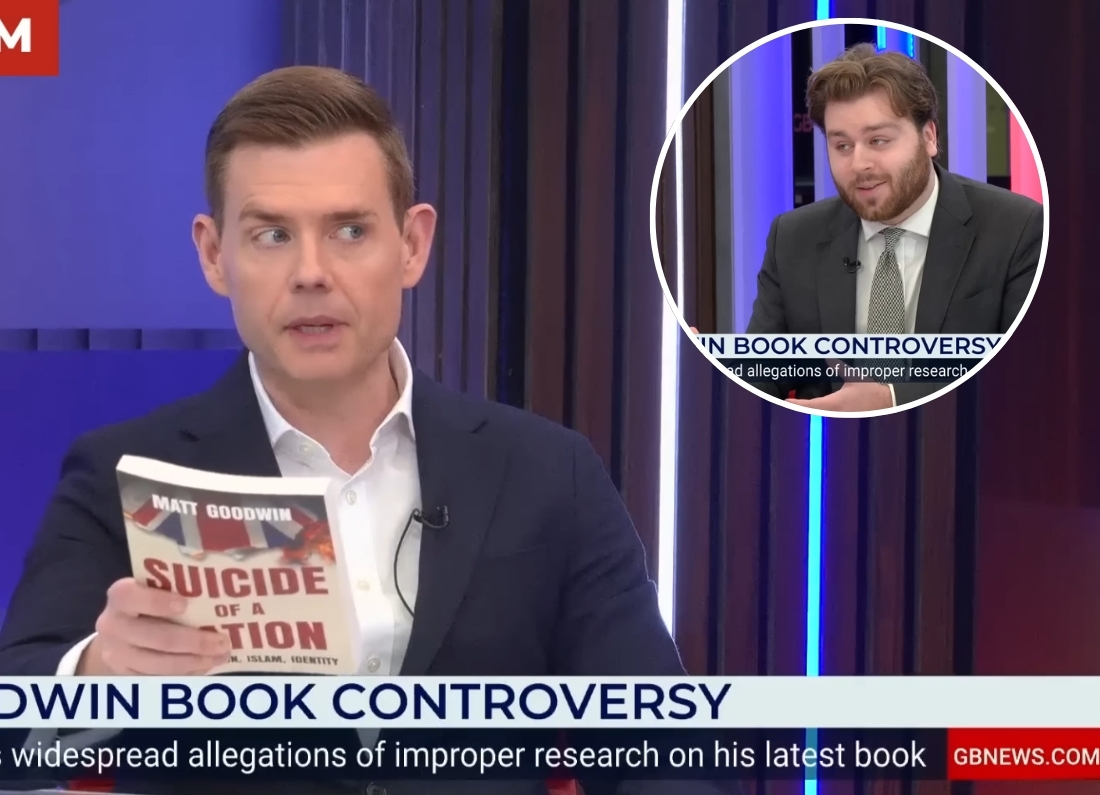
There are bad weeks, and then there is the week Matt Goodwin has just had. The former academic turned Reform UK commentator has been branded “MattGPT” across social media, lost a bruising live debate on his own television channel, and – as a final indignity – been named among GB News’s “Triggered Tantrums of the Week” by his own colleagues.
It is the kind of friendly fire that is genuinely difficult to recover from.
How it all started: the book
The trouble began when Goodwin published his latest work, Suicide of a Nation: Immigration, Islam, Identity – a self-published polemic arguing that Britain is in civilisational decline driven by mass immigration and multiculturalism. The book is dedicated to the “Forgotten Majority,” and its description promises “mass uncontrolled immigration, porous borders, two-tier multiculturalism, and a draconian regime of censorship” as the drivers of national collapse.
The problem was not the argument. The problem was what readers found when they actually looked at the evidence underpinning it.
Political writer and broadcaster Andy Twelves was only five chapters in when he published a lengthy thread on X documenting what he described as “a huge amount of what appears to be false quotes and basic misinterpretations of data that appear to be AI hallucinations.”
And then came the smoking gun: several of the book’s footnotes contained ChatGPT in the URL – making it unambiguously clear that at least some of Goodwin’s sources had been generated by the AI chatbot rather than located in any library or academic database.
There are only 12 footnotes in the entire book. Two contain ChatGPT source information in their URLs, and five are links to Goodwin’s own Substack posts. For a man who spent nearly a decade as a professor of politics at the University of Kent, it was a remarkable citation record.
The fake quotes
The most damaging finding was not the ChatGPT URLs – it was the quotes. Twelves and other readers identified multiple passages in which Goodwin attributed quotations to major historical and intellectual figures that simply do not exist in any verifiable source.
Quotes attributed to Roman statesman Cicero, economist Friedrich Hayek, political theorist James Burnham, and philosopher Roger Scruton could not be found in any primary text or reliable secondary source. For example, Goodwin’s book features the line: “The most dangerous experiments are those conducted on entire societies” – attributed to Hayek. There is no evidence Hayek ever wrote or said anything of the sort.
Goodwin also attributes to American lexicographer Noah Webster the line: “Language is the tie that connects past with future, and binds together the citizens of the same nation.” Webster’s actual line, from his documented writings, was: “A national language is a band of national union.” The two are not the same.
In a particularly telling detail, one writer asked ChatGPT itself about the Webster quotation. The chatbot initially claimed the quote was from Webster’s work – but when pressed for a source, admitted it was “attributed to him” but “not found verbatim in his major writings,” cautioning that it should be avoided as a direct academic citation. In other words, ChatGPT applied more rigorous sourcing standards to the quote than Goodwin did in a published book.
Goodwin’s response – and how it made things worse
When the allegations surfaced, Goodwin went on the offensive on X, accusing critics of being “notorious left-wing activists” trying to suppress a “bestselling book that points out clearly and with evidence the truth.” He insisted the book was “based on official UK census data and the very same projections used by the Office for National Statistics.”
He also claimed he used AI only “to obtain datasets” and that this was standard practice. But when challenged to name the “top demographers” who had peer reviewed his findings, he was unable to name a single one on camera.
In what became perhaps the most widely shared moment of the entire affair, Goodwin attempted to defend himself against accusations that his book was written with ChatGPT – by reading aloud a statement he had asked ChatGPT to write on his behalf.
The GB News debate
Sensing that the controversy needed to be addressed head-on, Goodwin agreed to a live debate on GB News with Andy Twelves. It did not go as he might have hoped.
Twelves opened by stating plainly: “Claims about immigration levels, welfare use, language decline, even baby names are just false. If you’re going to open your book up with a quote about Arnold Toynbee and the suicide of nations, you might want to make sure your own argument isn’t built on intellectual self-harm. This isn’t political. It’s just about truth.”
The debate was chaired by Miriam Cates – a Conservative MP whom Goodwin might reasonably have expected to be sympathetic – but who, as The Spectator noted, “treated him with admirable rigour and dispassion.” Tim Montgomerie, a prominent conservative commentator and hardly a critic from the left, compared the affair to Rachel Reeves’s “dodgy footnotes” and called for an inquiry.
When pressed to name the demographers who had verified his findings, Goodwin could not produce a single name. Twelves asked, with some relish, whether Goodwin needed to consult ChatGPT to identify who the world’s leading demographers were.
And then GB News turned on him too
If the debate was a bruising experience, what came next was pure humiliation. During a Saturday evening segment on GB News, host Cai Wilshaw named Goodwin among the channel’s “Triggered Tantrums of the Week” – a comic segment reserved for those deemed to have embarrassed themselves publicly.
The clip, which quickly spread across social media, shows the host and four panellists reacting with visible amusement. For a man whose primary media home is GB News, being mocked by his own channel – on a segment specifically designed to ridicule – represents a new depth to an already terrible stretch of weeks.
It caps a period that has seen Goodwin accumulate a growing collection of unflattering nicknames. After losing the Gorton and Denton by-election to Green candidate Hannah Spencer last month by more than 4,000 votes, he became “Matt Badloss” online. Now, with the book controversy in full swing, he has been rechristened “MattGPT” – a nickname that, as The Spectator observed, may well follow him for the rest of his career.
You can watch it in full below:
The bigger question
Beyond the personal embarrassment, the affair raises a genuine question about intellectual standards and the use of AI in publishing. Goodwin is far from the first author to lean on AI tools in research, and he is unlikely to be the last. But the combination of unverifiable quotes, minimal citations, ChatGPT URLs left visible in footnotes, and an inability to name a single peer reviewer when challenged under scrutiny represents a particularly comprehensive collapse of the standards expected of someone presenting themselves as a serious writer on serious subjects.
As one critic put it: “This is about more than a bad book by Reform’s notorious bad loser. If these falsehoods go unchallenged, they pile up over time and ossify into received wisdom, raised as proof purely because someone stuck them between hard covers.”
Whether Goodwin can rehabilitate his reputation from here remains to be seen. For now, the nickname has stuck, the GB News clip is circulating, and the questions about his sourcing remain unanswered. The book may be selling – but for rather different reasons than its author intended.
You may also like: Nigel Farage heckled repeatedly at Reform’s London local election launch in Croydon




Leave a Reply