

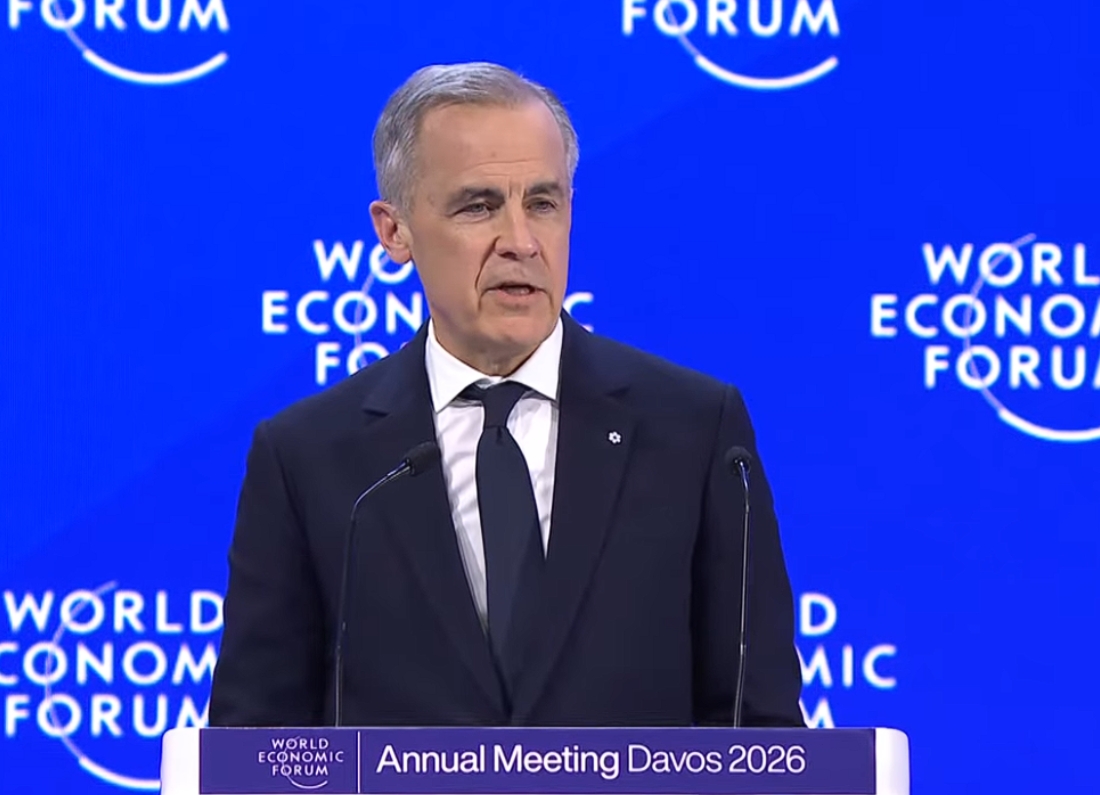
Mark Carney delivered one of the starkest speeches of the Davos summit so far, warning that the “rules-based international order” is no longer functioning as it once did, and arguing that countries can no longer pretend the old assumptions still hold while great powers openly use trade and security as leverage.
Speaking against the backdrop of rising transatlantic tensions driven by Donald Trump’s escalating push over Greenland, Carney framed the moment as something deeper than a normal diplomatic wobble – and urged leaders to stop acting as if the world can simply “transition” back to business as usual.
🌍 Davos gets a warning, not a pep talk
Carney’s central argument was blunt: the world is facing a rupture. He said that for decades, countries like Canada benefited from a system that was “partially false” but still useful – because it delivered enough stability and predictability for governments to pursue values-based foreign policy without constantly fearing economic punishment.
He told the room that many countries participated in the rituals of the post-war order, even while quietly acknowledging its contradictions – and that bargain has now collapsed.
🧱 “We lived inside a useful fiction”
In one of the most quoted sections of the speech, Carney described how the system’s power depended less on truth and more on collective performance – as if everyone agreed to keep the sign in the window even when reality didn’t match the slogan.
He said the world knew the strongest states would exempt themselves when convenient, that rules were enforced asymmetrically, and that international law was applied with “varied rigour” depending on who was involved – but leaders carried on because the fiction still produced outcomes.
Carney’s message was that the pretending no longer works.
💼 Trade is now a weapon, and everyone can see it
Carney said the shift is now out in the open: “great powers” are using economic integration as a tool of coercion, turning “tariffs into leverage” and exploiting supply chains and financial infrastructure as pressure points.
That framing lands directly in the current Greenland stand-off, where Trump has repeatedly treated trade threats as a way to force political submission, and where European leaders have been wrestling with how to respond without inviting escalation.
🧊 Greenland hangs over the summit
Carney didn’t need to name Greenland repeatedly for the subtext to land in the room. Davos is full of leaders trying to avoid a direct rupture with Washington while also refusing to publicly legitimise the idea that a territory can be pressured, purchased, or bullied into changing hands.
His warning – that you cannot rely on “mutual benefit through integration” when integration becomes “the source of your subordination” – was effectively a summary of the dilemma facing smaller allies when a superpower decides rules are optional.
🧠 Why the speech is cutting through
Carney’s speech is being widely shared because it doesn’t dress the moment up as a misunderstanding that can be smoothed over by nicer language. It describes a world where institutions still exist, but confidence in the guardrails has weakened – and where leaders have to decide whether they are going to keep performing diplomacy as theatre, or start dealing with the new reality.
That doesn’t mean Carney offered an easy solution. But it does explain why his remarks have resonated: he articulated what a lot of leaders are privately thinking while publicly trying to sound calm.
🔭 What happens next
The immediate test is whether European leaders can maintain a united line on Greenland while navigating Washington’s pressure tactics – and whether the wider transatlantic relationship can survive a period where tariffs, threats and “national security” claims are used as tools of influence rather than last-resort measures.
Carney’s underlying point is that middle powers need to adapt fast: diversify dependencies, reduce exposure to political mood-swings in major capitals, and stop acting shocked when leverage is used.
You may also like: Gavin Newsom urges Europe to ‘stand tall’ against Trump






Leave a Reply