

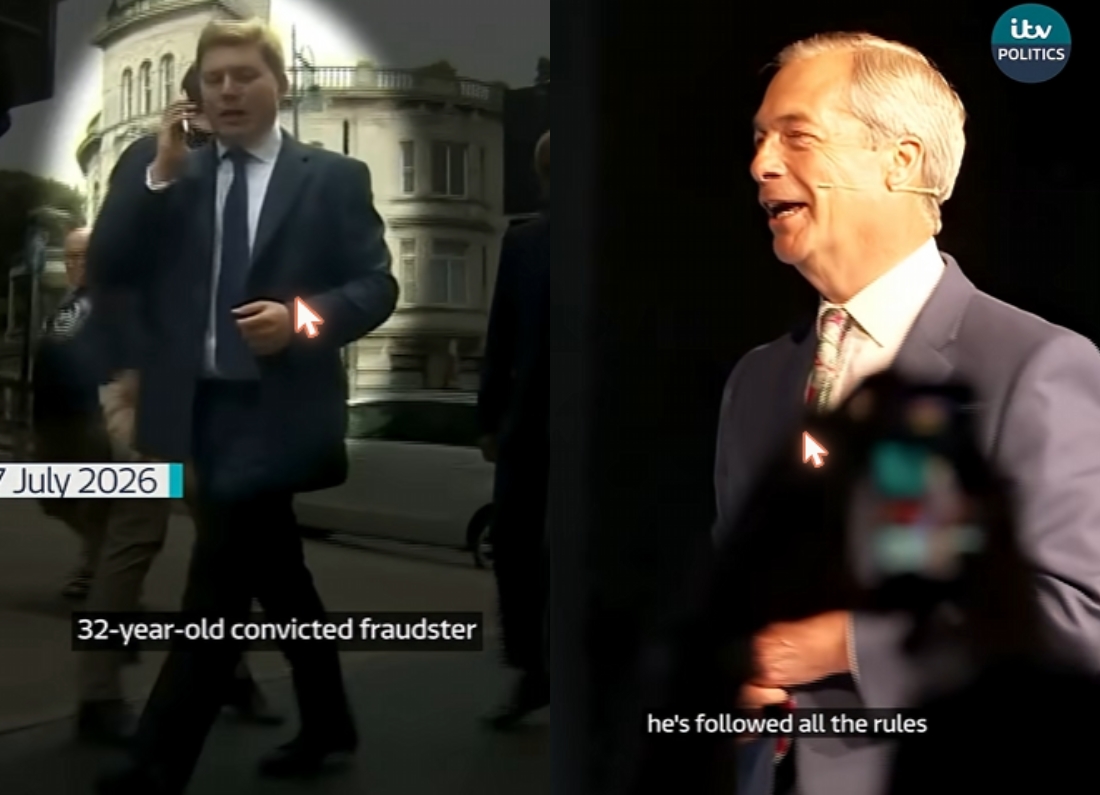
A betting account carrying George Cottrell’s name received almost $9 million in cryptocurrency from unidentified sources, at the same time Cottrell was providing gifts and benefits to Reform UK leader Nigel Farage, according to new reporting from the Financial Times.
Cottrell is a British aristocratic banker and convicted fraudster who’s already at the centre of a separate police investigation into donations made to Reform. In October 2024, the Polymarket account “GCottrell93” received roughly $8.8m from two separate wallets, money that was then used to bet on Donald Trump winning the US presidential election. Shortly after Trump’s victory, the bet returned $4.46m in profit, and almost all of it was then moved out into two different wallets.
Nobody has explained who actually put the original money in, or who ended up with the winnings once they came out. That absence of an answer is now the third or fourth time in this saga that a large sum connected to Cottrell has arrived from somewhere unidentified and then moved on just as opaquely.
Who George Cottrell actually is
Cottrell, 32, was convicted of wire fraud in the United States in 2017 after offering to launder money on the dark web, and served time in an American prison as a result. He’s a tax resident in Montenegro, where he’s become known locally as “Posh George,” and where he’s closely involved in the crypto-gambling scene, including Tether.bet, an offshore platform accepting bets in Tether, the cryptocurrency partly owned by Christopher Harborne, the same billionaire who gave Farage his own undisclosed £5m gift shortly before the 2024 election. Cottrell also places private bets for wealthy business associates and owns Geostrategy, a political consultancy operating between London and Delaware.
None of that background was widely known publicly until a Sunday Times Insight investigation this month revealed the true extent of Cottrell’s relationship with Farage: years of quietly funded staff, security, transport, social media production and accommodation, none of it declared when Farage entered Parliament in 2024, an apparent breach of the rules governing new MPs.
Cottrell’s already-established links to Farage
Cottrell reportedly recruited and paid three staff to run Farage’s social media in the run-up to the general election, and has continued letting him use a five-storey Georgian property he rents near Buckingham Palace. The relationship was well known within Westminster circles for years before it became public, and it’s this same relationship that now sits behind the most serious threat to Farage’s political future: a Parliamentary Standards investigation into whether all of this support should have been declared, an inquiry paused only because Farage resigned as Clacton’s MP and triggered a byelection, and which can resume the moment he’s re-elected.
This new betting account raises an obvious question on top of everything already reported: where is this 32-year-old’s money actually coming from, and is it possible funds from other people entirely have been flowing through him to fund gifts, donations or support for Farage.
What Cottrell won’t say
According to the FT, Cottrell declined to answer who actually beneficially owns the Polymarket wallet, whether any third party had a financial stake in the bets or the winnings, or whether any of the money went, directly or indirectly, towards travel, staff, security, accommodation, loans, gifts or any other support for Farage or Reform. His lawyers, Carter Ruck, said he wouldn’t comment on his financial affairs or on specific transactions, and made clear that silence shouldn’t be read as accepting the FT’s reporting.
That’s a familiar pattern from Cottrell by now. Asked previously whether he’d transferred money to his mother before her own donations to Reform, his lawyers gave an almost identical answer: he’d confirmed his instructions that “any donations by his mother have been entirely her own decision,” and would “decline to engage with your wider questions.” The betting account inquiry has been met with the same wall.
Part of a much bigger picture
Both Farage and Reform are already under serious pressure over separate reporting on their finances, and this story doesn’t stand alone so much as slot into an increasingly crowded timeline. Farage is facing formal parliamentary scrutiny over the undeclared support from Cottrell revealed by the Sunday Times, while the Guardian reported earlier this month that bankers had flagged concerns to the National Crime Agency, via suspicious activity reports, over at least four separate transactions involving senior Reform figures.
Those flagged transactions include the £5m gift to Farage from Christopher Harborne, itself the subject of a separate suspended parliamentary standards investigation, and a £1m donation from Cottrell’s mother, Fiona Cottrell, to Britain Means Business, a fundraising vehicle for Reform on which deputy leader Richard Tice sits as a director. Half of that £1m was then passed on to Reform in two £250,000 instalments. Reporting has separately established that George Cottrell opened an account with an obscure Australian payments firm, Oneify, just days before that money began moving, and that Fiona Cottrell received several unexplained six-figure cash transfers shortly before making her own donation, transfers the NCA reportedly couldn’t trace to their actual source, and which it referred to Australia’s own financial intelligence agency for help.
Fiona Cottrell, a 67-year-old self-described “retired stylist” from rural Worcestershire with no prior history of political giving, remains at the centre of a separate Metropolitan Police investigation into whether up to 35% of all funding Reform received during the 2024 campaign was, one way or another, actually routed through her.
The leak allegations cut both ways
Richard Tice has accused the NCA of leaking his and Farage’s private financial information to the press. Cottrell has made a strikingly similar complaint of his own, calling for an investigation into a suspected leak of his personal financial data, saying he’s concerned he may have been the victim of an “unauthorised disclosure” after details of his financial activity ended up in the hands of journalists. He’s formally asked the NCA to check whether any confidential information drawn from its own records could have made its way to the media.
It’s a notable position for Cottrell to take, given that virtually everything currently publicly known about his financial arrangements, the Sunday Times investigation, the Polymarket account, the Oneify payments, has come from journalists piecing together financial records rather than from anything Cottrell or Reform have voluntarily disclosed. Whether that information trail traces back to an NCA leak, or simply to old-fashioned financial reporting, is a separate question the agency itself will presumably have to address.
Where this leaves things
What’s accumulated around Cottrell now spans a Sunday Times investigation into years of undeclared support for Farage, a Metropolitan Police inquiry into his mother’s donations, an NCA referral over the source of those donations, an Australian payments firm opened days before a suspicious transfer, and now a nearly $9m cryptocurrency betting account whose actual owner Cottrell won’t confirm. Individually, each of these threads has its own specific facts and its own unresolved questions. Together, they form the financial backdrop against which Farage is currently asking Clacton voters to re-elect him, and against which the paused parliamentary investigations into both the Harborne gift and the Cottrell-linked support will resume the moment he’s back in the Commons.
Cottrell has offered no account of where the betting account’s money originated or where its profits ended up. Until he does, or until investigators establish it independently, that remains one more unanswered question in a story that already has a considerable number of them.




Leave a Reply