

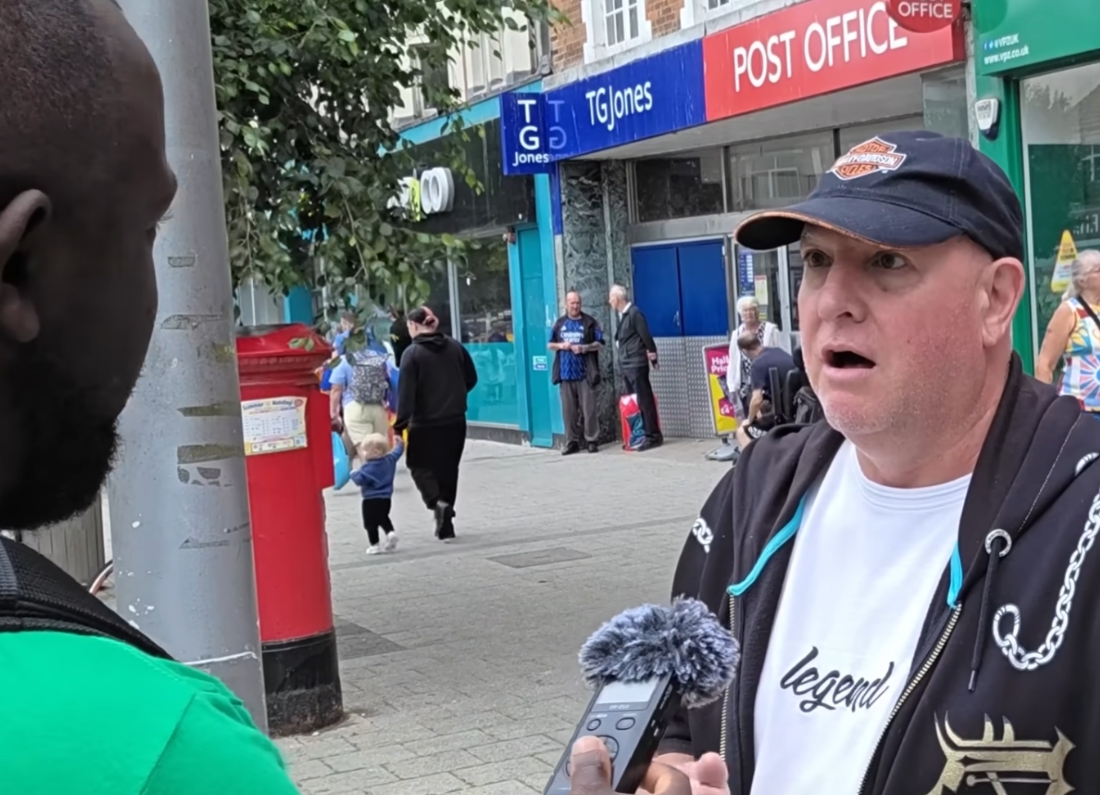
A Clacton voter who opened by calling Nigel Farage “brilliant” admitted he knew little about Reform’s actual policies once Femi Oluwole explained how they could affect his benefits and healthcare.
The lengthy street interview was filmed days before Thursday’s byelection, where Farage is trying to regain the seat he resigned from in July. Femi uploaded it as “Femi convinces Clacton voter NOT to vote Farage.” The footage doesn’t show a firm declaration that the man’s abandoned Farage, but his confidence clearly weakens as the conversation goes on.
He supported Farage without knowing his policies
Asked why he liked Farage, the voter couldn’t point to a single policy or achievement. He said he doesn’t follow local politics closely, just that Farage seems “brilliant” whenever he sees him. Femi treated that the way you’d treat a job application: Farage wants to be prime minister, so his record and actual policies should be judged accordingly.
Brexit came up first, but the conversation quickly moved toward what’s actually dominating this man’s life. A workplace injury ended his career, leaving him on benefits while caring for his bed-bound mother. He talked about his mental health, an upcoming benefits assessment he’s dreading, and the fear of eventually losing his home, plus the constant pressure of finding money for his mother’s care when bills land.
[This section touches on distressing personal experiences. If you’re struggling, Samaritans can be reached free anytime on 116 123.]
It got unusually personal for a campaign interview. At one point he described thoughts of walking into the sea and not coming back. Femi stopped the political questioning there, acknowledged what he’d said, and responded with sympathy rather than pushing on.
What Reform’s actually promising on welfare
When they returned to politics, Femi asked why someone relying on disability support and public services would back a party promising major welfare cuts. That’s not a hypothetical concern. Reform’s 2024 programme promised £15bn a year in benefit savings through tighter assessments and moving over a million people into work, with independent medical assessments for claimants, though those with severe disabilities or serious long-term conditions would be exempt from regular checks. The party’s current policy says welfare should support only British citizens who “cannot get by without government help,” insisting work must always pay more than benefits.
None of that establishes exactly what would happen to this specific voter, that depends on his circumstances and whatever legislation an actual Reform government introduced. It does explain why Femi challenged the assumption that Farage would improve his situation.
The voter first said every party wants to make cuts. Femi disagreed, pointing out real differences between parties on tax, welfare and spending, and urged him to actually look at the policies rather than assume every politician’s identical. “You know he’s going to hurt you. Why vote for somebody who you know is going to hurt you?”
The healthcare footage
Femi then showed him a 2012 clip of Farage, reported at the time by the Guardian, saying Britain would likely need to consider an insurance-based healthcare model and that he’d feel more comfortable getting value through the marketplace than through central government. Farage’s since defended an NHS free at the point of use, and Reform’s 2024 manifesto committed to that principle too. But he returned to the insurance question again in 2025, saying he was open to discussing systems used in countries like France.
For this voter specifically, the footage landed because he’d already said he can’t afford £80 a month for a funeral plan, let alone additional insurance costs. Femi’s point: a wealthy person can navigate a more heavily insured health system far more easily than someone living on £19 a day.
‘I didn’t realise’
The clearest shift came near the end. “I didn’t realise he’s cutting all the benefits,” the voter said after Femi laid out Reform’s approach.
He didn’t suddenly endorse anyone else. He stayed distrustful of politics generally and kept asking who he was actually supposed to vote for, Femi mentioned the Greens and Lib Dems, and the voter dismissed Count Binface as unserious. His closing line on Farage was far less certain than his opening one: “You may have opened my eyes a little, like, to the other side of Nigel.”
Not an explicit promise to vote against him. Evidence that an opinion built mostly on Farage’s public persona had started genuinely wobbling.
How people reacted
Most of the response focused less on party politics and more on the man himself. @LagottoParent: “The guy needed that hug, hope you took him for a cuppa afterwards.” @mark_tolver: “Man, I actually really feel for this guy. He’s just a normal bloke who’s had a run of bad luck and no one to help him and his mum out.” @janewest2845: “Carers like him deserve so much more than the £80 quid a they get. I want my tax helping people like him and his Mum.”
Others picked up on his line that politicians are all the same. @noabsolutes8085: “The times I have heard ‘it can’t get any worse’ but it can.” @Galactic_Queen0 said the exchange showed exactly why the “they’re all the same” argument can be so damaging in practice.
The interview didn’t produce the clean conversion its own title claimed. It showed something less dramatic and more believable: a voter who genuinely liked Farage as a person, forced to actually consider what a Farage government might do to him.
Clacton votes on 13 August.
If you’re struggling or having suicidal thoughts, Samaritans can be contacted free at any time on 116 123.




Leave a Reply