

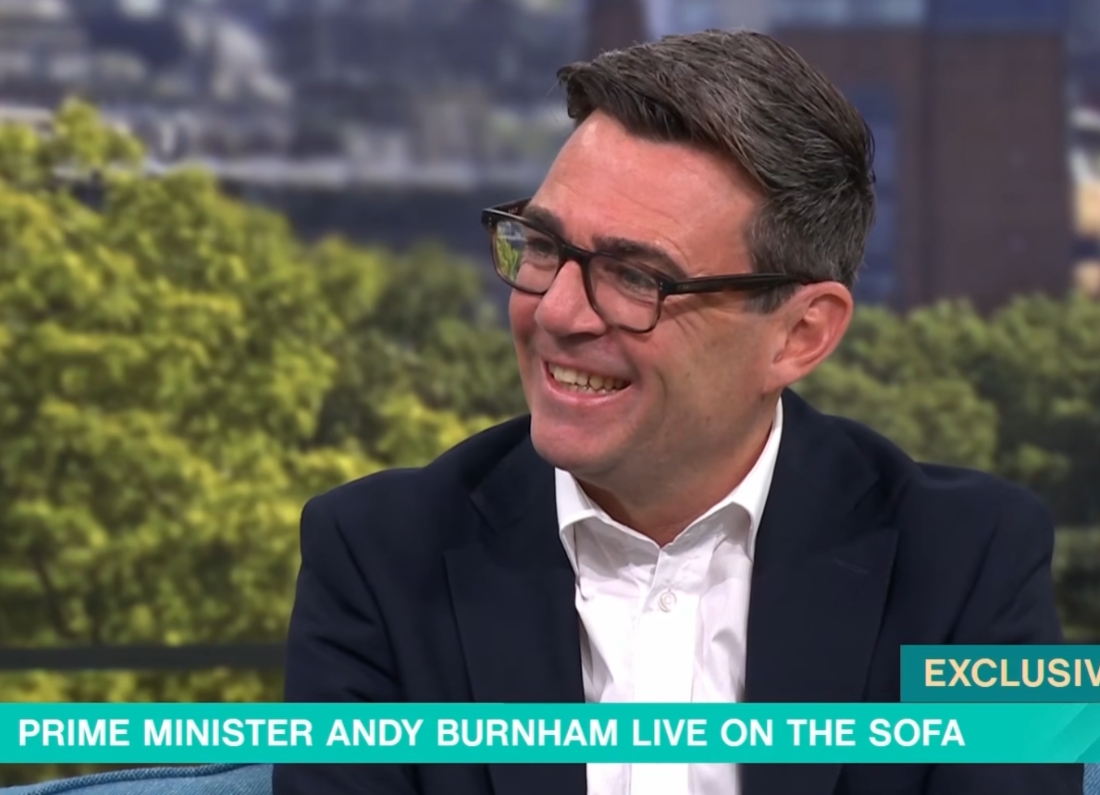
The Prime Minister has revealed further details of his plans to dramatically change how Britain is governed, with a new operation in Manchester set to take a leading role in economic growth and tax devolution.
Speaking to The Times, Burnham said the new northern base would take responsibility for economic growth away from the Treasury as part of his wider attempt to break what he sees as Westminster’s grip over decision-making.
The move will not abolish the Treasury or remove its responsibility for the public finances. Instead, Burnham wants his Manchester operation to take the lead on the government’s growth agenda and work on proposals for devolving greater tax powers around the country.
It represents one of the clearest indications yet that Burnham intends to use his premiership to fundamentally reshape the relationship between Downing Street, Whitehall and Britain’s regions.
And according to the Prime Minister, the changes will be substantial.
“It’s a huge transfer of power,” Burnham told The Times.
What is ‘No 10 North’?
The idea of establishing a northern counterpart to Downing Street has been closely associated with Burnham since his arrival in Number 10.
Rather than operating almost exclusively from Westminster, the Prime Minister wants part of the machinery at the centre of government permanently based in Manchester.
Burnham has previously spent years arguing that Britain’s political and economic system concentrates too much power in London.
His experience as Mayor of Greater Manchester was dominated by battles over devolution, transport funding and the ability of regional leaders to make decisions without constantly seeking approval from Whitehall.
Now he is attempting to apply that argument from the opposite side of the table.
No 10 North is expected to operate from Manchester and become considerably more than a symbolic second office for the Prime Minister.
Burnham’s latest comments suggest it will have a genuine role in shaping economic policy.
Responsibility for driving economic growth will move from the Treasury to the new operation, while officials based there will also lead work examining how greater taxation powers could be devolved.
Burnham described that second task as potentially even more significant.
“It’s a huge transfer of power, but potentially even more significant is the work on tax devolution,” he said.
Burnham takes aim at Treasury control
The Treasury is one of the most powerful institutions in British government.
It controls public spending and taxation and has traditionally exercised considerable influence over the policies pursued by other departments.
Critics of Britain’s highly centralised system have long argued that this gives Whitehall too much control over decisions affecting towns, cities and regions hundreds of miles away from London.
Burnham has been among the most persistent advocates of changing that system.
As Greater Manchester mayor, he pushed for greater local control over transport, housing, skills and public services.
The creation of the Bee Network, which brought buses in Greater Manchester back under local public control through franchising, became one of the most prominent examples of his approach.
Since becoming Prime Minister, Burnham has signalled that he wants to take the principles behind that model nationwide.
His government has already backed greater public control of buses elsewhere in England, including the intervention announced this week to protect services in the West Midlands following National Express’s decision to leave the regional market.
But moving responsibility for economic growth out of the Treasury represents a much bigger intervention in the machinery of central government.
Tax powers could move away from Westminster
Perhaps the most significant long-term part of Burnham’s plan concerns taxation.
Britain remains unusually centralised compared with many other developed countries, with the overwhelming majority of taxation determined nationally.
Local authorities raise council tax and business rates, while devolved governments in Scotland and Wales have varying powers over certain taxes.
English regions, however, have comparatively little ability to raise revenue independently.
Burnham wants that to change.
The Prime Minister said No 10 North would lead work on tax devolution, potentially giving areas outside London greater ability to raise and spend their own money.
Exactly which taxes could eventually be devolved, and to whom, has not yet been settled.
Any substantial transfer would also raise difficult questions about inequality between wealthier and poorer areas.
Regions with a smaller tax base could potentially raise less money locally, meaning any new system would need mechanisms to prevent already disadvantaged communities being left further behind.
But Burnham’s direction of travel is clear: he wants more decisions about regional economies made in the regions themselves.
A ten-year plan for Britain
The Manchester operation forms part of a much wider programme Burnham is preparing to set out.
The Prime Minister is expected to publish a ten-year plan for the country covering economic reform, infrastructure and public services.
Burnham told The Times that he wanted government to take a longer-term approach rather than constantly operating around short political cycles.
He has also signalled support for greater public control over essential services and infrastructure.
That fits a pattern already emerging during the opening weeks of his premiership.
Transport has become an early focus, with the government backing public control of regional bus networks and announcing that disabled bus-pass holders in England will be entitled to free bus travel at any time of day from April 2027.
The wider question is how far Burnham intends to take that philosophy.
Moving economic-growth responsibilities out of the Treasury suggests the answer may be considerably further than simply changing individual policies.
Can Burnham really decentralise Westminster from inside Number 10?
There is an obvious contradiction Burnham will have to overcome.
Prime ministers have repeatedly promised to devolve power away from Westminster, only for Britain’s political system to remain heavily centralised.
Central government departments control enormous budgets, while councils and regional authorities frequently depend on funding settlements determined in Whitehall.
Giving away meaningful power can also mean giving away political control.
Burnham now occupies the most powerful office in the very system he spent years criticising.
His challenge will be proving that No 10 North is more than another government office with a Manchester postcode.
If responsibility, officials and eventually meaningful taxation powers genuinely move with it, the project could represent a significant change in how England is governed.
If the Treasury and Whitehall retain the final say over the important decisions, critics will inevitably question whether anything fundamental has really changed.
Burnham, however, is presenting the project as the beginning of something much bigger.
After years spent arguing that Britain’s economy is too heavily controlled from London, the former Greater Manchester mayor now has an opportunity few advocates of devolution ever receive.
He has the power to do something about it.
And he is promising what he calls a “huge transfer of power” away from the centre.






Leave a Reply