

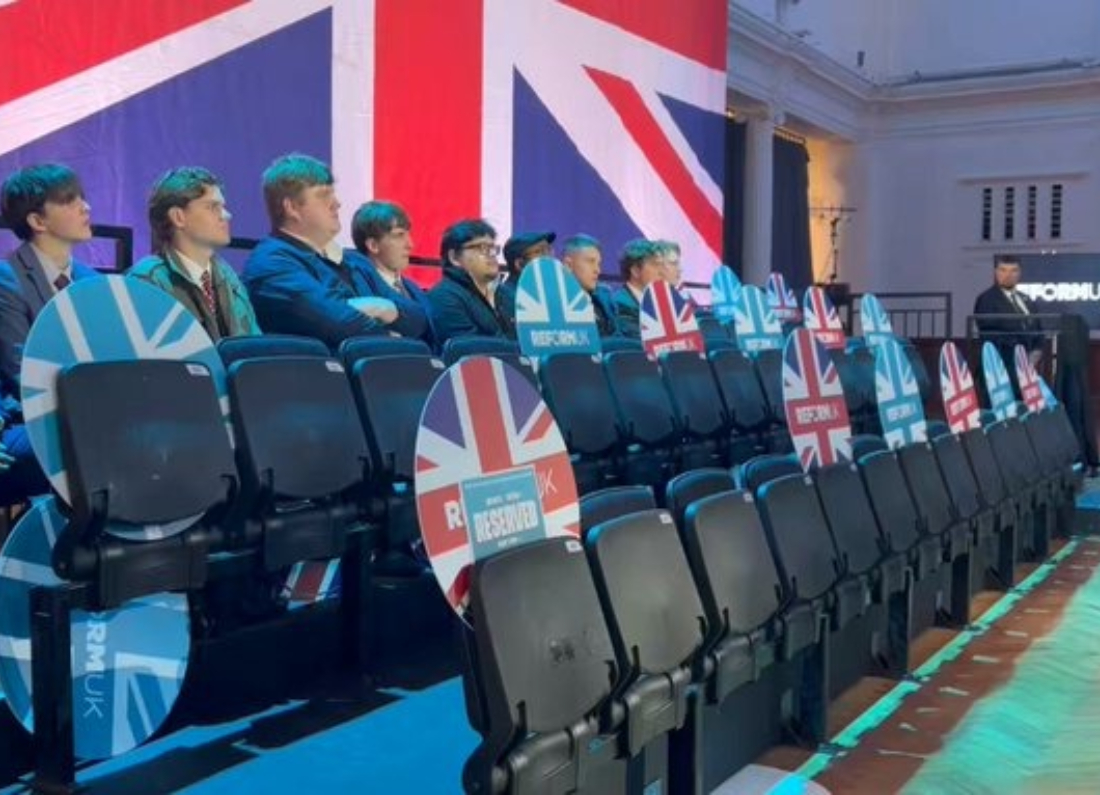
Nigel Farage has blamed his own staff for a poorly attended Reform UK event after the party unveiled its alternative Budget in front of rows of empty seats in Westminster.
The Reform leader was forced to address the embarrassing turnout at London’s Lindley Hall on Monday afternoon, where he appeared alongside the party’s Treasury spokesman Robert Jenrick to launch an economic programme intended to demonstrate that Reform was ready to govern.
Photographs and videos from the event showed large sections of the venue unoccupied, despite the party using the occasion to present what it called its Economic Rescue Plan just two days before Chancellor John Healey’s Budget.
Farage acknowledged the problem when questioned about the attendance, placing the blame firmly on the people responsible for organising the event.
“As for this hall, well, staff incompetence,” he said.
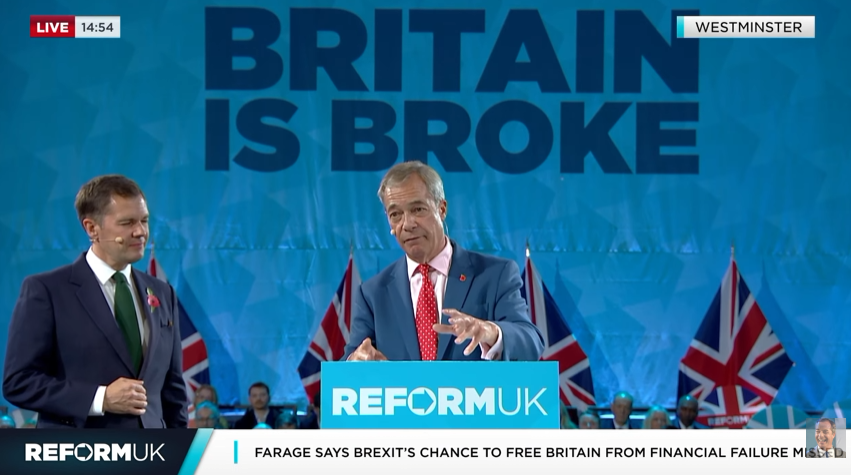
The admission prompted immediate ridicule from Labour and the Conservatives, who seized on the contrast between Reform’s ambitions to overhaul the British government and its apparent difficulty filling a venue for one of its biggest economic announcements.
Farage blames staff for the empty seats
The event was intended to showcase Reform’s economic proposals to businesses and the wider public ahead of Wednesday’s Budget.
Instead, the audience became one of the most conspicuous features of the afternoon.
Images taken inside Lindley Hall showed empty chairs stretching across the room, while journalists attending the event commented on the unusually sparse turnout.
Farage offered an explanation that raised further questions about the planning behind the launch.
“It’s all well and good advertising to businesses but, on Mondays, people who run businesses tend to be rather busy,” he told those present.
He argued that business owners had demanding schedules and that attending an afternoon political event in London could mean sacrificing valuable working time.
“No doubt many of those that are here, it’s going to cost them a very great deal of money to have given up their day to come and visit us here in London.”
Farage also insisted that the party remained capable of attracting substantial crowds, pointing to attendance at Reform conferences and other political gatherings.
But that did little to distract from the photographs emerging from Westminster, which showed a considerably quieter atmosphere than the packed rallies that have become part of Reform’s public image.
Guests reportedly moved to fill the background
The empty seats were particularly awkward because the event was being filmed and photographed for national news coverage.
According to journalists present, attendees were moved into seats behind the podium before Farage and Jenrick addressed the room.
The arrangement meant the section visible behind the speakers appeared better occupied in television pictures, even though other parts of the hall remained sparsely populated.
Footage also showed Farage watching from a balcony while Jenrick delivered part of the presentation.
At one point, the Reform leader could be seen pacing and appearing unimpressed as his colleague spoke to the audience below.
Jenrick attempted to introduce some humour into proceedings, joking that he might watch the former BBC programme Cash in the Attic rather than the Chancellor’s Budget statement on Wednesday.
Farage did not appear particularly amused by the remark.
The images created an unfortunate backdrop to an event at which Reform was attempting to project competence, professionalism and economic credibility.
While an empty room does not determine the merits of a political party’s policies, the contrast between the intended presentation and the actual turnout was difficult to ignore.
Reform unveils an ambitious alternative Budget
Behind the attendance controversy was a substantial attempt by Reform to establish itself as a credible alternative to Labour’s economic programme.
Jenrick presented what the party described as 64 measures intended to encourage economic growth, reduce government spending and cut taxes.
Reform has pledged to reduce annual public spending by £40 billion initially, with reductions eventually rising to £80 billion by the fifth year of a government.
The party argues that the savings could be achieved through changes to welfare spending, the civil service, overseas aid and subsidies associated with the transition towards net zero.
It has also proposed reducing energy costs and introducing tax changes intended to benefit households and businesses.
Jenrick insisted that the government was preparing another Budget that would postpone difficult decisions rather than address Britain’s economic problems.
Reform, he argued, would pursue a fundamentally different approach.
“Reform UK has the plan to make the economy work again: spend less, tax less, borrow less and finally put the British people first.”
The proposals include reversing restrictions on new North Sea oil and gas drilling, abolishing the energy profits levy and changing environmental requirements affecting planning decisions.
Other measures include scrapping the Renters’ Rights Act, reversing certain energy efficiency requirements for new homes and introducing restrictions on low-traffic neighbourhoods.
Reform maintains that its proposals would reduce costs, stimulate investment and encourage businesses to expand.
However, several of the measures have attracted criticism from housing and energy campaigners, who argue that weakening environmental and rental protections could create longer-term costs for households.
Energy campaigners question the party’s proposals
Among the most contentious parts of Reform’s economic programme are its plans to expand fossil fuel production and remove some existing environmental regulations.
The End Fuel Poverty Coalition criticised the proposals, arguing that they would provide significant benefits to the oil and gas industry without guaranteeing lower bills for consumers.
Its coordinator, Simon Francis, questioned whether increasing North Sea production would make a meaningful difference to household energy costs when oil and gas are traded on international markets.
The coalition also raised concerns about Reform’s plans to weaken energy efficiency requirements, warning that tenants could be left living in poorly insulated homes with higher heating costs.
The party argues that existing regulations impose unnecessary expenses on developers, landlords and businesses, ultimately increasing the cost of housing and energy.
The disagreement reflects a wider debate about whether Britain’s economic problems are best addressed by reducing regulation and public spending or investing in infrastructure, energy efficiency and public services.
It was the substantive argument Reform had hoped to place at the centre of Monday’s event.
Instead, much of the immediate attention fell on the unexpectedly empty seats.
Conservatives mock Farage and Jenrick
The Conservatives were quick to take advantage of the situation.
A party spokesperson described the turnout as embarrassing for Farage and Jenrick, contrasting the event with a recent pre-Budget appearance by Kemi Badenoch that the Conservatives said had attracted more than 300 activists.
The spokesperson also accused Reform of recycling Conservative policy proposals, joking that the party might now need to borrow some Conservative supporters to fill its events.
Labour joined in the criticism.
A Labour source mocked footage of Farage watching the proceedings from a balcony, suggesting that even the few people present might have struggled to remain enthusiastic about the presentation.
The reaction was particularly pointed because Reform has spent much of the past two years presenting itself as a movement capable of attracting audiences that the established political parties could only envy.
Its conferences and rallies have frequently featured large crowds, with Farage using that enthusiasm to argue that his party represents a growing challenge to the traditional political establishment.
Monday’s turnout provided an unusually visible opportunity for his opponents to question that narrative.
Farage admits Reform has had a difficult summer
The awkward event comes as Reform attempts to recover from a series of political setbacks and declining opinion poll ratings.
An Ipsos survey published on Sunday placed Labour on 32 per cent, the Conservatives on 24 per cent and Reform on 20 per cent.
Other recent polls have continued to place Reform ahead of the Conservatives, but the latest surveys suggest that the competition for second place has become considerably tighter.
Farage acknowledged that the party had endured a challenging period, while insisting that its supporters had not permanently abandoned it.
“Markets are volatile. Markets go up, markets go down. We’ve had a difficult summer, of that there is no doubt,” he said.
He maintained that Reform remained optimistic about its prospects and suggested that some of its voters were temporarily less engaged rather than switching their allegiance permanently.
“A lot of our voters are just sitting back on their heels at the moment. Our job is to energise them and get them back.”
The party has also been dealing with questions about political donations, candidate vetting and allegations involving former senior officials.
Despite those difficulties, Reform has secured a substantial financial advantage through donations from cryptocurrency entrepreneurs Christopher Harborne and Ben Delo, who contributed £36 million each in September.
The funding is supporting plans for a major expansion of the party’s campaigning and media operations, including a new television-style platform and additional staff.
A difficult launch for Reform’s economic pitch
The turnout controversy does not mean Reform’s economic proposals will be dismissed by voters.
The party retains substantial electoral support and has the financial resources to mount an extensive national campaign.
But Monday’s event was designed to demonstrate that Reform could offer a serious economic alternative to the government, with Jenrick setting out proposals affecting public spending, taxation, housing and energy.
Instead, Farage found himself answering questions about why so few people had turned up.
His explanation was unusually direct, blaming the party’s own organisers rather than the public or the media.
It was an awkward admission from a leader who has repeatedly promised to bring greater efficiency and discipline to the machinery of government.
The party’s next task is to persuade voters that its proposals can withstand scrutiny, particularly its spending cuts and promises to reduce household costs.
For now, the most widely circulated images from Reform’s alternative Budget launch are not charts showing the impact of its economic policies, but photographs of empty chairs at Lindley Hall.
And Farage has already made clear who he believes was responsible.
“As for this hall, well, staff incompetence.”






Leave a Reply