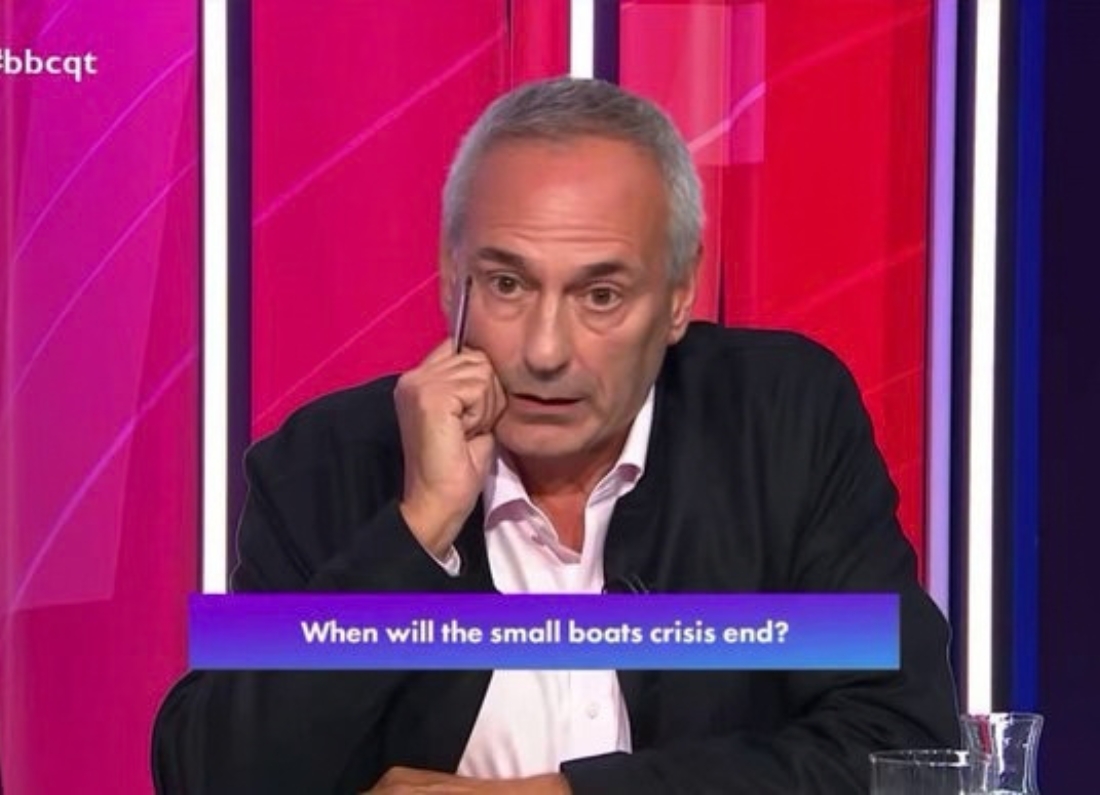
Kevin Maguire has pushed back against what he called the “demonisation” of asylum seekers arriving in Britain by small boat, arguing that the debate has become badly distorted and that people are often blamed for not working when the system itself usually prevents them from doing so.
The Mirror journalist made the comments during BBC Question Time in Peterlee, County Durham, after the panel was asked when the small boats crisis would finally end. The discussion quickly became heated as audience members raised concerns about people entering Britain irregularly, the cost of accommodation and whether asylum seekers were contributing while their claims were processed.
Maguire accepted that Channel crossings were a problem that governments needed to tackle, but argued that the issue had been given “disproportionate attention” and that the circumstances of the people making the journey were too often ignored.
He said many were “fleeing terror” and chose Britain because they already had family connections here or spoke English, before adding that Britain’s history also helped explain some of those links.
When one audience member complained about asylum seekers coming to Britain and not working, Maguire immediately challenged the premise.
“We don’t let them work! That’s it. You can’t accuse them of not working when we don’t let them work.”
On that point, the rules broadly support him. People seeking asylum are not normally allowed to work while their claim is being considered. They can apply for permission only if they have been waiting more than 12 months for an initial decision through no fault of their own, and even then employment is restricted to qualifying skilled occupations.
Asylum seekers are usually barred from working
The restriction creates one of the more contentious features of the asylum system.
People who would otherwise be destitute can receive accommodation and financial support from the Home Office while their claims are processed, but in most cases they cannot simply take a job and support themselves instead.
Maguire told the audience:
“We do not let asylum seekers work so we have to put them up.”
That does not mean every asylum seeker is permanently prevented from entering employment. Those who are eventually granted refugee status gain unrestricted access to the labour market, while limited permission can be granted to some people whose asylum cases have been outstanding for more than a year. But for someone whose claim is being handled within that first year, the general rule is that they cannot work.
Home Office figures show that 40,168 people were awaiting an initial asylum decision at the end of June 2026, down 56 per cent from a year earlier and 77 per cent from the peak in June 2023. At the same point, 93,293 people were receiving asylum support, a broader figure which also includes people at other stages of the process, including appeals.
One part of Maguire’s claim needs correcting
During the Question Time discussion, Maguire also said people in hotels received “£10 a day”.
That is not what the current Home Office support rate says.
Asylum seekers whose accommodation also provides their meals currently receive £9.95 per person per week, rather than per day, for other essential items. Those in accommodation where they have to provide their own food normally receive £49.18 per person per week.
So while Maguire was correct that asylum seekers are generally prevented from working and may receive only a small cash allowance when meals are included, his description of the £10 figure as a daily payment was inaccurate.
That distinction was missed in much of the social-media praise for his intervention.
‘Let’s not demonise and scaremonger about them all’
Maguire went on to argue that poor accommodation and restricted financial support should not be confused with asylum seekers receiving a luxurious lifestyle at public expense.
He described some hotels as “grotty” and said the government was increasingly moving people into other forms of accommodation, while accepting that houses of multiple occupation could themselves create pressures for local communities.
The number of asylum seekers housed in hotels has in fact fallen sharply. At the end of June, 16,021 people receiving asylum support were living in hotels, down 50 per cent on the previous year and 71 per cent below the September 2023 peak of 56,018. Another 73,068 were housed in non-hotel accommodation.
The government says it inherited around 400 asylum hotels at the 2023 peak, costing taxpayers roughly £9m a day, and has been trying to reduce reliance on them while clearing more initial asylum decisions.
Maguire told the Question Time audience:
“Let’s not demonise and scaremonger about them all.”
He also argued that crimes committed by people from minority backgrounds attracted disproportionate political and media attention compared with equivalent offences committed by white Britons.
That claim is harder to measure objectively than the asylum statistics, but it became one of the most contentious parts of the discussion.
Telegraph journalist Annabel Denham pushed back strongly against Maguire’s wider characterisation, describing Britain as a “soft touch country” and questioning how he could simultaneously argue that people were fleeing persecution while complaining that their accommodation was poor and their financial support limited.
Small boat arrivals have fallen sharply this year
The argument also came at an important moment for the Channel crossings debate because the number of arrivals has fallen significantly during 2026.
Figures published in late September showed 18,565 small boat arrivals between 1 January and 23 September, compared with 32,188 over the same period in 2025, a reduction of about 42 per cent. The overall total was running at its lowest level for that point in the year since 2022.
That does not mean crossings have ended. The Home Office recorded another 1,620 arrivals between 2 and 6 October alone, including 609 people arriving in eight boats on 5 October.
Nor do small boat arrivals account for every person seeking asylum in Britain.
In the year to June 2026, 86,000 people claimed asylum. Around 34,000, or 40 per cent, had arrived by small boat, while approximately 35,000 had initially entered Britain legally on a visa or with another form of permission before later making an asylum claim.
Since 2018, 95 per cent of people arriving by small boat have claimed asylum. Of those who had received a substantive initial decision by the end of 2025, around 79,600 were granted asylum or another form of protection and 53,300 were refused.
That means the common description of every person crossing the Channel as simply an “illegal immigrant” can obscure what happens after arrival. Crossing without permission is an irregular entry route, but the overwhelming majority subsequently make an asylum claim which must be considered under the asylum system.
The argument over work is likely to continue
Allowing asylum seekers to work earlier has been debated repeatedly because supporters argue it would reduce dependence on taxpayer-funded accommodation and support while helping people integrate if they ultimately receive protection.
The current government has not abolished the general restriction. Under rules updated in March, people whose claims have been outstanding for more than 12 months can still seek permission to work, but new permissions are restricted to occupations at RQF level 6 or above.
Maguire’s intervention drew praise online, particularly for challenging the idea that people can simultaneously be barred from most employment and then blamed for not having jobs.
@narindertweets wrote:
“A brilliant contribution from @Kevin_Maguire on #BBCQT Asylum seekers are demonised for being in a system that prevents them from working. ‘Let asylum seekers work’ He acknowledges there is a problem but it is blown out of all proportion.”
Joe Connor is a UK-based reporter specialising in politics, public policy, and national affairs. He has previously contributed to publications including The London Economic (JOE Media Group) and Spotted News.
At The Daily Britain, he covers Westminster politics, elections, and breaking political developments, alongside in-depth analysis of policy decisions and their real-world impact.










Leave a Reply