

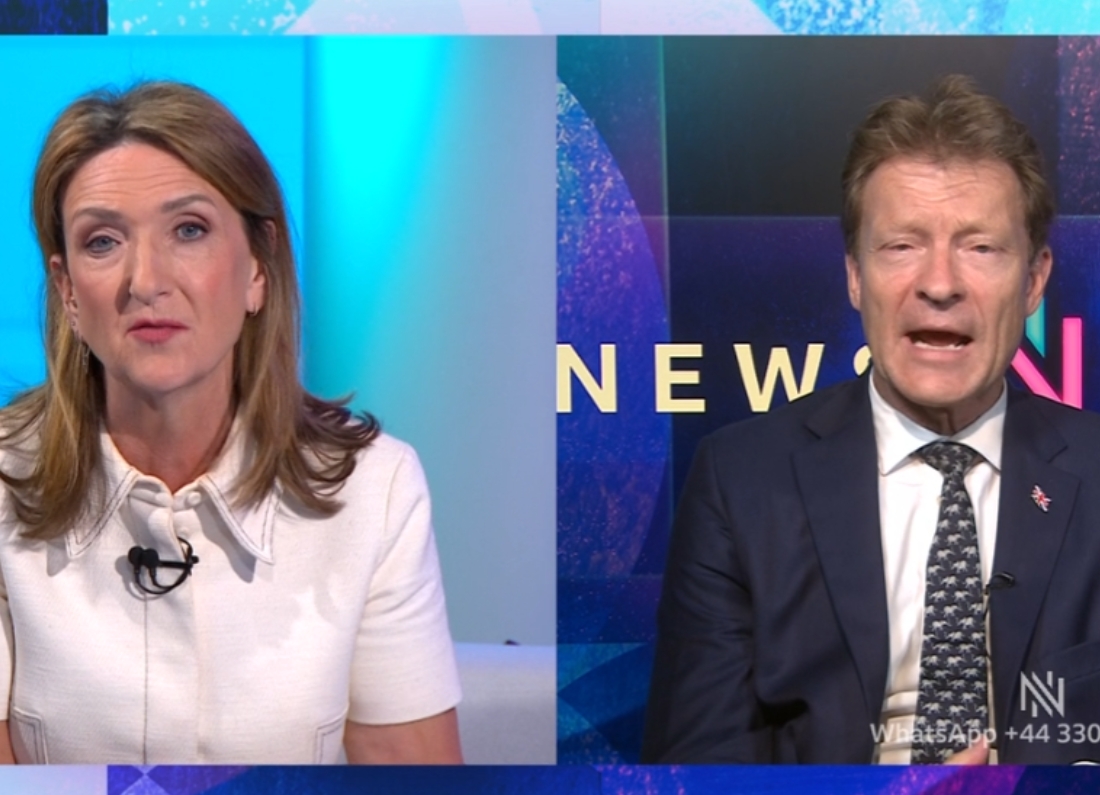
Richard Tice struggled to explain Nigel Farage’s increasingly complicated security arrangements during a tense appearance on Newsnight, after Victoria Derbyshire repeatedly asked why the Reform UK leader still needed a £5m private gift if both the state and his party were offering protection.
Farage has said the money from cryptocurrency billionaire Christopher Harborne will help fund his security for the rest of his life. Yet reports suggest he rejected a substantial taxpayer-funded protection package because he considered it inadequate, while Tice has now confirmed that Reform UK is paying for security for its MPs.
The three explanations may each make sense in isolation. Put together, they leave an obvious question: what exactly is the £5m paying for?
Derbyshire tried several times to get a straight answer. Tice never really provided one.
Farage reportedly rejected a state security package
According to the i Paper, Farage was offered a taxpayer-funded protection package following police advice about the threats he faced. The reported offer included a bodyguard, a car and a trained driver, placing Farage on a similar level of protection to Conservative leader Kemi Badenoch and senior Cabinet ministers.
Farage reportedly turned the package down because he believed it was inadequate. He had previously received publicly funded protection and is said to have viewed the later offer as a downgrade.
That distinction is important. Reform argues that Farage was not refusing protection for the sake of it, but rejecting an arrangement that did not match the risks identified around him.
The problem is that the rejected offer was hardly insignificant. A dedicated bodyguard, secure transport and a trained driver represent a substantial commitment of public money. It also sits awkwardly alongside Reform claims that the state has offered the party little or no meaningful security support.
Where the £5m comes in
Farage’s private security has become part of the wider controversy surrounding the £5m gift he received from Harborne. Farage has cited his lifelong need for protection as one of the reasons he accepted the money. His argument is that state-backed security is tied to political office and could disappear when he is no longer an MP, while the threats against him may continue long afterwards.
That is not an impossible argument. A politician who remains highly recognisable after leaving Parliament could still face threats without automatically qualifying for the same publicly funded support. Farage has said he expects to need protection “until the day that I die”.
But that still does not explain the current arrangement clearly. Farage was offered state-funded protection while serving as an MP. Reform is now paying for security for its own politicians. The £5m is also said to exist partly for Farage’s security. Derbyshire wanted to know how all of those pieces fit together.
Victoria Derbyshire asks the obvious question
During Tice’s appearance on Newsnight, Derbyshire asked why Farage had rejected the state package. Tice initially said he was not familiar with the specific report. He then argued that Farage required a much higher level of protection than had been offered.
Derbyshire pressed him on why the state should provide more when Farage had already received £5m that he said would help pay for private security. Tice’s answer appeared to be that Farage may need the money later, particularly when he is no longer an MP and may no longer qualify for state protection.
That explanation addresses the future, but it does not settle what is happening now. Farage is currently an MP. He was offered publicly funded security. He rejected it. Reform is paying for security. The private gift is being defended partly on the basis that it will cover security. Derbyshire’s confusion was understandable.
Reform is also paying for security
The exchange became harder for Tice when he confirmed that Reform UK itself was funding protection for its politicians. The party says it has been forced to meet those costs because the authorities have not provided adequate support. Reform figures have spoken repeatedly about threats faced by their MPs and senior figures, particularly since the death of Ann Widdecombe.
There is a legitimate argument over whether the current system responds quickly enough to threats against politicians. There are also obvious reasons why detailed security arrangements cannot always be discussed publicly.
But Reform cannot simultaneously use secrecy to avoid answering every financial question. If party funds are covering Farage’s current security and the state also offered him a protection package, the public is entitled to ask what portion of Harborne’s £5m is actually being reserved for security, how that figure was calculated and whether the money can be spent on anything else.
Those questions matter because the payment was not a small personal contribution. It was an extraordinary sum given to one of Britain’s most prominent politicians by a wealthy businessman with interests in cryptocurrency policy. The purpose of the gift is central to the public debate around it.
The explanation keeps changing shape
The difficulty for Reform is not necessarily that any single explanation is impossible. It is that the explanation changes depending on which part of the controversy is being discussed.
When asked why Farage accepted £5m, security is presented as a major reason. When asked why he rejected state-funded protection, the answer is that it was not good enough. When asked who is paying for his security now, Reform says the party is covering it. When Derbyshire asked how those claims work together, Tice shifted towards the argument that the £5m may be needed later in Farage’s life.
That could be true. But it raises further questions. Was all £5m specifically ring-fenced for security? Is it being held in a separate structure? Who controls the money? Can Farage use it for political activity, staffing, travel or personal expenses? What happens to any remaining funds if the expected lifetime security costs never approach £5m?
Reform has not provided enough detail to make those questions go away.
Security concerns do not remove the need for scrutiny
Farage may face a genuine and serious threat. Acknowledging that does not mean every financial arrangement made in the name of security should be accepted without examination.
The two issues can exist at the same time. Farage can require protection and still be expected to explain a £5m gift. The state can have failed to offer what he considered adequate security while still having offered more than Reform initially suggested. The party can pay for current protection while the public asks why one individual needed a separate multimillion-pound fund.
Scrutiny is not the same as dismissing the threat. It is possible to take Farage’s safety seriously without accepting every claim made about the money surrounding it. That was the distinction Derbyshire kept trying to establish.
The wider Reform security row
The interview came during a chaotic period for Reform’s public messaging on MP security. Zia Yusuf claimed the state was not offering support to Reform MPs. That was challenged after reports emerged that Farage had been offered a car, trained driver and bodyguard.
Richard Tice has separately praised Commons Speaker Lindsay Hoyle as “brilliant” in his efforts to protect MPs, just hours after Yusuf called Hoyle “a coward” and “a disgrace to his office”.
Robert Jenrick accused the government of failing to protect Farage because it disliked Reform’s political views, only to be challenged by Nick Robinson over the evidence for that claim and the protection Farage had turned down.
The party is making a serious case, but it is doing so through contradictory accounts. That weakens its argument and makes it harder to separate legitimate security concerns from attempts to redirect attention away from Farage’s financial affairs.
The figures still do not add up
Tice’s central defence appears to be that Farage may need private protection long after his entitlement to state support ends. That is plausible, but it is not enough on its own.
A lifetime security estimate of £5m should be capable of explanation. There should be some account of how the figure was reached and how the funds are being handled.
Instead, the public is left with a large private gift whose purpose seems to move between present protection and possible future costs, while other organisations pick up the bill today.
Farage rejected taxpayer-funded security because he believed it was inadequate. Reform says it is paying for protection itself. The £5m is also being defended as money needed for security.
Derbyshire’s question was simple: why are all three necessary?
By the end of the interview, Tice had spoken at length without making the answer any clearer.
You can watch it below:







Leave a Reply