

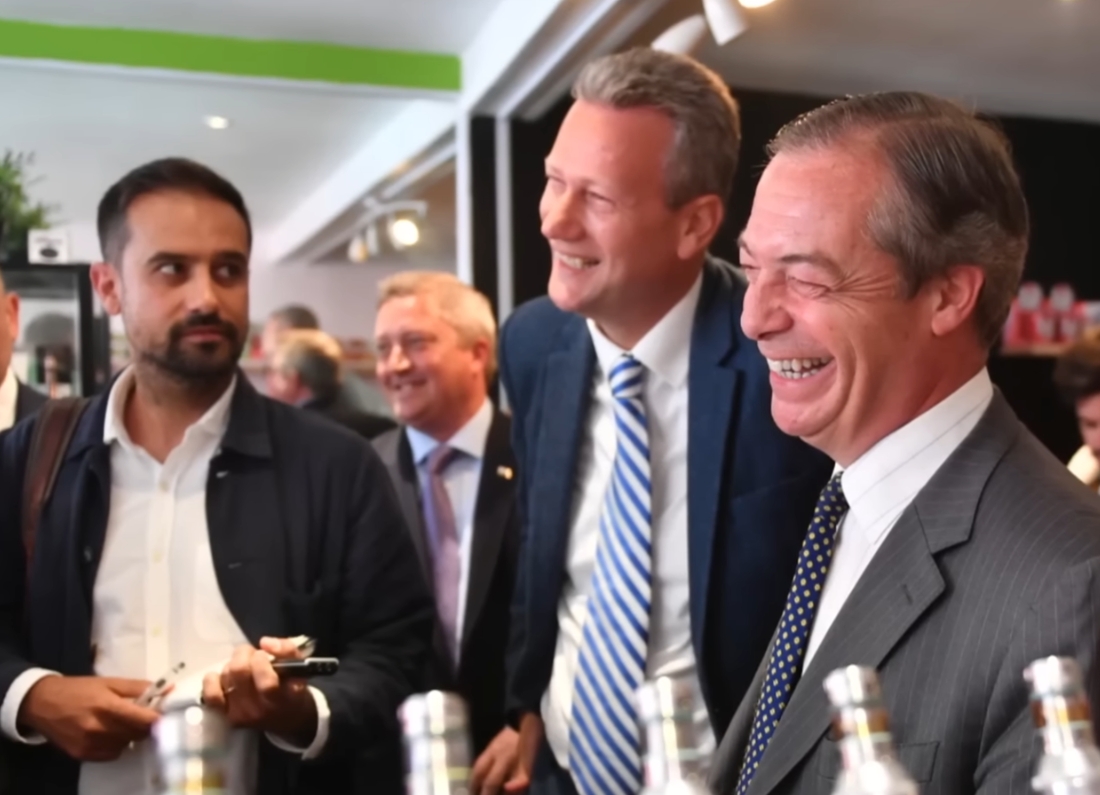
In October 2019, Nigel Farage and his Brexit Party MEPs voted against a European Parliament resolution calling for stronger action against foreign electoral interference and Russian disinformation.
At the time, it was treated as another clash between Farage’s anti-EU party and the institutions it had been elected to disrupt. The Brexit Party said it opposed handing Brussels more power and money. Its critics accused it of refusing to defend democratic institutions from an increasingly aggressive Kremlin.
Six years later, that vote looks more politically significant.
Nathan Gill, who sat in Farage’s European parliamentary group and later led Reform UK in Wales, is now serving a ten-and-a-half-year prison sentence after admitting he accepted payments to make speeches and public statements advancing pro-Russian interests.
Gill pleaded guilty to eight bribery offences covering the period from December 2018 to July 2019. Prosecutors said he received around £40,000 from pro-Russian Ukrainian figures in return for speeches, media appearances and parliamentary activity. The sentencing judge said the ultimate source of the requests and money was Viktor Medvedchuk, the Ukrainian oligarch and close ally of Vladimir Putin.
The offences took place months before the Brexit Party’s October 2019 vote against stronger anti-disinformation measures.
That timing does not prove Farage or other Brexit Party MEPs knew what Gill had been doing. There is no evidence that Farage was involved in Gill’s crimes, and Reform UK condemned Gill’s conduct as “reprehensible, treasonous and unforgivable” after he was sentenced.
But the conviction changes the context in which that old vote must now be viewed.
It is no longer possible to discuss Farage’s movement, Russia and foreign political influence as an entirely hypothetical concern. A senior figure who operated within Farage’s European political operation was being paid to push messages beneficial to the Kremlin while holding elected office.
That fact gives new weight to a question Reform would rather consign to the past: why did Farage’s Brexit Party vote against proposals intended to strengthen Europe’s defences against exactly this kind of activity?
What the Brexit Party voted against
The European Parliament resolution passed on 10 October 2019 by 469 votes to 143, with 47 abstentions.
It called for stronger measures to counter foreign electoral interference and disinformation. Among its recommendations was an upgrade to East StratCom, the EU unit established after Russia’s annexation of Crimea to identify and challenge Kremlin-backed propaganda.
The resolution expressed “deep concern over the highly dangerous nature of Russian propaganda” and called on EU institutions to develop a more effective strategy against disinformation. It also criticised social media companies over their response to political manipulation and the misuse of personal data exposed by the Cambridge Analytica scandal.
The measure was non-binding, but it was backed by the European Parliament’s largest political groupings. Farage and the Brexit Party voted against it.
David Bull, then a Brexit Party MEP, defended the decision by saying the party would “always vote against more power and spending by the EU”. He dismissed concerns about Russian interference as “baseless propaganda and scare stories used to shut down debate”, adding that the party opposed restrictions that could threaten free speech.
That explanation was consistent with the Brexit Party’s general approach in Brussels. Its representatives routinely opposed measures they believed expanded EU authority, regardless of the policy area involved.
Yet the wording is harder to brush aside now.
This was not merely an objection to bureaucratic expansion. A Brexit Party representative publicly described concerns about Russian interference as baseless. We now know that, during the same broad period, one of Farage’s MEPs was secretly receiving money to promote narratives favourable to Russian interests.
Again, this does not establish that the wider party knew what Gill was doing. It does establish that the threat the party dismissed was operating inside the political environment in which its own representatives worked.
Nathan Gill was not a distant or irrelevant figure
Gill’s defenders cannot plausibly present him as someone who wandered briefly through Reform’s orbit without influence or standing.
He represented Wales in the European Parliament from 2014 until Brexit. He was elected under UKIP and later joined the Brexit Party group led by Farage. In 2021, he briefly became the leader of Reform UK in Wales.
The court heard that Gill accepted money in exchange for carrying out public duties improperly. He made speeches in the European Parliament, appeared on a pro-Russian Ukrainian television channel and sought to involve other MEPs in activity that promoted messages favourable to Moscow.
His contact was Oleg Voloshyn, a former Ukrainian politician and journalist described by prosecutors as pro-Kremlin. The sentencing remarks said Voloshyn and his wife had links to 112 Ukraine, a television channel owned by an associate of Medvedchuk.
Gill was stopped at Manchester Airport in September 2021 while travelling to Russia. Analysis of his phone uncovered extensive correspondence with Voloshyn stretching from 2018 into 2020.
The case was not about a stray social media post or an ambiguous comment on foreign policy. It was a proven bribery operation involving an elected British politician taking money to use his office in support of a foreign political agenda.
The judge imposed ten and a half years in prison. The Crown Prosecution Service has also begun proceedings intended to recover the criminal proceeds.
Farage later described Gill as a “bad apple” and said he felt personally betrayed by someone he had believed to be honest.
That may be true. Political leaders can be deceived by colleagues.
The difficulty for Farage is that a “bad apple” explanation does not answer the institutional question. How did a politician taking Russian-linked bribes operate within his parliamentary group without being detected? What scrutiny was applied to the speeches, media appearances and contacts of MEPs working under the UKIP and Brexit Party banner? Has Reform conducted a genuinely independent examination of whether Gill influenced anyone else?
Those questions became more pressing after prosecutors disclosed evidence that Gill had tried to recruit other MEPs into interviews and public interventions. Reporting has since raised questions about other members of Farage’s European bloc who repeated talking points connected to Gill’s operation, although there is no suggestion that those individuals committed criminal offences or knew Gill was being paid.
A serious internal inquiry would not begin by assuming collective guilt. It would establish who knew what, which contacts took place and whether safeguards failed.
Farage has resisted calls for that kind of investigation.
Farage’s own record on Russia
Gill’s conviction would be politically damaging to any party leader. It is particularly awkward for Farage because of his own long history of comments about Putin, NATO and Ukraine.
In 2014, Farage said that, “as an operator”, Putin was the world leader he most admired. He praised the Russian president’s handling of Syria while making clear that he did not approve of Putin politically or personally.
Farage also made at least 17 appearances on the Kremlin-funded Russia Today channel between 2010 and 2014.
More recently, during the 2024 general election campaign, he said the eastward expansion of NATO and the European Union had given Putin a reason to present Russia as threatened. “We provoked this war,” Farage told the BBC, while also saying the invasion was Putin’s fault and that the Russian leader had used Western actions as an excuse.
There is a legitimate foreign policy debate about NATO expansion, relations with post-Soviet Russia and whether Western governments made strategic mistakes after the Cold War.
Holding that view is not evidence of corruption. Nor is appearing on a Russian state broadcaster, by itself, proof that a politician is acting for Moscow.
The issue is cumulative.
Farage admired Putin’s political effectiveness. He became a regular guest on Russia Today. He has repeatedly framed Western policy as a cause of Russian aggression. His party voted against a resolution designed to strengthen protections against Russian propaganda. A politician from his own European bloc was later convicted of taking money to promote Kremlin-friendly narratives.
Each fact has its own explanation. Together, they create a record that deserves more than a shrug.
The Russia report left Britain with unanswered questions
The wider British response to Russian political interference has often been marked by reluctance.
Parliament’s Intelligence and Security Committee published its long-delayed Russia report in 2020. It said the UK was a major target for Russian influence and described links between Russian elites and British politics as part of a “new normal”.
On the Brexit referendum, the committee reached a striking conclusion: it had not been given any post-referendum assessment of Russian attempts to interfere.
In other words, the absence of a definitive finding that Russia altered the result was not the same as proof that no attempt had been made. The intelligence community had not conducted the kind of retrospective assessment that would have allowed Parliament to reach a confident conclusion.
This distinction has often been blurred in political argument.
Those defending Brexit have sometimes treated the lack of proven interference as vindication. Critics have sometimes spoken as though the referendum result itself was shown to have been engineered by Moscow. Neither position is supported by the available evidence.
What the official report established was a failure to investigate properly.
That failure matters when looking back at the Brexit Party’s 2019 vote. The party dismissed Russian interference stories as baseless at a time when the British state had not done enough work to determine the scale of the threat.
Nathan Gill’s conviction does not settle the debate over the Brexit referendum. It does show that pro-Russian financial influence had penetrated the activity of a British MEP operating in Farage’s political group.
From Gill’s bribes to Reform’s current money questions
The Russia story now lands during a separate crisis over Farage’s finances and Reform UK’s funding.
Farage is under scrutiny over a £5m gift from Christopher Harborne, a cryptocurrency billionaire based in Thailand. The payment was reported to the National Crime Agency through a suspicious activity report, a mechanism used by financial institutions when a transaction raises concerns that warrant examination.
A suspicious activity report is not evidence of criminal conduct. Farage and Harborne deny wrongdoing, and the filing of a report does not mean investigators have concluded the money was illicit.
The political question concerns disclosure.
Farage argues the gift was made before he returned to frontline politics and before becoming an MP, meaning it did not fall under parliamentary registration rules. He has said the money was connected to security and support following years of campaigning.
His critics point to the timing, his later return as Reform leader and policy positions that could benefit interests linked to cryptocurrency. A parliamentary standards inquiry has been examining whether the gift should have been declared.
Farage has also faced questions over undeclared benefits allegedly provided by George Cottrell, a longtime associate who previously served a prison sentence in the United States after pleading guilty to wire fraud connected to an undercover money-laundering investigation.
Reports have said Cottrell provided Farage with support that included staff, accommodation and security. Farage disputes suggestions that he broke parliamentary rules and says some of the support related to his personal safety during a period when he was not serving as an MP.
Separately, police have been investigating £500,000 in donations to Reform UK made by Cottrell’s mother, Fiona Cottrell, over possible breaches of political donation law. No arrests have been made, and the existence of an investigation does not establish wrongdoing.
None of these current financial controversies is evidence of Russian involvement.
That boundary must be made clear.
The relevance lies in political transparency. Gill’s case demonstrated what can happen when foreign-linked money reaches a politician through channels hidden from voters. Farage’s current scandals concern different people and different allegations, but they also turn on the public’s ability to know who funds political activity, what benefits elected representatives receive and whether existing rules are strong enough.
A political movement that has already seen one senior figure imprisoned for taking covert foreign-linked payments should be unusually serious about transparency.
Instead, Farage has framed much of the latest scrutiny as persecution.
Reform says it is being smeared
Reform’s response is that opponents are stitching unrelated stories together to imply guilt by association.
On Gill, the party has condemned his actions in the strongest terms. It says he left years ago and acted alone.
On Russia, Farage says he has been honest about his views and has always acknowledged that Putin was responsible for invading Ukraine, even while arguing that NATO and EU expansion helped create the conditions for conflict.
On the £5m gift, Farage says he followed the rules that applied at the time and has been targeted through illegally leaked financial information.
On the Cottrell-linked donations, Reform figures have attacked the investigation as part of a campaign to damage a party that threatens the political establishment.
Those defences should be reported fairly. They are not inherently implausible. Different scandals can become bundled together in a way that creates a more sinister impression than the evidence justifies.
But Reform’s answer cannot simply be that every question is a smear.
Gill was not invented by hostile journalists. He admitted taking bribes.
The 2019 vote is a matter of public record.
Farage’s comments on Putin and Ukraine are his own.
The £5m gift exists, as do the parliamentary questions surrounding its disclosure.
Police are investigating the Cottrell donations.
These are facts. The analytical question is what they reveal about the culture, judgment and safeguards around Farage’s political movement.
The unanswered question from 2019
The Brexit Party’s defence of its 2019 vote was ideological. It opposed giving the EU more power. It said claims of Russian interference had been exaggerated to suppress debate.
That position deserves to be revisited in light of what happened inside its own group.
Had the proposed anti-disinformation measures existed in a stronger form, would they have detected Gill? Perhaps not. His crimes involved bribery, private messages and covert payments rather than only public disinformation.
But the resolution was responding to the broader ecosystem that made such operations valuable. Russia and its allies did not need every politician to be directly controlled. They benefited when elected figures repeated favourable narratives, undermined confidence in democratic institutions and opposed efforts to expose coordinated influence.
Gill was paid because his status as an MEP gave those messages credibility.
The Brexit Party vote was therefore not an abstract dispute about Brussels spending. It was a decision about whether democratic institutions should build stronger defences against foreign manipulation.
Farage’s group voted no.
Six years later, one of the politicians within that orbit is in prison for selling his public office to people advancing pro-Russian interests.
That does not prove the party was knowingly aligned with the Kremlin.
It does make its earlier dismissal of the threat look dangerously complacent.
Why an independent inquiry matters
After Gill was jailed, the government announced a review of foreign financial interference in British politics. It was tasked with examining political finance rules, cryptocurrency and whether the Electoral Commission has adequate powers to identify hostile influence.
Reform welcomed the broader review.
What Farage has not embraced is a separate, independent examination of his own movement.
That is the step he should now take.
Such an inquiry should cover Gill’s role in UKIP, the Brexit Party and Reform Wales. It should examine which MEPs he approached, what speeches or media appearances were arranged, and whether anyone noticed unusual patterns in his work.
It should also examine whether current vetting and financial disclosure processes within Reform are sufficient for a party seeking national power.
This would not be an admission of collective wrongdoing. It would be the responsible response to an extraordinary breach of trust.
Farage has repeatedly presented Reform as the party that will clean up Westminster and break a corrupt establishment. That claim cannot coexist comfortably with resistance to scrutiny when the questions concern his own organisation.
A pattern is not proof, but it is reason to investigate
There is a temptation in political writing to turn a collection of troubling facts into a conspiracy theory.
That should be resisted.
There is no evidence that the Brexit Party’s 2019 vote was bought by Russia. There is no evidence Farage knew Gill was taking bribes. There is no established Russian connection to the £5m Harborne gift or the current Cottrell investigations.
Those caveats do not make the wider story meaningless.
Gill’s conviction proves that Russian-linked money reached a senior politician from Farage’s movement and bought parliamentary activity.
The Brexit Party voted against stronger measures to combat Russian propaganda while dismissing concerns about interference.
Farage has spent years making arguments that critics say echo Kremlin framing of the war in Ukraine.
Reform now faces separate questions about opaque funding, undeclared benefits and whether money connected to wealthy backers has been properly disclosed.
The responsible conclusion is not that these episodes prove a hidden Russian operation controlling Reform UK.
It is that the party’s record now warrants serious, independent scrutiny.
Farage asks the public to trust him when he says Gill was one rogue figure, his financial arrangements were lawful and criticism of his party is politically motivated.
Trust is not a substitute for transparency.
The old 2019 vote matters because it shows how confidently Farage’s party dismissed a threat that later appeared inside its own ranks.
Nathan Gill is now in prison. Russia’s attempts to influence Western politics have not stopped. Questions over the money surrounding Farage and Reform are growing rather than disappearing.
The movement that once voted against stronger defences now wants to be trusted with the government of Britain.
It is entitled to reject guilt by association.
It is not entitled to reject the questions.




Leave a Reply