

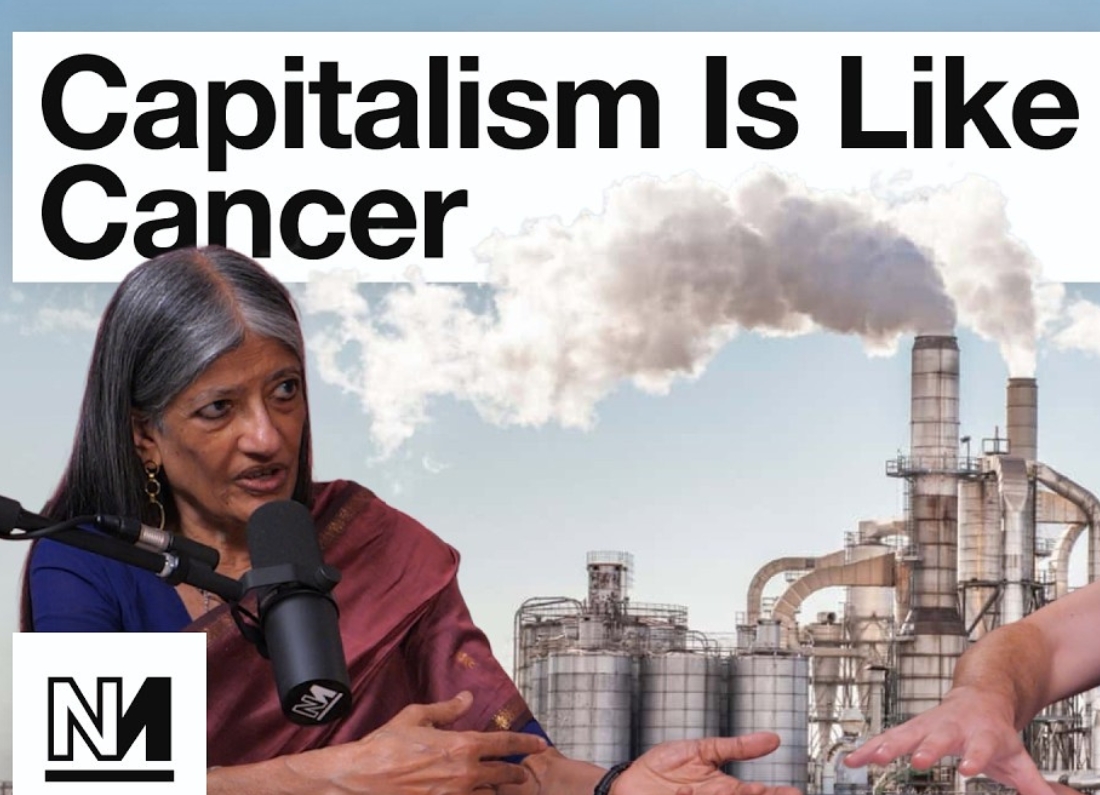
Novara Media’s Michael Walker spoke to Jayati Ghosh, professor of economics at the University of Massachusetts Amherst and a leading heterodox development economist, following a wave of high-profile economic interventions questioning whether continued GDP growth should remain the primary goal of economic policy.
In early June, a team led by French economist Thomas Piketty released a global justice report proposing that income converge around €5,000 a month across countries, a plan that would allow substantial growth in developing economies while implying an effective end to growth in the global north. A week later, Ghosh joined Joseph Stiglitz and other economists in a Guardian letter arguing that “growth is a doomed strategy,” on the basis that growth has become decoupled from poverty reduction and is inconsistent with avoiding environmental catastrophe.
Not everyone agrees
The degrowth argument has faced significant pushback. Financial Times data journalist John Burn-Murdoch has argued that “the arguments for degrowth are shrinking,” contending that growth has allowed richer countries to shift toward renewable energy and that the empirical link between growth and poverty reduction remains strong. That dispute, over whether growth and poverty reduction are genuinely decoupling or whether the correlation still holds once the data is properly examined, is a live and unresolved one among economists, and Ghosh’s position represents one side of that debate rather than a settled consensus.
The core argument
Ghosh’s central case is not that growth is inherently bad, but that treating it as an end in itself is a category error. “That’s the ideology of the cancer cell,” she said. “The economy should serve society, not the other way around.” Her argument is that pursuing specific social and environmental goals, cleaner public transport over polluting private transport, for instance, might sometimes increase GDP and sometimes decrease it, and that the GDP outcome should be treated as irrelevant to whether the policy is worth pursuing.
On the question of whether Western political systems can tolerate low growth given voter expectations of rising living standards, Ghosh argued the premise is flawed. “There’s no link now between GDP growth and employment. There’s no link now between GDP growth and real wages,” she said, citing 35 years of stagnant median wages in the US despite periods of GDP growth reaching as high as 5%, and a falling wage share of national income across most rich countries.
The India poverty dispute
Ghosh directly challenged the widely cited World Bank narrative that Indian economic liberalisation in the 1990s dramatically reduced extreme poverty, from around 50% in 2000 to roughly 5% today. She argued the underlying poverty measurement has been repeatedly redefined in ways that understate hardship, including treating ownership of a mobile phone as evidence of not being poor. She cited a UN Food and Agriculture Organization indicator measuring the ability to afford a regionally defined nutritious diet, which found 71% of India’s population could not meet that threshold in 2023, even as the official poverty rate stood around 25%. She was careful to note poverty has genuinely fallen in India over time, “just not to the extent that they are proposed.”
China, India and the role of economies of scale
Asked to explain the divergence between China’s growth trajectory and India’s, Ghosh pointed to China’s much larger and more equal domestic market at the outset of reform, which allowed manufacturers to achieve economies of scale, producing for tens of millions of consumers rather than the fragmented, unequal market India’s own inequality has produced. She also stressed sustained high public investment, describing China as investing roughly a fifth of GDP in infrastructure for four decades, and the state’s success in disciplining domestic capital in a way India’s licensing system, in her account, failed to achieve.
She described China’s development model as resting on an implicit bargain following the Tiananmen Square crackdown: continuously rising wages and living standards in exchange for the absence of independent trade unions and political dissent, noting wages in China grew at 6-10% annually for extended periods, undercutting the idea that Chinese growth relied on wage suppression specifically, as distinct from broader labour and political repression.
A different model: Thailand
Asked which country she considers to be “getting it about right,” Ghosh pointed to Thailand rather than the more commonly discussed China or United States, citing two specific policies introduced under former prime minister Thaksin Shinawatra: a near-universal healthcare scheme charging a flat 30 baht (roughly $1) fee regardless of the treatment required, paired with doubled healthcare staffing and higher pay in rural areas, and a scheme providing each local community with a fixed sum to be allocated by local council decision, a model Walker noted bears some resemblance to the devolution agenda Andy Burnham has been pursuing since returning to Westminster.
International corporate tax reform
Ghosh, speaking in her capacity as co-chair of the Independent Commission for the Reform of International Corporate Taxation, set out the case for “unitary taxation,” treating multinational corporations as single global entities for tax purposes rather than allowing profit-shifting between subsidiaries in different jurisdictions, alongside a global minimum corporate tax rate to prevent a regulatory race to the bottom.
She argued the OECD’s own two-pillar reform process, agreed after nine years of negotiation, was substantially weakened by corporate lobbying, and that the Trump administration subsequently persuaded the G7 to exclude US multinationals from the agreed minimum tax altogether, despite US firms accounting for an estimated 76% of profits among the world’s largest 4,000 companies.
Wealth taxes and the Colombia example
On personal wealth taxation, Ghosh backed economist Gabriel Zucman’s proposal for a roughly 2% global tax on the wealth of billionaires, arguing this would be equivalent to an effective income tax rate well below what most salaried workers already pay, while closing the loophole allowing extremely wealthy individuals to hold little formally taxable income by structuring assets through trusts and holding companies. She cited Colombia’s introduction of a 1.5% wealth tax on individuals holding more than $15m under finance minister José Antonio Ocampo, arguing the revenue generated was substantial relative to the small number of people affected, and that predictions of wealthy Colombians relocating to avoid the tax did not materialise at meaningful scale.
This mirrors arguments made by economists Gary Stevenson and Mariana Mazzucato in recent interviews, both of whom have argued Britain’s incoming government under Burnham faces a limited set of genuine choices on wealth taxation, revenue and public investment.











Leave a Reply