

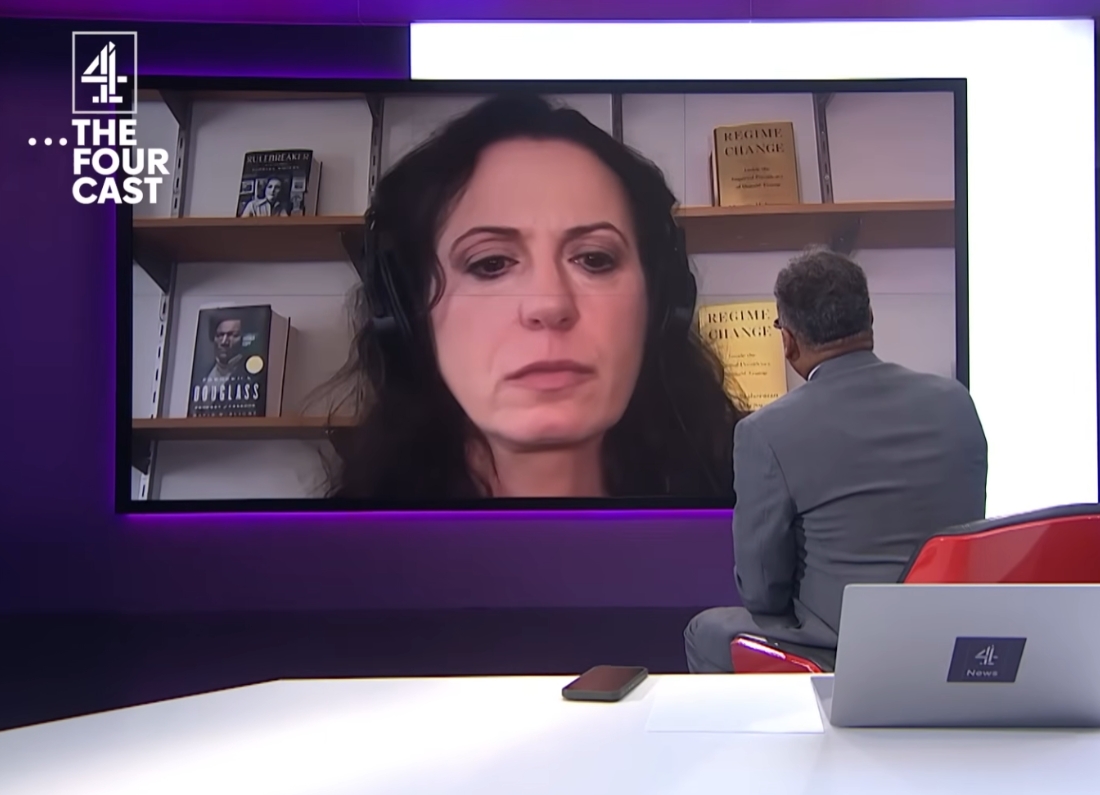
Maggie Haberman has spent more time reporting on Donald Trump than perhaps any journalist alive. Her new book, Regime Change, written with New York Times colleague Jonathan Swan, attempts to document what is actually happening inside his second-term White House – a significantly harder task than the first, she says, because the people around him are genuinely loyal in a way that his first-term circle were not. In a Channel 4 interview with Krishnan Guru-Murthy, she laid out the most significant findings.
The one that generated the most reaction was her answer to the final question. Asked whether Trump was thinking about a successor – whether he was behaving like an emperor choosing who would follow him – she paused before answering. “I’m not sure that he wants a successor,” she said. “I think that if it was up to him, he would just be the last.”
The list
The most extraordinary single moment Haberman describes in the book came during a visit to the Oval Office on 16 March. She and Swan had been asking to interview Trump, had fact-checking questions and wanted to discuss specifics from their reporting. At one point they asked him about power – how he was seeing himself in the context of power given things he had been saying to people.
Trump summoned his aide Natalie Harp and asked her to “go get the thing from the historian.” She returned with two printouts. The document, Trump said, was from a presidential historian. It began, essentially, by stating that Donald Trump was the most powerful person who had ever walked the face of the earth. Then it listed the top ten – Mao, Hitler, Stalin, Tamerlane, Genghis Khan, Alexander the Great, Napoleon, the Caesars – “some of the great monsters and conquerors of history,” as Haberman puts it.
“He was making no moral distinction at all between people who had murdered and people who had conquered or people who had built empires,” she said. “It was that they had power and they were willing to use it and that was how he was seeing himself.”
The punchline: the person who wrote the document was not a presidential historian. It was Gary Player’s former caddy and business associate. Trump either didn’t know or didn’t care. The document served its purpose regardless of its provenance.
Iran: the disaster he knows is a disaster
On Iran, Haberman was direct. Trump’s relationship with Netanyahu has been publicly deteriorating, and Haberman confirmed the reporting: he knows the war has not gone as intended. “In this particular issue, he knows that this is not going well. He knows that it has led to consequences he believed it would not. He believed this was going to be quick, it was going to be like going into Venezuela, and that the US would be able to have some form of a not puppet government necessarily, but a government it could work with in Iran. Iran is a theocracy of 90 million-plus people. It’s not Venezuela.”
He dismissed accountability for the Iranian school strike with “that was a long time ago.” He signed his Iran deal at Versailles, a location the internet immediately found historically resonant. The only person who aggressively told him the war was a bad idea was JD Vance – which irritated Trump rather than giving him pause. “Trump was warned about munitions depletion, which the US is really facing right now. The possibility that Iran would close the Strait of Hormuz, which obviously happened. Trump wanted to move ahead.”
Why? Haberman’s explanation: he simply wanted to. “Trump is much more hawkish about Iran, Iran in particular above anywhere else in this world, than his team realised he was or that his team wanted to acknowledge.” He believed it would be quick. He believed, as he told an anxious adviser before the war: “It’s going to be okay. You know how I know? Because it always is.”
The walking moral hazard
Haberman’s description of Trump as “something of a walking moral hazard his whole life” is one of the book’s central characterisations. “He takes actions and somebody else holds the bag. Whether it was the banks when he was running casinos that were in dire peril, whether it was his legal bills which his political action committee ended up paying, whether it was the fallout from January 6th which members of his party faced. And now the immunity decision.”
In the Iran context, the bill is the US taxpayer. The casualties are service members. “He doesn’t seem to be responsive to domestic politics the way that he was in term one.” She is describing a man who has learned, across four indictments, two assassination attempts, an impeachment and a Supreme Court immunity ruling, that consequences do not reach him – and who has drawn the obvious conclusion from that pattern.
The loyalty and the money
Haberman addressed the question of how a White House so full of true believers can still produce the leaks and internal conflicts that her book documents. Her answer: two things can be true at once. The people closest to Trump genuinely believe in him – they have witnessed him survive things that should have ended any other political career and developed a “near mystical faith” that he must know something they don’t. But that doesn’t mean everyone feels fine about everything. It means they keep their doubts extremely tightly under wraps.
On the money flowing to the Trump family, she said the book only scratches the surface. “There’s the crypto deal. There is a separate Bitcoin venture Eric Trump was involved with. A company that Don Jr. works with has a bunch of investments in companies, at least one that has a contract with the US government.” The family says they have nothing to do with it. “But any other president would be concerned about the appearances.” Trump’s position, and the family’s position, is that they suffered during the investigations and are unapologetic about what they are making now.
Genius or madman?
Guru-Murthy asked Haberman the obvious question. She didn’t give the obvious answer. “He has an unbelievable feral sense for people’s weaknesses. And he has, as he made very clear to us, a willingness to use power in a way that previous American presidents just have not been willing to.” She noted that he took the country to war without talking to Congress – no authorization, no process, no debate. George W. Bush went through a congressional process for a deeply unpopular war after 9/11. Trump simply moved. “They are all about projecting strength. And that is all he cares about.”
It is not genius, exactly. “Sometimes he acts on impulse or things that he likes and that other people don’t. And sometimes that overlaps with good politics and sometimes it doesn’t.” But the feral instinct for weakness – in opponents, in institutions, in the people around him – is real and effective.
The 1990 Barbara Walters interview, currently going viral again, shows the same man with the same instincts 36 years earlier – willing to lie directly, willing to project strength, willing to make whatever claim suited the moment. Owen Jones has argued that Britain’s lack of a constitution makes it more vulnerable to a Reform version of this dynamic than America was to Trump himself. Whether or not that comparison holds, the pattern Haberman describes – a man who has never faced real consequences, who sees power as its own justification, and who genuinely believes things always work out because they always have for him – is one that the YouTube comments on her Channel 4 interview found uncomfortably familiar.
“Fascists are always haunted by their own mediocrity,” one commenter wrote, with over 380 likes. “He will only be remembered as the worst, most corrupt, most stupid president in history,” wrote another with over 1,100. And from someone who had clearly read the transcript carefully: “I wish she’d been asked to elaborate” on the final answer. The one about being the last.
You can watch the full interview below:
6 responses to “Maggie Haberman: Trump doesn’t want a successor – he wants to be the last”
-
Political Power needs a Baseball/Presidential commissioner, you get to run for the offices through the minor leagues county positions are rookie ball, states positions are A-AA, congressional and Cabinet/department positions/Vice President AAA, Senate/ Supreme Court/ President, MLB. The commissioners office oversees abuses like , illegal gifts, stock options, illicit affairs. And any occurrence of recidivism is canceling to any career forwards. You can stay in the minors but your forever Crash Davis.
-
It will be a while to crawl back our country to a decent democracy. Trump enables the racist, jingoistic, radical religious nationalism that was already there. Mitch McConnell enabled Trump more than any with Supreme Court appointment shenanigans and failing to have Trump convicted following Jan 6.
-
Except for a few, people enable him and so he stands above accountability. But what goes up must come down and it will be a mess.
-
Trump’s biggest asset is that he has no conscience. There will be no “Have you no decency?” appeal that will disarm him. He has no decency. I dread the idea that he will die in office, although many people are hoping for that. That would only facilitate his apotheosis in the minds his cult and ensure his policies become law as they did after Kennedy died in office. it is a tough spot for our government to be in, but Impeachment is the best answer.
-
So he will blow up the world so he will be the last man standing.. Dangerous Idiots need to be stopped..not watched!
-
Having watched Trump for YEARS, I can name all the things he is not. But the most important thing is fthat he does NOT have a moral center. None whatsoever. He craves power and attention and has shown time and time again that he will do virtually anything to attain them. I hope Karma catches up with him soon before he keels over while in one of his tantrums. He can’t stand to be disagreed with. If he is not winning an argument, he stalks off and afterward vents his spleen on Truth Social. He is a bully, simply as that. No one in the WH will stand up to him. He throws billion dollar lawsuits around when he doesn’t get his way. Trump is the very definition of a “snowflake”. Anyone who mocks the disabled, who calls veterans “losers” is a disgrace to the Office of the President.






Leave a Reply