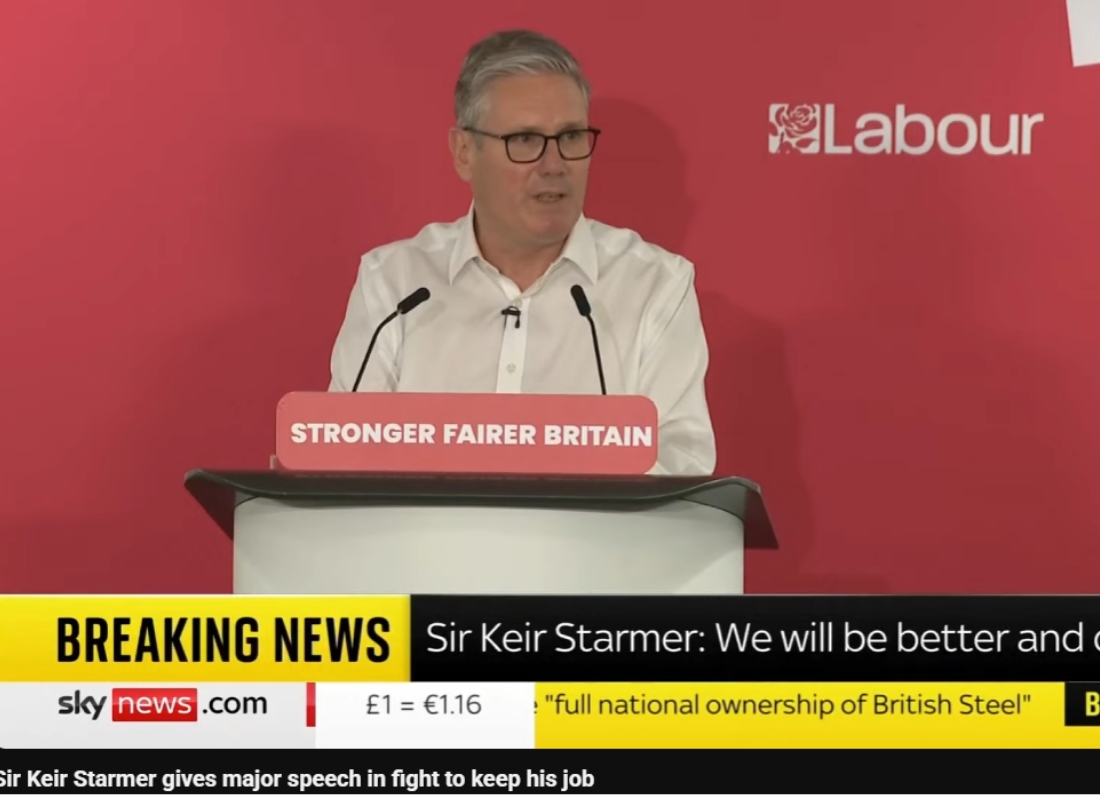
Keir Starmer has delivered the most consequential speech of his premiership, pledging that Britain will be “at the heart of Europe,” that “incremental change won’t cut it” and that he will “prove his doubters wrong” – as Labour MPs immediately began issuing statements saying the speech had failed to convince them and as financial markets registered a mild rise in gilt yields in the aftermath of the address.
The speech, delivered Monday morning, was designed to forestall an immediate leadership challenge from the growing body of Labour MPs who have called for a departure timetable since Thursday’s election results. It represented Starmer’s most explicit attempt to articulate a defining political mission after nearly two years in government during which, in his own words, “the hope wasn’t there enough.”
Whether it succeeded will be determined not by the speech itself but by what Labour MPs decide to do in the hours and days that follow.
What Starmer said
The speech had four principal components.
On hope and change: “People need hope. We will face up to the big challenges and we will make the big arguments. To meet the challenges that our country faces, incremental change won’t cut it.” He acknowledged being frustrated by his own government’s pace and accepted that “some people are frustrated with me” and that he had “doubters.”
On Europe: The speech’s centrepiece was a commitment to rebuild the UK’s relationship with the European Union as the defining mission of his government. “This Labour Government will be defined by rebuilding our relationship and by putting Britain at the heart of Europe. So that we are stronger on the economy, on trade, on defence, you name it.” He cited a youth mobility scheme allowing young Britons to live and work in EU countries as part of this agenda. He attacked both Reform UK and the Conservatives for being “defined by breaking our relationship with Europe.”
On his doubters: When ITV’s Robert Peston told him that most Labour MPs and ministers he had spoken to over the weekend believed Starmer was “no longer the best person for the job,” the Prime Minister replied: “I’m not going to shy away from the fact that I’ve got some doubters, including my own party. And I’m not going to shy away from the fact that I have to prove them wrong. And I will. I had my doubters when I took on the Labour Party. I had my doubters who said we couldn’t change this party and make it capable of winning an election. And I proved them wrong.”
On leadership change: Asked whether there would need to be a general election if Labour chose a new leader, Starmer drew directly on the Conservative comparison: “We tested it to destruction under the last government and inflicted huge damage on this country. A Labour government will never be forgiven if we repeat that and inflict that on the country.”
The immediate Labour response
The speech had not finished before Labour MPs were registering their dissatisfaction publicly.
David Smith, the MP for North Northumberland – a constituency that is mostly made up of the old Berwick-upon-Tweed seat, which the Conservatives won in 2019 with a majority of almost 15,000 – issued a statement immediately after the speech ended. He said Starmer should set a timetable for his departure and that the government needed “to act faster, and be more radical.”
Smith’s intervention is specifically significant because North Northumberland is precisely the kind of seat Labour needs to hold at the next general election. A Labour MP representing a marginal constituency saying the speech failed to convince him is a different kind of pressure to the same message from a safe seat.
As we reported in our piece on Catherine West’s ultimatum, she had given the cabinet until Sunday to act or she would begin collecting 81 signatures on Monday morning. The speech was Starmer’s attempt to make that ultimatum unnecessary.
As we also reported in our coverage of Rayner’s bombshell Sunday statement, the former Deputy Prime Minister had called blocking Burnham a mistake and warned it may be Labour’s “last chance.” Her response to Monday’s speech will be one of the most watched political moments of the day.
The EU reset – and why it matters
The Europe commitment is the most substantive policy announcement in the speech and the one with the most potential to shift political terrain. Starmer is explicitly framing the EU relationship – rebuilding trade links, creating a youth mobility scheme, pursuing closer defence cooperation – as his government’s defining mission going forward.
This is a departure from his previous approach, which sought to avoid relitigating Brexit while pursuing incremental alignment with EU rules. The shift to explicitly framing the EU relationship as a mission rather than a process is politically significant – and directly confrontational with both Reform and the Conservatives, whose collective position is that any closer relationship with Europe represents a betrayal of the 2016 referendum result.
As we reported in our Brexit immigration data piece, the case for EU realignment has strengthened significantly since the referendum. Net migration peaked at 944,000 after Brexit – the opposite of what was promised. The economy is 6-8% smaller than pre-Brexit projections suggested.
Farage will argue the EU reset is a reversal of the democratic will of the British people. Starmer’s bet is that the people who voted for Brexit in 2016 are not the same people who will vote at the 2029 general election – and that a younger electorate, facing a decade of economic consequences from Brexit, a housing crisis and a cost of living emergency, can be won back to a European-facing political programme.
What the markets said
Financial markets were watching the speech as a proxy for political stability. After the speech concluded Monday morning, the yield on benchmark 10-year gilts stood at 4.957% – up four basis points from before the speech but little changed from its pre-speech position. Kallum Pickering, chief economist at Peel Hunt, told CNBC: “Markets are very good at looking through noise but if you do get a leadership challenge, I wouldn’t be surprised if you see bond yields go up somewhat.”
The market reaction suggests the speech neither resolved the political uncertainty nor significantly deepened it. The question of whether Starmer survives is still open and bond markets know it.
What happens now
As we reported in our structural analysis of why prime ministers keep falling, a single speech is almost never sufficient to reverse a prime minister’s political decline once it reaches the point Labour’s has reached. The question is not whether the speech was good – it was, by Starmer’s historical standards, more direct and more visionary than most he has given. The question is whether the people with the power to trigger a leadership challenge believe it is enough.
As we reported in our Labour leadership crisis piece, Streeting has 81 MPs and is “preparing a case.” Rayner has said blocking Burnham was a mistake. Catherine West said she would act Monday morning if the speech didn’t convince her. More than 40 MPs have publicly called for change. David Smith, representing a marginal the party cannot afford to lose, said within minutes of the speech ending that it wasn’t enough.
Starmer said he would prove the doubters wrong. He has proved doubters wrong before – over his own leadership, over Labour’s electability, over a string of political crises. The difference this time is that the doubters are no longer on the outside of his party looking in. They are in his parliamentary party, in his cabinet and in the audience watching him speak.
This story is developing. We will update as Labour MPs respond throughout Monday.