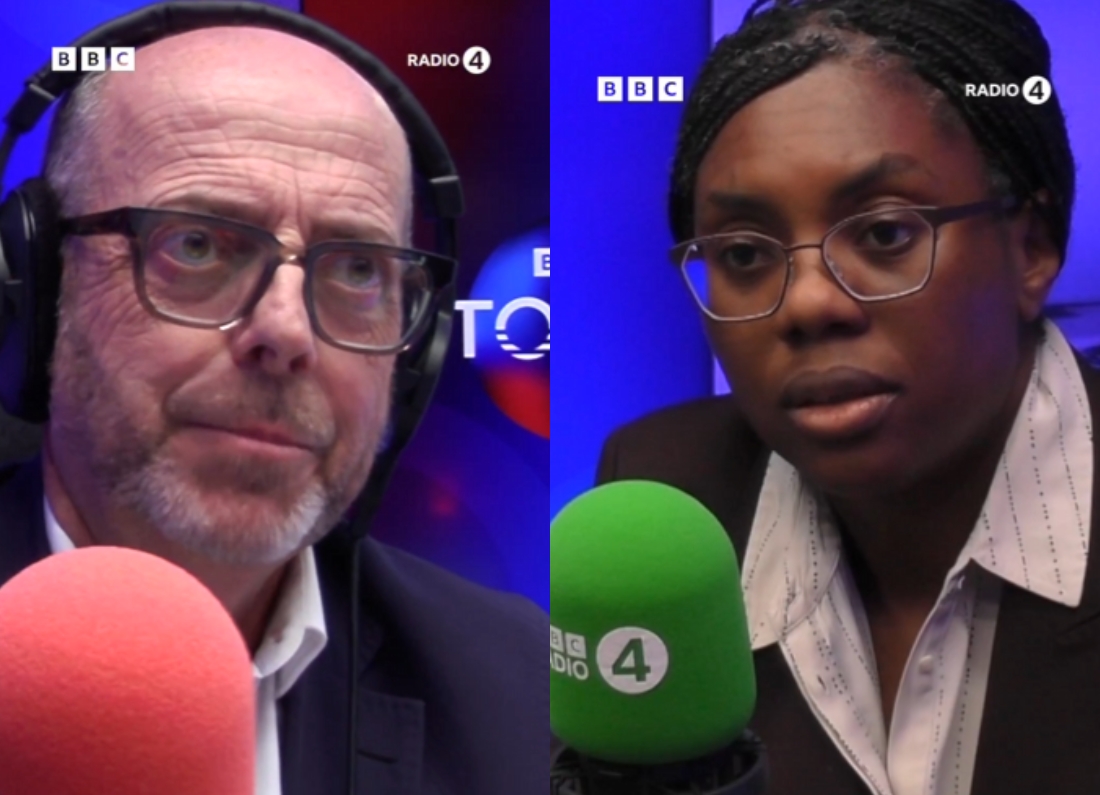
Conservative leader Kemi Badenoch used a Today programme interview to argue that pro-Palestine marches should be banned because they platform antisemitism – while defending the right of Tommy Robinson to hold marches despite their association with anti-Muslim hatred – and questioned whether Nigel Farage’s undisclosed £5 million personal gift from a crypto billionaire means he has been “bought.”
The interview produced two of the week’s most striking political moments: a defence of a distinction between marches that many will find difficult to justify on consistent principles, and a direct attack on Reform UK’s leader from the Conservatives that goes considerably further than anything previously said publicly about the Harborne donation.
The marches argument
Badenoch argued that pro-Palestine marches should be banned on the grounds that they have platformed antisemitism – citing the stabbing of two Jewish men in Golders Green last week and the killing of two Jewish men at Heaton Park synagogue last year.
When it was put to her that Tommy Robinson marches are a platform for anti-Muslim hatred and that Muslims might feel threatened by things said at Robinson events, Badenoch said the two kinds of marches were “different” and “not the same.”
She went on: “Criticism of religion is allowed in this country. We mustn’t mix the two things. I am talking about the attacks on Jews. It’s not the faith that’s being attacked, it’s the people.”
She then rejected what she called “whataboutery” on antisemitism. “I do have to ask, why is it that whenever we’re talking about Jewish hatred, we always have ‘what about, what about’? When something happens to Black people, no one does the whataboutery. When something does happen to Muslims, we don’t say what about antisemitism? Why do we have this double standard that, whenever there’s an issue with antisemitism and Jews being attacked, we have to broaden it out all the time?”
Why the distinction is contested
Badenoch’s argument contains an internal tension that critics were quick to identify. She frames pro-Palestine marches as platforms for attacks on Jewish people as people – not on Judaism as a faith. She frames Tommy Robinson marches as platforms for criticism of religion – Islam – rather than attacks on Muslim people as people.
This distinction does not hold up to scrutiny. Tommy Robinson marches have been documented sites of anti-Muslim abuse, threats and intimidation directed at Muslim individuals and communities – not abstract theological debate about Islam. The victims are Muslim people, not a religious text.
Badenoch’s “whataboutery” argument is also logically circular. She invokes it specifically to prevent the comparison she finds uncomfortable – between the standard she is applying to pro-Palestine marches and the standard she is applying to Robinson marches. The comparison is not whataboutery. It is the straightforward application of the principle she is invoking.
Badenoch is free to argue that pro-Palestine marches should be banned. But the argument requires engaging with why the same reasoning does not apply to Robinson marches – not dismissing the comparison as a deflection from antisemitism.
The Farage ‘bought’ attack
The second major moment in the interview came when Badenoch was asked about whether right-wing voters wanting rid of Labour should back Reform. She turned the question into a direct attack on Farage’s character.
“You look at Nigel Farage’s fishy £5m,” she said. “I think that’s a very, very concerning story. No one gets £5m directly. This was not for his party. He kept it a secret. What was that money for? Who’s bought him?”
When it was put to her that Farage insists the gift was personal, she said: “I don’t understand why somebody who works in crypto gives this sort of personal gift, as Farage calls it, and then all of a sudden Farage is promoting crypto. He should have declared it. We’ve already made a report to the standards committee. He should have declared it because those are the rules in this country. He is not someone who plays by the rules. I play by the rules.”
The word “bought” is significant. It is not a claim about parliamentary procedure – it is an allegation about personal corruption. It suggests that Harborne’s £5 million gift was not a personal kindness but a purchase of political influence, and that Farage’s subsequent advocacy for cryptocurrency policy was the service rendered in return.
What Harborne and Farage say
Harborne has said he was not expecting anything in return for the gift “apart from ensuring Farage’s safety.” He told the Telegraph the donation was made when Farage was out of frontline politics and before he had announced he would stand as an MP.
Farage has said the money was a personal unconditional gift for his security, that he has “not promised Harborne a single thing in return,” and that his advocacy for cryptocurrency is an independent political position. He said: “I believe strongly in crypto, but that’s not because someone gave me money.”
The Conservatives have referred the matter to the parliamentary standards commissioner. Both Labour and the Conservatives consider the failure to declare the gift a breach of the rules, even if Farage’s position – that it was personal and therefore did not require declaration – is the one being tested through that process.
The political context
Badenoch’s interview came in the days before the May 7 local elections, in which the Conservative Party is expected to lose most of the councils it controls to Reform UK. Her attack on Farage is therefore both a matter of principle and a matter of political survival – the Conservatives need to give voters a reason to choose them over Reform, and the Harborne donation provides a direct line of attack on Farage’s credibility as an anti-establishment outsider.
Whether “who bought him?” breaks through with the voters who are currently moving from Conservative to Reform is uncertain. But it represents a sharper and more direct challenge to Farage’s financial integrity than the Conservative Party has previously been willing to make publicly.
You may also like: Reform’s plan to scrap renewable energy contracts could trigger Truss-style chaos, industry chief warns