


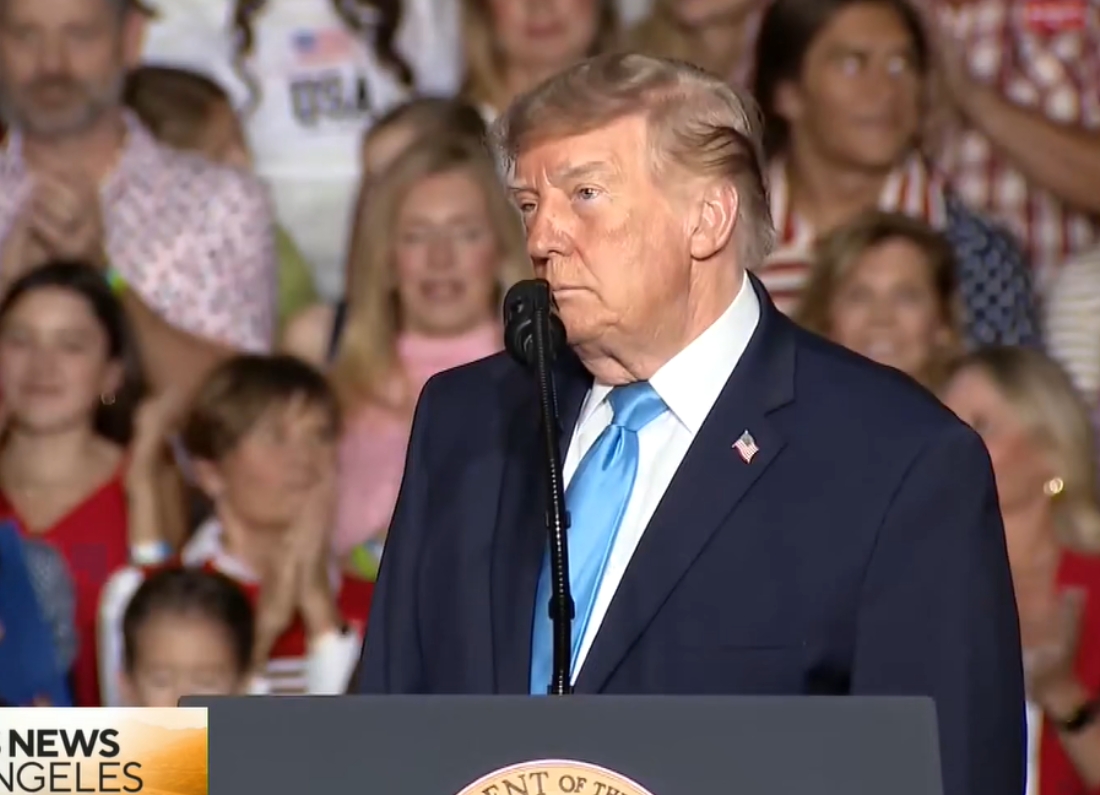
Donald Trump has reignited fresh speculation about how long he wants to stay in the White House after posting a provocative message on Truth Social asking supporters whether he should try for a “fourth term”.
In a short late-night post, the US president wrote: “RECORD NUMBERS ALL OVER THE PLACE! SHOULD I TRY FOR A FOURTH TERM?”
Even by Trump’s standards, the wording is striking – not least because the US constitution’s 22nd Amendment explicitly limits presidents to two elected terms. But Trump has a long track record of flirting with the idea of staying in power longer than the rules allow, often couching it as a joke, a provocation, or a rallying cry to his base. This time, the wording “fourth” – rather than “third” – is what has set off the latest round of confusion and argument.
🧨 What Trump actually said – and why “fourth term” is doing the work
The post itself is doing two things at once: boasting and baiting.
The boast is the “record numbers” claim – a familiar Trump move, designed to frame everything as proof of popular demand. The bait is the question: should he try for a fourth term?
The immediate complication is arithmetic. Trump is currently serving a second term. So why “fourth”?
One explanation is that Trump continues to treat the 2020 election as illegitimate, repeating his false claim that he “really” won. In that framing, his current term becomes his “third” – and the next would be his “fourth”. Another explanation is simpler: it’s a deliberately inflammatory line meant to dominate headlines and force allies and opponents into reacting on his terms.
Either way, the post lands in the same place: it invites an argument about whether the rules can be bent -and whether he should attempt it.
📜 The constitutional barrier he can’t wish away
The 22nd Amendment is blunt: “No person shall be elected to the office of the President more than twice.”
That’s why the mainstream reading is straightforward: a third elected term is prohibited, and so would be any attempt to be elected again after two wins.
To change that, the US would need a constitutional amendment – a process that requires supermajorities in Congress and ratification by states. In other words: politically enormous, structurally difficult, and not something that happens because a president posts in all caps at midnight.
⚖️ The “workarounds” people keep floating – and why they’re so contested
Still, Trumpworld has occasionally played with ideas that try to skate around the limit – the most commonly discussed being a route via the vice presidency. That theory goes: run as VP, then ascend to the presidency.
But that’s exactly where legal uncertainty and political chaos would collide. Critics argue it clashes with other constitutional provisions and the spirit of term limits; supporters try to sell it as a technical loophole. The point isn’t that it’s a clean path – it isn’t – but that the conversation itself keeps the idea alive.
Trump has engaged with this universe of “cute” constitutional games before. Reporting in late 2025 noted him dismissing the VP workaround as “too cute” while still basking in the attention around term-limit speculation.
🎭 He’s teased it before – and sometimes half-walked it back
Trump has repeatedly teased the notion of serving beyond the normal endpoint, then sometimes stepped back without fully closing the door.
CBS News documented that he downplayed talk of a third term in late October, acknowledging he is “not allowed to run” again, while still leaving plenty of performative ambiguity around his intentions.
That pattern matters because it’s part of how Trump’s political messaging works: push the boundary, watch the reaction, then decide whether to escalate or retreat – all while keeping the spotlight.
🗳️ Why this matters even if it never happens
Even if there is no realistic legal route to a “fourth term,” the politics of it can still be potent.
For Trump’s supporters, it functions as a loyalty test and a signal of dominance – the idea that rules are obstacles to be challenged, not limits to be respected. For opponents, it is a warning flare about democratic norms. For institutions and rivals inside the Republican Party, it complicates planning for a post-Trump future – especially when he has also floated possible successors like JD Vance and Marco Rubio in recent months.
And for everyone else, it keeps American politics stuck in the same exhausting loop: not “what policy is next?” but “what norm gets stress-tested next?”
You may also like: What the 22nd Amendment actually says about presidential term limits





Leave a Reply