

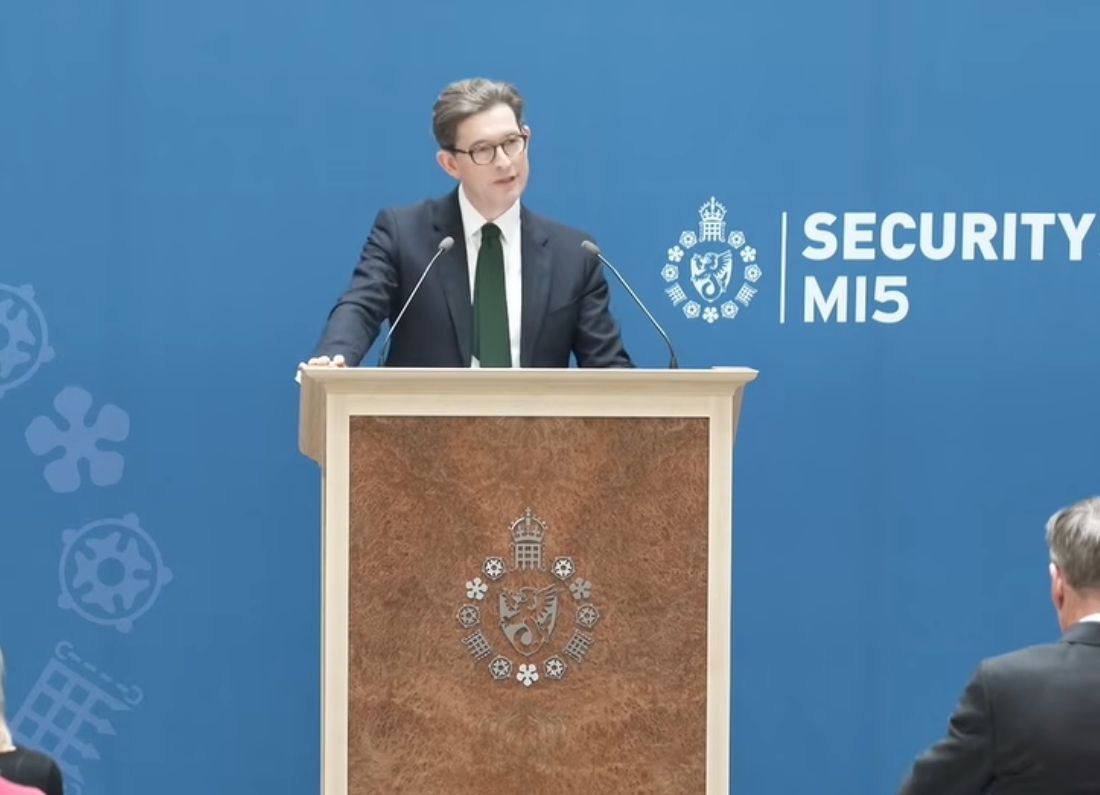
MI5 has warned that anti-immigration and anti-Muslim extremism is increasingly developing into plans for terrorist attacks in Britain, as the country’s overall terror threat returns to its highest level in almost five years.
Sir Ken McCallum, the director general of MI5, said the most significant recent change in extreme right-wing terrorism had been the movement from grievance and online hatred towards what the security service regards as genuine terrorist intent.
In his annual threat update at Thames House, McCallum said:
“Over the last year the most marked trend has been an increase in cases where extremist versions of anti-immigration and anti-Muslim grievance are tipping into terrorist intent.”
He said MI5 had dealt with would-be attackers who wanted to target mosques and locations connected with immigration and asylum.
The warning comes as the Joint Terrorism Analysis Centre has raised the UK terror threat level back to SEVERE, meaning an attack is considered highly likely. McCallum said the change reflected the terrorist threat as a whole, but added that the recent increase was driven in significant part by extreme right-wing terrorism.
MI5 says the threat is becoming younger
One of the most troubling parts of McCallum’s assessment was the age of some of the people now appearing in extreme-right investigations.
He said MI5 had recently been investigating a radicalised 13-year-old in Britain whose case produced intelligence that helped an overseas partner prevent a potentially lethal attack.
McCallum also pointed to the case of a 16-year-old from Inverclyde who received a ten-year prison sentence after attempting to plan an attack on his local Islamic centre.
He said:
“Extreme Right Wing Terrorism also continues to skew young, driven by the internet.”
That concern is not new, but the scale has become increasingly difficult for counter-terrorism agencies to ignore.
In MI5’s 2024 threat update, McCallum said 13 per cent of all people being investigated by the security service for involvement in UK terrorism were under 18, around three times the proportion recorded three years earlier. He warned then that extreme right-wing terrorism was particularly concentrated among younger people consuming propaganda and violent material online.
The latest update suggests that problem has continued.
From online hatred to real attack planning
MI5 has repeatedly warned that the internet has changed the nature of terrorism in Britain.
Traditional terrorist organisations still matter, but investigators are increasingly dealing with individuals who may have no direct relationship with an established group and whose beliefs are assembled from a mixture of extremist propaganda, conspiracy theories and online subcultures.
McCallum said that in both Islamist and extreme right-wing terrorism, lone individuals radicalised online now make up much of the threat.
The difficulty for investigators is distinguishing between people posting violent material or engaging in hateful online rhetoric and the much smaller number who are moving towards an actual attack.
The security service says that line can be difficult to identify until a suspect starts looking for weapons, researching targets or taking other practical steps.
McCallum said the cases MI5 had encountered over the past year included would-be attackers considering mosques and asylum-related sites as targets.
Asylum sites have increasingly become flashpoints
The warning comes after years of increasingly heated political debate around asylum hotels, small boat crossings and immigration.
Protests and counter-protests have taken place outside hotels housing asylum seekers around Britain, while some locations have been targeted by violence and intimidation.
The most serious example in recent years came during the disorder following the Southport killings in 2024, when a hotel housing asylum seekers in Rotherham was attacked by a crowd and attempts were made to set fire to the building while people were inside.
Police and security officials have repeatedly distinguished between lawful opposition to immigration policy and extremism or terrorism.
McCallum’s warning was specifically about the point at which grievance becomes an intention to carry out serious violence, rather than about people simply holding anti-immigration views.
That distinction matters because MI5 is not describing opposition to immigration as terrorism. It is warning that a growing subset of people consuming extreme anti-immigration and anti-Muslim material are progressing towards plots that meet the terrorist threshold.
UK threat level returns to SEVERE
McCallum also confirmed that the national terrorism threat level has recently returned to SEVERE for the first time in almost five years.
SEVERE is the second-highest level on the UK system and means an attack is considered highly likely.
The current threat does not come from one ideological source. MI5 continues to investigate Islamist terrorism, extreme right-wing terrorism, Northern Ireland-related violence and other emerging forms of extremist activity.
McCallum said Islamic State and al-Qaida remain capable of directing or inspiring attacks, while three Islamist extremists were convicted in February after planning to use automatic weapons against members of the Jewish community in Manchester.
But he made clear that the rise in extreme right-wing terrorist activity had played an important part in the latest change to the overall threat assessment.
Russia, Iran and China add to MI5’s workload
The domestic terrorism warning was only one part of a much broader assessment of the threats facing Britain.
McCallum said MI5 is now devoting roughly as much effort to hostile-state activity as it does to terrorism, with operations linked to Russia, Iran and China dramatically increasing over the past decade.
Russia remains what MI5 describes as the most aggressive state threat to Britain, with Moscow accused of cyber attacks, espionage and attempts to interfere in democratic politics.
McCallum also confirmed that Russia had attempted to interfere in the 2016 Brexit referendum through pro-Brexit media activity and social-media manipulation, while saying the impact appeared to have been limited.
Iran has become another major concern. MI5 says it has dealt with repeated Iranian-linked plots against people and interests in Britain, including threats involving Jewish communities, dissidents and military sites.
McCallum said the suspected plot involving RAF Fairford was “not unique” and warned that Iran’s hostile activity in Britain had become increasingly aggressive.
MI5 is also preparing for AI-powered threats
The agency is creating a new AI Threat Assessment Centre amid concerns that artificial intelligence could make terrorism and hostile-state activity more dangerous.
McCallum said AI could help extremists improve attack planning, make cyber operations more effective and potentially lower the technical barrier to developing biological threats.
The technology also offers opportunities for the intelligence services themselves, including faster analysis of large amounts of data and improved detection of suspicious activity.
MI5’s concern is that the same tools increasingly used by businesses and ordinary consumers will also become available to lone attackers and hostile governments with far more dangerous intentions.
‘No system can catch them all’
McCallum stressed that the recent plots involving young extreme-right suspects had been stopped through intelligence work and international cooperation, but he warned that security agencies could not guarantee every attack would be prevented.
He said:
“Both plots were averted by rapid professional work. We will continue to work tirelessly to detect and get ahead of such volatile threats. But no system can catch them all.”
That is why MI5 is increasingly talking not only about intelligence and policing, but also about what McCallum calls “societal resilience”.
The agency wants businesses, public bodies and communities to be more aware of the threat environment and better prepared to respond when extremists or hostile states try to exploit social division.
McCallum said Britain had entered “a new era of national security” in which terrorism and hostile-state activity increasingly overlap with online disinformation, political intimidation and rapidly changing technology.







Leave a Reply