

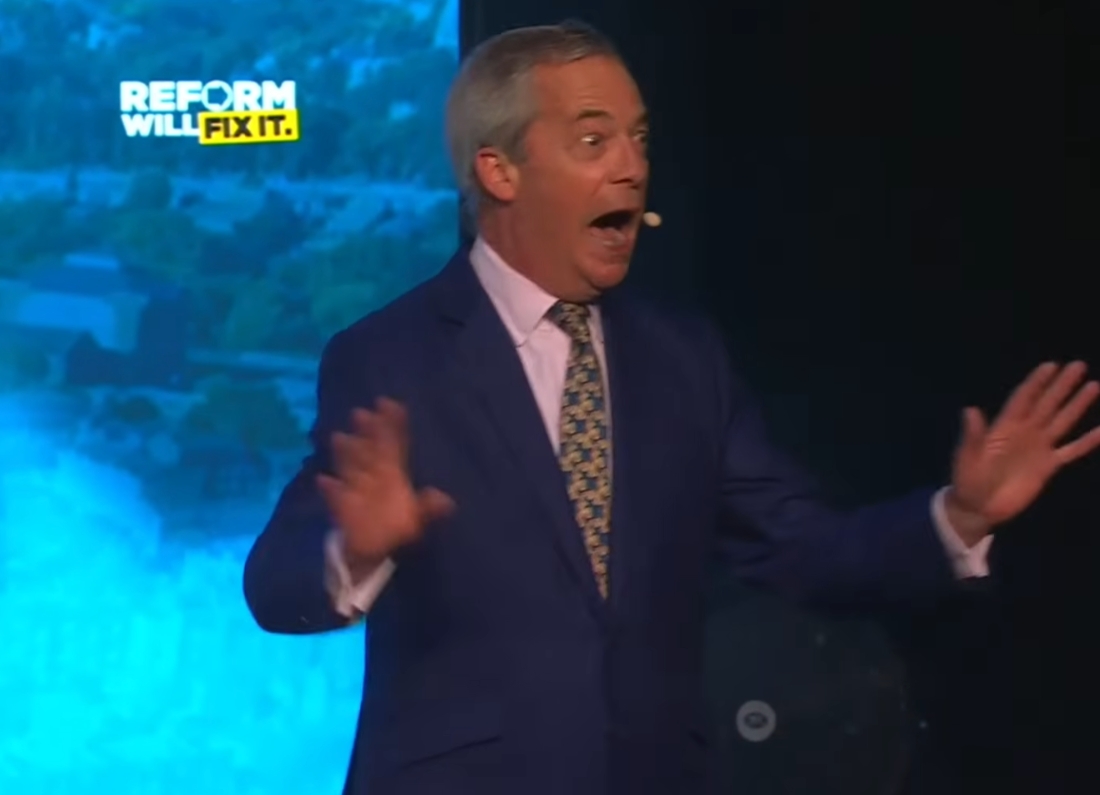
Nigel Farage faced repeated interruptions from protesters at Reform UK’s London local election campaign launch on Saturday evening, as activists disrupted the event both inside and outside the venue – and as a major march against the far right was taking place elsewhere in the capital on the same day.
The rally took place at Fairfield Halls in Croydon, a council-owned arts venue that had itself become a source of local controversy in the weeks before the event. The choice of location was deliberate: Reform has set its sights on making significant gains in the London borough’s May elections and used the evening to launch its push for Croydon and wider London.
The disruptions inside the hall
The most visible moments of the evening came when multiple activists inside the hall stood up to challenge Farage directly during his speech.
Campaigners from youth climate movement Green New Deal Rising (GNDR) chanted “Reform is not welcome here” and accused the party of being bankrolled by billionaires at the expense of working people. Both activists were removed by security after making their statements.
A separate man also rose to his feet during the speech. “I’m a son of a bricklayer and the son of a teacher,” he told the room, “and you’ve done f*** all for the working class.” He too was escorted out.
Farage’s response to the disruptions was characteristic. He repeatedly shouted “Boring! Boring! Boring!” at the hecklers – and, in what appeared to be a pre-prepared touch, a custom-made “Boring” graphic appeared on the screen behind him, echoing his standard reply to hecklers. He also told the audience: “We’ve got a screamer.”
The fact that the graphic appeared to have been prepared in advance drew comment online, with some observers suggesting it indicated Reform had anticipated disruptions – and had stage-managed its response accordingly.
After the hecklers were removed, Farage addressed the crowd: “What other party leader in modern Britain would have a public event and invite anyone to come along and listen to what I have to say? You can agree, you can disagree – it doesn’t matter. Who else would come along and do that?”
The protesters’ message
After the event, the GNDR activists explained their actions in a video posted on X. They said they had disrupted the rally “because we will not allow Nigel Farage’s hate to exist unopposed in London.” One of the activists added: “Reform is doing nothing for working class people like me and you. All that they’re doing is stamping on us and making us poorer and poorer, while they’re funded by billionaires.”
The group also referenced the timing of their protest, noting it came on the same day as a large anti-far-right march through central London – the Together Alliance demonstration, which drew significant crowds and was billed by organisers as the biggest march in the UK to counter the far right.
Protests outside the venue
The disruption was not confined to inside Fairfield Halls. Protesters from Stand Up To Racism also gathered outside the building during the rally, chanting slogans including “Shame on you” and “Off our streets.”
Michael Holland from Croydon Stand Up To Racism told the BBC that Farage was “not welcome in Croydon” because “he ferments division and we are not having it.” He added: “We are a multicultural town. The vast majority of people in Croydon are anti-racist and we get on brilliantly together.”
The venue itself had been a source of contention ahead of the event. A coalition of community groups had written to BH Live, the social enterprise that operates the venue, expressing dismay at the booking. The letter noted that Croydon is one of the most diverse boroughs in the country, describing it as “the very opposite of what Farage and Reform want Britain to look like.”
What Farage was actually there to say
Beyond the disruptions, the rally had a clear political purpose: to launch Reform’s London local election campaign ahead of the 7 May polls.
Farage said his party is “competitive” in a number of London boroughs, naming Bromley, Bexley and Havering specifically, and suggesting there were “maybe two or three others” where Reform could make significant gains. Analysts have suggested Reform could win eight or nine council seats in Croydon alone, mostly at the expense of the Conservatives.
Reform has invested heavily in the 2026 local elections. The party is reported to have committed around £5 million to the local election campaign nationally, including full-page advertisements in the Metro. The Croydon rally was billed as a “high-energy, broadcast-style event” on the party’s own events page.
Croydon is currently under Conservative control, and the threat from Reform is being closely watched – not just by Labour and the Greens, but by the sitting Conservative Mayor Jason Perry, whose re-election prospects could be complicated if Reform splits the right-wing vote in the borough.
The bigger picture
Saturday’s events in Croydon took place against a notable backdrop. Across the city, the Together Alliance march was drawing large crowds through central London in opposition to the far right. Organisers of the march claimed attendance of around 500,000. Protesters carried placards including “Stop Reform” and “Don’t let Farage and Reform divide the country.”
The contrast – Farage rallying supporters in a council-owned Croydon venue while a major anti-far-right demonstration moved through the capital – captured something of the polarised mood of British politics with just over five weeks until polling day.
Whether the heckling and protests translate into votes against Reform on 7 May remains to be seen. What Saturday demonstrated is that wherever Reform campaigns in London, it is unlikely to do so without pushback.
You may also like: The ‘Manosphere’ Liability: Why Reform UK is distancing itself from extreme online figures

Leave a Reply