

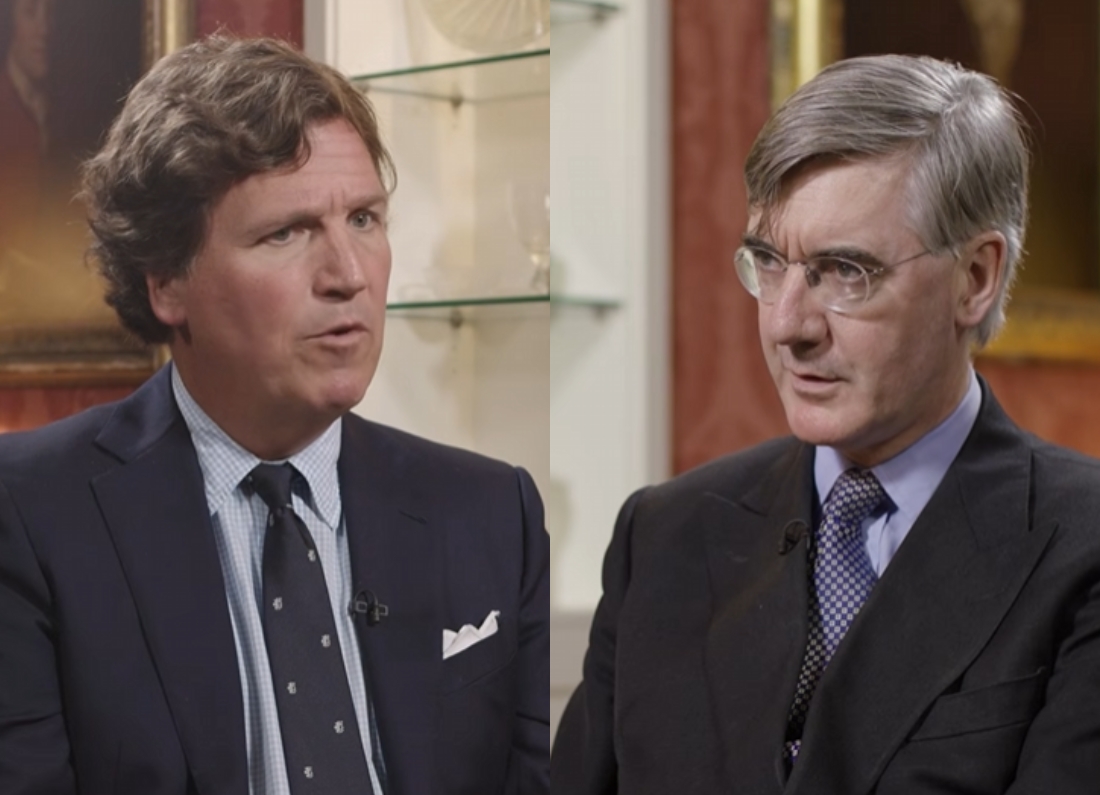
Jacob Rees-Mogg has found himself receiving praise from some very unexpected corners of the internet after challenging Tucker Carlson over Russia, NATO and the war in Ukraine.
The former Conservative cabinet minister appeared on Carlson’s podcast for a long and occasionally surreal discussion about Britain’s defence policy, the Second World War, nuclear weapons and whether the UK should continue supporting Ukraine.
Carlson framed the interview around the idea that Britain had little to gain from confrontation with Russia and repeatedly questioned why the UK should be prepared to fight in defence of Ukraine.
Rees-Mogg strongly disagreed.
One particular exchange has now gone viral because Carlson attempted to argue that Russia had been provoked by broken Western promises over NATO expansion, only for Rees-Mogg to bring up the Budapest Memorandum and ask what value international agreements would have if Russia could simply disregard them.
You can watch the full interview further down the article.
Carlson brings up NATO expansion
The argument came during a discussion about why Britain should support Ukraine and what Russia had previously agreed to.
Rees-Mogg pointed to the 1994 Budapest Memorandum, under which Ukraine gave up the nuclear weapons left on its territory following the collapse of the Soviet Union. Russia, the United States and the United Kingdom reaffirmed commitments to respect Ukraine’s independence, sovereignty and existing borders, and to refrain from threatening or using force against its territorial integrity.
Carlson responded by moving the discussion onto NATO.
He said there had subsequently been:
“a verbal agreement which has been testified to by people who were present, that the United States would not expand NATO to Russia’s borders.”
He argued that Russian concerns about having NATO and potentially nuclear weapons close to its territory were understandable.
Rees-Mogg’s point was much simpler: whatever had been said during discussions surrounding German reunification, Russia had later signed an agreement specifically recognising Ukraine’s sovereignty and borders.
When Carlson suggested those earlier assurances changed the picture, Rees-Mogg replied:
“All sorts of things have happened.”
Carlson then argued that the immediate question was why Britain should risk a potentially nuclear confrontation with Russia.
Rees-Mogg answered that deterrence works by making clear that aggression will carry consequences:
“What I am arguing is that if we are prepared for war, war becomes less likely. That’s the whole basis of deterrence.”
Carlson replied:
“How about if you stop fighting the war, they will be less likely to nuke you?”
Rees-Mogg rejected that argument and said allowing Russia to take Ukraine would increase rather than reduce the danger of further aggression.
Carlson’s ‘promise’ claim is more complicated than he suggested
The history Carlson invoked has been argued over for decades.
There were discussions in 1990, during negotiations over German reunification, in which Western officials used language suggesting NATO’s military presence would not move further east. Former British ambassador Sir Rodric Braithwaite has noted that some American and West German officials used loose language and that Western officials later said there was no intention at that time to enlarge NATO further.
But no treaty was signed banning future NATO enlargement beyond Germany.
The formal settlement over German reunification contained restrictions relating to foreign forces and nuclear weapons in the territory of the former East Germany, but it did not give the Soviet Union a permanent veto over countries in central and eastern Europe later applying for NATO membership.
NATO has long rejected the claim that the alliance formally promised never to expand eastwards, pointing out that even Mikhail Gorbachev later said wider NATO enlargement was not actually discussed during those negotiations.
That does not mean Russia did not resent NATO’s later expansion or believe it had been misled politically. It does mean Carlson’s presentation of a clear Western promise followed by a straightforward betrayal leaves out a great deal of history.
Rees-Mogg turns it back onto the Budapest Memorandum
The part of the exchange which attracted the most attention came when Rees-Mogg forced the discussion back onto the commitments Russia itself had made to Ukraine.
The Budapest Memorandum was signed on December 5, 1994 by Ukraine, Russia, Britain and the United States. Ukraine agreed to eliminate the nuclear weapons on its territory and join the Nuclear Non-Proliferation Treaty as a non-nuclear state.
In return, Russia, Britain and the US reaffirmed that they would respect Ukraine’s independence and existing borders and refrain from threatening or using force against it.
Rees-Mogg challenged the logic of treating that agreement as effectively meaningless once Russia later decided its strategic interests had changed.
Carlson insisted he was not saying the agreement was pointless, but quickly returned to NATO expansion and the events in Ukraine after 2014.
For viewers, that was the moment Rees-Mogg appeared to have Carlson stuck.
The internet found itself praising Rees-Mogg
The response was particularly striking because plenty of the people sharing the clip made clear they were not normally Jacob Rees-Mogg admirers.
@JoshEakle wrote:
“Tucker got called out to his face on the ‘NATO expansion’ myth, in real time, and starting squirming.
It is simultaneously satisfying and embarrassing to watch.
Tucker might be the most repulsive figure in American public life.”
@hissgoescobra wrote:
“Tucker gets absolutely schooled on the Budapest Memorandum and the myth of ‘no NATO expansion.’ He literally crumbles when faced with basic facts, as does every Russian propagandist. Glorious.”
@NickCohen4 admitted:
“Rees Mogg is magnificent here – please don’t shout at me”
@Cox_A_R wrote:
“In every clip of Jacob Rees Mogg with Tucker Carlson I’ve seen, he wipes the floor with him. Great work.”
And @goldman wrote:
“I don’t like Rees-Mogg at all. But listen, if you bring weak ass sophistry into a knife fight with an old Etonian, Oxford union, parliamentarian you are going to get FUCKED UP.
There’s a bene gesserit breeding program that designed this man for victory in this form of combat.…”
@MahyarTousi added:
“Jacob skilfully exposed Tucker’s low IQ way of thinking about the world order.”
It was not the only moment Carlson left Rees-Mogg baffled
The wider interview contained several other extraordinary exchanges.
At one point Carlson argued that Russia does not punish people simply because it dislikes their ideas, prompting Rees-Mogg to respond with an incredulous:
“WHAT?”
That clip also went viral, largely because even viewers with little affection for Rees-Mogg found themselves sharing his disbelief.
Carlson also questioned whether Britain should have entered the Second World War after Nazi Germany invaded Poland, arguing that the UK destroyed its empire and weakened itself by fighting.
Rees-Mogg replied that opposing Hitler had been:
“fundamental.”
He described the war as:
“the classic Good versus Evil.”
When Carlson asked whether Britain had benefited from fighting it, Rees-Mogg’s answer was straightforward:
“We did the right thing.”
Those exchanges help explain why the NATO clip landed so strongly. Carlson appeared to expect ideological common ground with a prominent Brexiteer and traditional conservative, but repeatedly discovered that Rees-Mogg’s conservatism does not extend to accepting Carlson’s increasingly sympathetic framing of Vladimir Putin or revisionist arguments about Nazi Germany.
Rees-Mogg now says he cannot believe Carlson means it
Rees-Mogg has since spoken about the interview on Times Radio and said he struggled to believe Carlson genuinely held some of the positions he expressed.
He described parts of Carlson’s argument as “nonsense” and suggested the American broadcaster may have found that more extreme material attracts clicks, attention and money from audiences drawn to conspiracy theories.
That assessment may be one of the few things likely to unite people across a surprisingly wide stretch of British politics.
There are plenty of arguments to have about NATO, Western foreign policy and whether Europe has relied too heavily on the United States for its security. There are also legitimate historical debates about how NATO enlargement was handled after the collapse of the Soviet Union.
But Carlson’s claim ran into a basic problem: Russia itself signed an agreement recognising Ukraine’s borders after those earlier German reunification discussions had already taken place.




Leave a Reply