

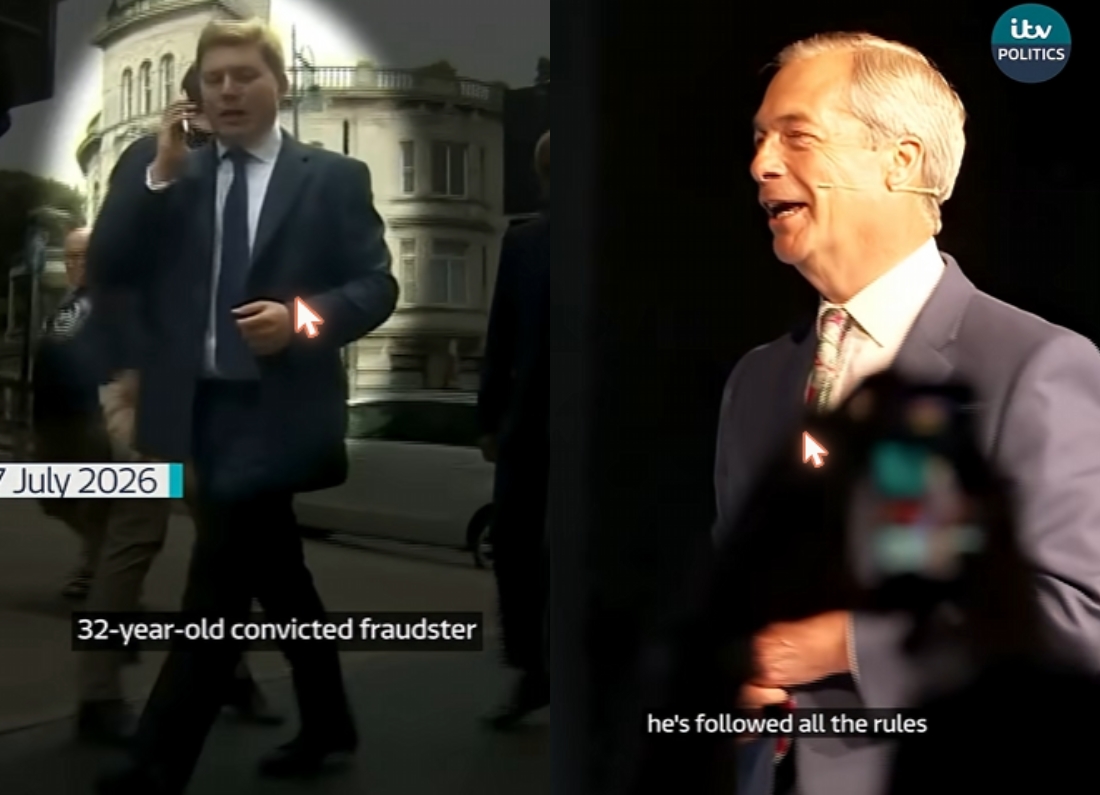
Days before an “unexplained” £500,000 donation reached Reform UK, George Cottrell, the convicted criminal who has secretly funded Nigel Farage for years, opened an account with an obscure Australian payments firm that would go on to channel the money.
Cottrell became a client of Oneify, a little-known company that moves crypto and traditional currency across borders, in late May 2024. Within a fortnight, the platform had been used as a conduit for donations whose ultimate source the National Crime Agency has been unable to trace.
How the money moved
An initial £1m was deposited into Britain Means Business, a UK company owned by Richard Tice, who was then leading Reform. Tice says Fiona Cottrell, George’s mother, made the donation. Whether the money actually originated from George Cottrell’s newly opened Oneify account remains unknown. According to the Guardian, Fiona Cottrell received several six-figure tranches of cash from an unidentified source shortly before making the £1m payment through the platform.
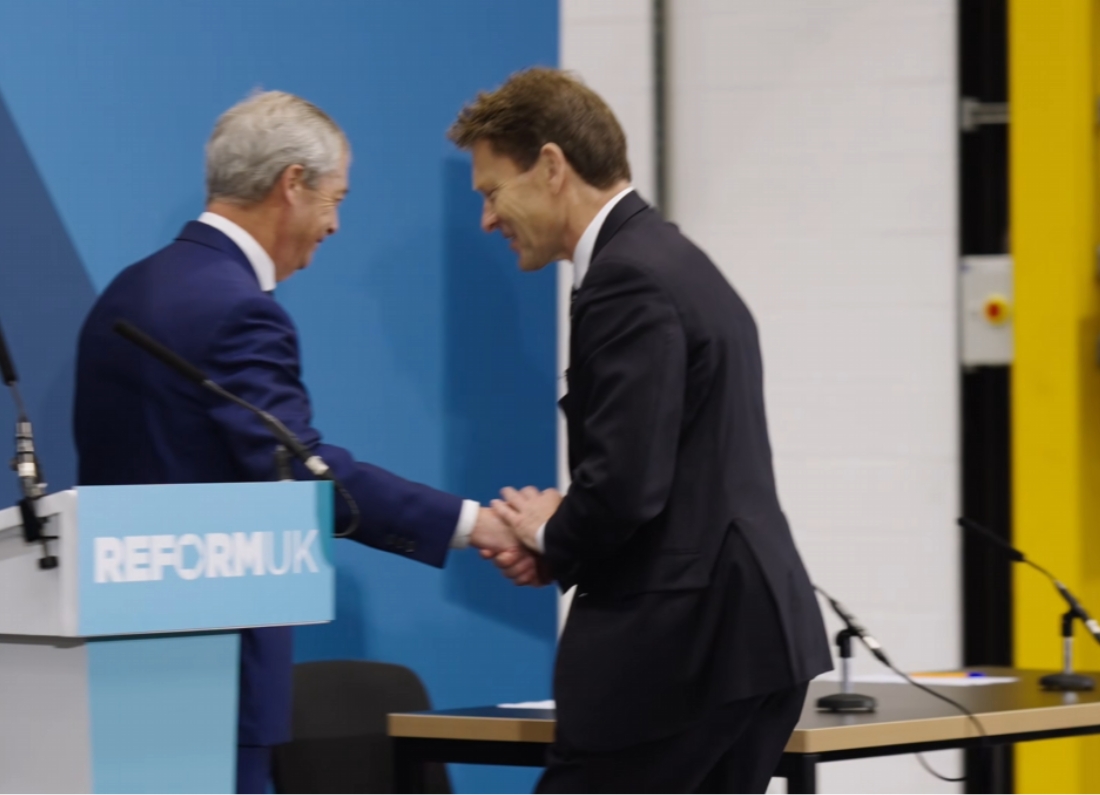
Tice then transferred half that sum, £500,000, to Reform. His own company, rather than Fiona Cottrell, was listed as the donor on Electoral Commission filings.
Taken together with the payments already under Metropolitan Police investigation, Fiona Cottrell had a role in 35% of all funds Reform received during the election campaign.
Why the “permissible donor” question matters
The disclosures raise the obvious question of whether George Cottrell, who was already funding Farage’s staff, security and social media output, was the true source behind donations attributed to his mother. Fiona Cottrell qualified as a “permissible donor” because she appeared on the UK electoral roll at the time.
George Cottrell, a tax resident in Montenegro known as “Posh George,” says he was eligible to donate as an “overseas voter” by the time of the election, though it remains unclear whether he actually held that status at the time these specific payments were made. Concealing the true source of a political donation can carry a substantial fine or a prison sentence.
Cottrell, 32, was convicted of wire fraud in the United States in 2017 after offering to launder money on the dark web. His 67-year-old mother is a self-described “retired stylist” living in a cottage in rural Worcestershire, with no history of political activity or donations before the 2024 general election.
Since June last year, Fiona Cottrell has been at the centre of a separate Scotland Yard inquiry into a £500,000 donation made in her own name, rather than through Tice’s company, during the same campaign. It is not clear whether the Oneify-routed £500,000 forms part of that same criminal investigation.
What Cottrell’s lawyers say
George Cottrell has never previously been linked to Oneify, based just outside Sydney, and has continued using the platform to make and receive payments as recently as this year. Asked this month whether Cottrell transferred money to his mother before her donations to Reform, his lawyers at Carter Ruck said: “Our client has confirmed his instructions that any donations by his mother have been entirely her own decision.” They added: “He therefore declines to engage with your wider questions.”
Cottrell held that position again this weekend, with his lawyers declining to discuss “private information” relating to banking transactions.
The timeline: election called, then the cash arrives
Cottrell opened his Oneify account through his wholly owned Montenegrin company, Private Family Office, on 28 May 2024, less than a week after Rishi Sunak called the snap general election. The entity he was instructed to deposit funds into was Oneify’s UK banking partner, SettleGo Solutions Ltd, since Oneify itself is not a UK-regulated financial entity.
At that point, Cottrell had already been secretly funding Farage for months, while Farage’s public position remained that he would not stand for Parliament. That changed on 3 June, when Farage announced he would return to frontline politics as Reform’s leader and its candidate for Clacton.
Within a week, £1m moved from Oneify to Britain Means Business, Tice’s company, previously known as Leave Means Leave. There is no reference to the payment anywhere in its unaudited accounts for the year.
Tice, who became MP for Boston & Skegness at that election, has said the £1m came entirely from Fiona Cottrell, describing her as a legally permissible donor from “a very successful aristocratic family” his own family had known for five decades. But the Guardian has reported that, before making the payment, “hundreds of thousands of dollars were repeatedly” deposited into her account from an unidentified source. The NCA was reportedly unable to determine the origin of those funds and contacted Austrac, Australia’s anti-money laundering agency, for assistance. Neither body appears to have confirmed the money was genuinely hers.
Once the £1m had passed through Oneify, Britain Means Business forwarded half of it, £500,000, to Reform in two instalments of £250,000, on 10 and 12 June.
The company behind the payments
Oneify describes itself as helping clients move money “globally,” from “Wollongong,” its headquarters near Sydney, to “Westminster.” Founded in 2016, the company built its website only three years ago and otherwise has almost no public footprint. It is wholly owned, via a shell company, by Dane Cornish, a 43-year-old Australian who describes himself on LinkedIn as an “experienced entrepreneur.”
His business partner in other offshore crypto ventures, though not formally connected to Oneify on paper, is Daniel Jefferies, a 62-year-old British citizen currently seeking residency in Monaco who made his money supplying payment processing systems to pornography and gambling companies. Jefferies declined to comment.
SettleGo, Oneify’s UK partner, is owned by Ozan Ozerk, a Cypriot-Norwegian millionaire. In November, Turkish authorities launched an investigation into a separate network of his companies over allegations of introducing “criminal assets” derived from “illegal betting activities” into the country’s financial system. Ozerk has denied wrongdoing, telling the Sunday Times the allegations are matters for his companies, not him personally.
George Cottrell has connections to all three men, Cornish, Jefferies and Ozerk, and has continued transacting through Oneify into this year.
A party in Montenegro offers a rare glimpse behind the curtain
Between 17 and 19 September 2025, Jefferies threw a party in Tivat, Montenegro, to mark his wife’s 60th birthday, arriving on a yacht reportedly costing €450,000 a week to charter and flying in DJs Pete Tong and Cameron Jack for a weekend of parties at local nightclubs and beach resorts.
At one dinner, sources say Jefferies was joined at the main table by Cottrell himself, alongside Ozerk, with Cornish seated nearby. On another night, guests partied at a bar above Salon Privé, a crypto-casino Cottrell is closely involved with, belonging to the owner of Tether.bet, the offshore gambling platform in which Cottrell is a key behind-the-scenes figure and occasional customer.
The casino also housed a “crypto ATM,” a machine converting cash into digital currency, which local politicians said belonged to Cottrell and which was the subject of a 2023 police investigation. Four armoured cash-in-transit vehicles, owned by the casino’s holding company, were parked behind the venue.
These disclosures offer a rare window into Cottrell’s business dealings, largely shielded from scrutiny by layers of offshore corporate structure. He remains closely involved in Tether.bet, which accepts bets in Tether, the cryptocurrency partly owned by Christopher Harborne, the same billionaire who gave Farage an undisclosed £5m gift shortly before the election. Cottrell separately places private bets for wealthy business associates and owns Geostrategy, a political consultancy operating between London and Delaware.
Why this matters for Farage
The relationship between Farage and Cottrell was well known within Westminster but escaped serious public scrutiny until a Sunday Times Insight investigation this month, which revealed Cottrell had provided in-kind benefits including staff, security, transport, social media production and accommodation, none of which Farage declared upon entering Parliament in 2024, an apparent breach of the rules.
Farage resigned as an MP and called a byelection in Clacton days after that investigation was published, citing it, alongside mounting questions over the undisclosed £5m Harborne gift, as evidence he was the victim of an establishment attack. He denies breaking any rules and has said the public, rather than parliamentary authorities, should judge his conduct. As a direct result of his resignation, both investigations, into Harborne and into Cottrell, have been suspended.
Since that speech, further allegations have surfaced. The Sunday Times revealed Fiona Cottrell was at the centre of a Scotland Yard inquiry into potential offences including “disguising” hundreds of thousands of pounds in donations to Reform. The Guardian later reported that both Cottrells had been questioned as part of that inquiry. Concealing a donation carries a penalty of a fine or up to a year in prison.
Farage’s principal declared opponent in the Clacton byelection, scheduled for 13 August, remains the satirical candidate Count Binface. Should Farage win, both suspended investigations would resume immediately, potentially resulting in his suspension from the Commons and, in turn, yet another byelection, while the separate criminal inquiries involving Cottrell and his mother continue regardless of the result.
Across the six weeks between the snap election being called and polling day on 4 July 2024, Fiona Cottrell appears to have provided, directly or indirectly, more than 35% of all funding Reform UK received.
The responses
Fiona Cottrell declined to comment on any of these matters when approached at her Worcestershire home last month. George Cottrell, through Carter Ruck, said he “does not know, and does not remember having met, Ozan Ozerk,” and “will not comment further on questions related to his mother’s donation” since it constitutes “obviously private information.” His lawyers added: “Information relating to banking transactions is subject to strict obligations of confidence and can only have been obtained by unlawful means; that is, by someone acting in breach of obligations of confidence.”
Cornish and Oneify did not respond to requests for comment. Ozerk said: “SettleGo Solutions Ltd is an independent and regulated corporate entity and I have no involvement in its day-to-day activities.” He described only a “limited” acquaintance with Cornish, no business relationship, and said he had no relationship whatsoever with the Jefferies family or either Cottrell.
A spokesperson for SettleGo said: “Dr Ozerk is not involved in the day-to-day running of our business. SettleGo Solutions Ltd is an independent business, regulated in the UK. The company operates in compliance with all regulatory standards, and all necessary due diligence. We cannot comment on individual customers or transactions.”
The NCA said it “does not routinely confirm or deny the existence of investigations.” Austrac said it does not “comment on individual businesses or its intelligence-sharing activities.” A Reform UK spokesperson said: “Reform takes pride in its stringent vetting of donations and always ensures that the Electoral Commission guidelines on donations, as set out in the Political Parties, Elections and Referendums Act 2000, are strictly followed, as has been the case with donations so far.”






Leave a Reply