

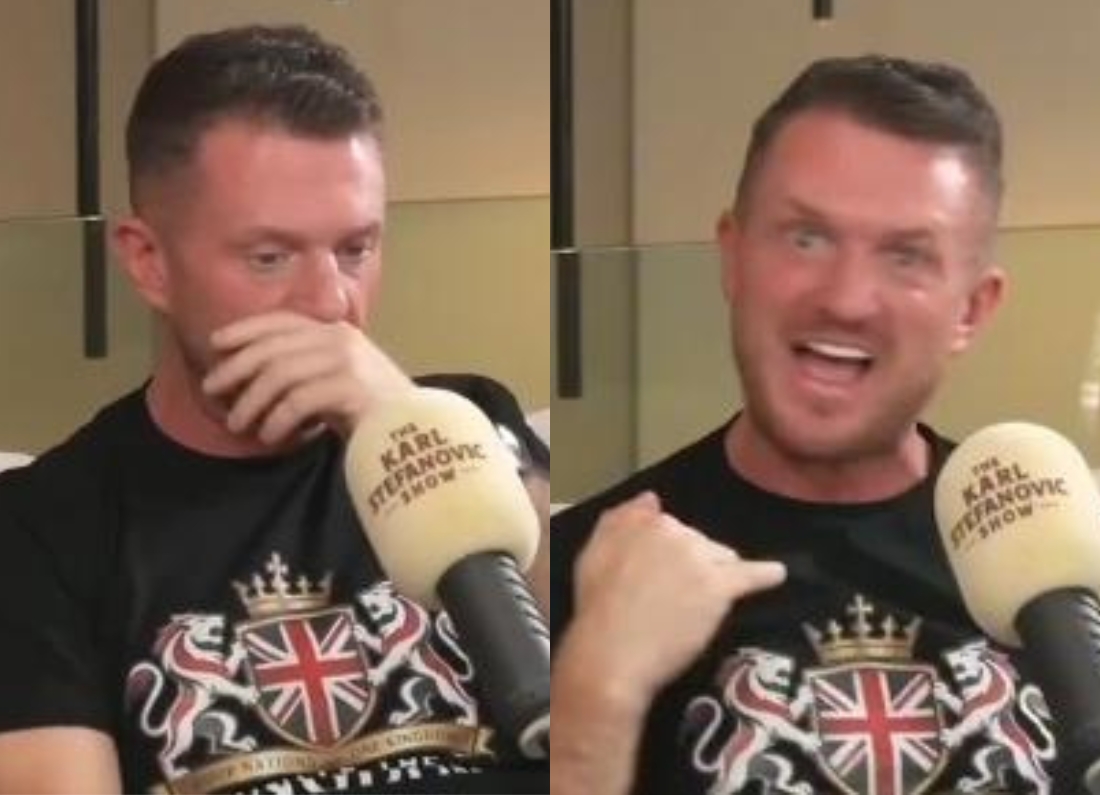
Tommy Robinson has deleted a viral post and admitted he “got it wrong” after falsely accusing a Glasgow father of filming children in a park.
But the man at the centre of the smear says the apology does not address the damage already done to him or his family.
Quroum Beg, 43, was with his children at a park near his home in the Gorbals when an anti-immigration protest approached the area. After taking his children home, he returned to film the demonstration and challenge those taking part.
A selectively framed video was later shared online, showing Beg sitting on a swing while protesters accused him of filming children. Robinson, whose real name is Stephen Yaxley-Lennon, shared the footage with his millions of followers and described Beg as an “invader”.
The accusation was false. Beg was filming the protest, not children. He was born in Glasgow, describes himself as a fourth-generation Scot and says his own children are the fifth generation of his family to live in the country.
By the time Robinson corrected the record, the original post had already been viewed more than 100,000 times and flooded with racist comments. Beg said he had been left fearing for his life.
What happened in the park
Beg had been spending Sunday evening with his children at Richmond Park when protesters wearing face coverings and carrying anti-immigration banners began moving through the residential area. He said families quickly packed away picnics and took their children home as the march approached.
Beg did the same, before returning alone to film what was happening. “They came to our doorstep, and I felt that I had to take a stand because I saw all my neighbours being fearful and leaving the park,” he later told STV. As the protest passed, Beg told the crowd: “I’m not afraid of you, keep on walking.”
The confrontation escalated. Protesters shouted abuse, while a police officer advised Beg not to “antagonise” the crowd. Officers eventually led him away towards a nearby playground for his own safety. It was there that another protester recorded the clip which would later be stripped of its context and spread across social media.
A woman can be heard asking why Beg is filming children. He replies that he is filming the protest. Chants of “get him out” follow as police escort him away. The video was then handed to an online audience primed to believe the worst.
Robinson called him an “invader”
Robinson shared the footage with the words: “Another invader hanging around a park filming children. Glasgow again too!”
That post transformed a local confrontation into a national pile-on. Beg was not named directly, but his face was clearly visible. The allegation implied predatory behaviour around children, while the word “invader” presented a Glasgow-born Scottish man as a foreign threat in his own neighbourhood.
Beg said the fallout left him unable to sleep and worried that strangers might recognise him without ever learning the truth. Police Scotland provided him with access to an urgent police response system because of concerns for his safety. He also said protesters confronted him again the following morning.
This is the part that cannot be undone simply by pressing delete. A false allegation can travel around the world in hours. The correction rarely reaches the same audience, and even when it does, the original suspicion can linger. Beg now has to live with the consequences of a claim he did nothing to create.
The apology came with a lengthy qualification
Robinson eventually deleted the post after reporting by STV and other outlets established what had actually happened. He wrote: “I have to correct the record here. In this instance I got it wrong, as did many others, so for that I apologise and I have deleted that post.”
Had he stopped there, it might have resembled a straightforward admission of responsibility.
He did not. Robinson continued by arguing that the false accusation should not distract from what he claimed were other incidents involving migrants filming children. He used derogatory language, insisted the wider issue should be pursued “relentlessly” and said people should be more careful about the facts while never apologising for “protecting children”.
That is why Beg is unsure whether Robinson has really apologised to him at all. “I’ve been alerted that he’s apologised to his followers,” Beg said. “Has he apologised to me? And the harm this caused to my reputation and my family?”
He added that being falsely accused and then subjected to abuse had been “deeply distressing”, and confirmed he was taking legal advice.
‘Is he apologising to me or his followers?’
Beg’s question gets to the heart of the matter. Robinson’s correction acknowledged that the example was wrong, but it did not fully reckon with what he had done to the person in the video.
He did not name Beg in the apology. He did not directly address the racist abuse which followed. He did not acknowledge that branding a Scottish father an “invader” invited his followers to see him as someone who did not belong. Nor did he explain why he shared the footage before checking whether the accusation was true.
Instead, the apology quickly became another opportunity to repeat the wider narrative which had allowed the false allegation to spread in the first place. That leaves Beg wondering whether the statement was intended to repair the damage or simply protect Robinson’s own credibility.
“The original tweet put my life at risk,” Beg told Glasgow Live. “He hasn’t apologised for the harm that it caused me and what I’ve had to go through for the last couple of days. I don’t know if I can accept his apology because I don’t know if he’s apologising to me.”
A false story built for social media
The incident shows how quickly footage from a tense public confrontation can be manipulated once it is removed from its original context.
The clip did not show Beg taking his children home. It did not show him returning to film the march. It did not explain why police were escorting him away. It showed a brown man in a playground, a protester accusing him of filming children and police nearby.
For those already inclined to see migrants and ethnic minorities as threats, that was apparently enough. Robinson’s post supplied the conclusion before anyone had checked the facts.
The falsehood then spread through thousands of reposts, with racist comments attaching themselves to Beg’s face and an accusation that could have placed him in real danger. When major accounts amplify unverified claims, the damage is not abstract. It lands on real people who have families, jobs and homes in the communities being discussed. Beg was not a symbol in an immigration debate. He was a father who had taken his children to a park.
‘If I don’t stand up, who will?’
Beg said he returned to the demonstration because he had watched families in his multicultural neighbourhood leave the park in fear. He wanted the protesters to know that local residents could see what they were doing and would not simply disappear from their own streets.
“I’m fourth generation in this country,” he said. “My kids are fifth generation. If I’m not going to stand up for myself and make a point, then who is?”
The remark exposes the ugliness of the “invader” label. No number of generations appears sufficient for people determined to treat Scottish identity as something based on skin colour. Beg was born in Glasgow, but online agitators still found it natural to cast him as an outsider.
He said the incident had left him questioning what being Scottish now meant and whether his family had a future in a place he had always considered home. That is a much bigger harm than one deleted post.
Deleting the lie does not delete the consequences
Robinson has admitted he was wrong. That matters.
But an apology should be judged by whether it confronts the harm caused, not merely whether it contains the word “sorry”. Beg has had his face circulated alongside a false accusation involving children. He has received racist abuse, feared for his family and required additional police protection.
Robinson’s correction came only after the truth had been established elsewhere, and it was followed immediately by language reinforcing the same atmosphere of suspicion that produced the original smear.
Beg is entitled to ask whom the apology was really for.
The post may be gone from Robinson’s account. It has not disappeared from Beg’s life.



![Crypto Toll And Passcode? Iran's New Hormuz Status Quo [YouTube]](https://thedailybritain.co.uk/wp-content/uploads/2026/04/donaldtrumpstraitofhormuz.jpg)
Leave a Reply