

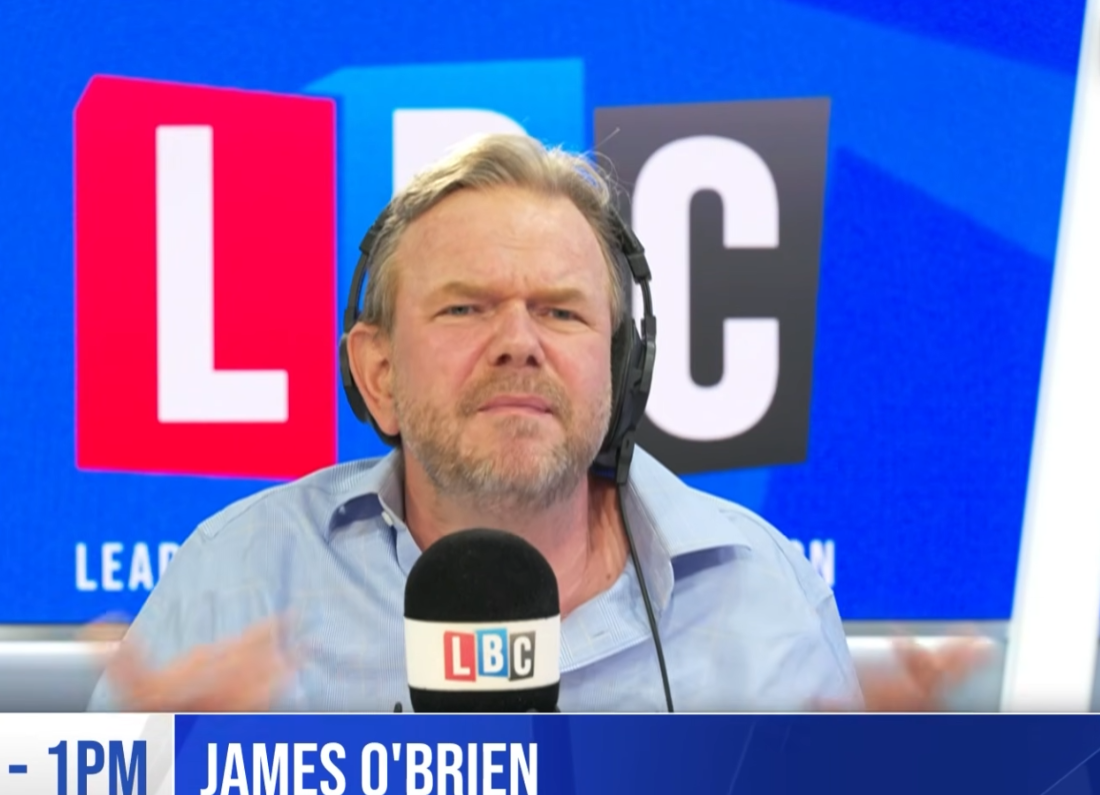
James O’Brien has delivered a furious response after the Covid Inquiry concluded that almost £10 billion of public money was wasted on PPE under Boris Johnson’s government.
The scale of the failure is difficult to overstate. Of the £14.9 billion spent on personal protective equipment during the pandemic, nearly two-thirds was wasted. Some of it was unusable. Some was bought at inflated prices. Some was never needed in the quantities ordered. Meanwhile, doctors, nurses, care workers and ambulance crews were turning up for shifts unsure whether the equipment waiting for them would protect them at all.
For O’Brien, the story was not only about incompetence. It was about what happened when a national emergency collided with a political culture built around access, contacts and privilege.
“It was arguably the most abject lesson in cynicism that I’ve ever had,” he said on LBC, “when I looked around this country in the dog days of the pandemic and the lockdowns and saw almost all of the ruling class in this country hear the alarm bells ringing and think, ‘How can I make a few quid?'”
That line landed because it captured the anger many people still feel about the pandemic years. While NHS staff were reusing masks, wearing flimsy aprons and worrying about taking the virus home to their families, politically connected suppliers were being fast-tracked through a system the inquiry has now concluded was inherently unfair.
The inquiry’s verdict
Baroness Heather Hallett, the former judge chairing the Covid Inquiry, found that the government’s emergency PPE system was badly designed and dangerously unprepared. The UK entered the pandemic with an inadequate stockpile. Plans had not been properly stress-tested. The government was then forced into a frantic global scramble for protective equipment, much of it sourced from China.
The result was an extraordinary waste of public money. “The waste of public money was vast and could have been avoided,” Hallett said. “Of approximately £14.9bn spent on PPE, nearly two-thirds, almost £10bn, was wasted.”
The inquiry also turned its attention to the so-called “VIP lane”, which gave priority to offers passed on by ministers, MPs, peers and senior officials. Hallett stopped short of finding corruption or cronyism in final contracting decisions. But she concluded that the system “embedded unfairness” and gave preferential treatment to suppliers with connections to government.
“Some suppliers received favourable treatment because they had connections to government,” she found, “undermining public trust at a moment when it was needed most.”
That distinction is important. The inquiry did not say ministers had deliberately created a scheme to enrich their friends. But it did say the system was biased towards the well-connected, increased the risk of abuse and should never be repeated.
For many people, that will sound uncomfortably close to the very thing ministers spent years insisting had not happened.
The VIP lane was not cheaper or more reliable
One of the most damaging findings concerns the argument ministers used to defend the VIP lane. Matt Hancock and others said it was designed to prioritise credible suppliers and move quickly during a national emergency. Michael Gove has now described the failures as “honest errors.”
But the inquiry found that VIP lane contracts were, on average, more expensive and more likely to have performance problems than those handled through ordinary routes. That is not a minor administrative mistake. It means the system gave special treatment to companies with political access and then produced worse results.
The government spent £4.2 billion on contracts routed through the high-priority lane. At the same time, experienced British manufacturers were struggling to get anyone in government to return their calls.
O’Brien remembered speaking to businesses during the pandemic that already made medical equipment and had products ready to go. One woman working for a ventilator company told his programme that her firm had working machines available but could not get through to anyone with the authority to deploy them.
“She had actual ventilators that were ready,” O’Brien recalled. “They were ready to be deployed, and she wasn’t able to get through to anybody in the relevant offices and departments.”
That memory becomes even harder to stomach now. Companies with real experience and usable products were left waiting, while politically referred offers were pushed to the front. As O’Brien put it: “If you know someone who is close to government, you get your calls answered. If you don’t, you don’t.”
PPE Medpro and the findings still to come
The most notorious VIP lane contract involved PPE Medpro, a company linked to Conservative peer Michelle Mone and her husband, Doug Barrowman. The company was awarded two contracts worth £203 million after Mone first approached Michael Gove in May 2020.
The inquiry has heard evidence about the deal, but Hallett’s conclusions have not yet been published because of an ongoing National Crime Agency investigation. Those findings will only be released once any criminal proceedings have concluded. Mone and Barrowman have denied wrongdoing.
The legal process must be allowed to run its course. But the wider facts are already stark enough. A newly formed company with a direct route into government received enormous contracts, while established manufacturers said they were being ignored. That contrast is one reason the phrase “honest errors” has provoked such fury.
Under one reaction to the LBC clip, an X user wrote: “I remember listening to this show on my daily walk and I’ll never forget the long-standing NHS PPE-providing contractors phoning in and telling the country they were being ignored in favour of lobbied Tory mates.” Another replied simply: “Professionals ignored… in favour of Tory speculators.”
The reaction was not subtle, because the scale of the failure was not subtle either.
‘For every pound spent on good PPE, two pounds went on the bad stuff’
O’Brien kept returning to the numbers because they are almost impossible to absorb. Wastage is inevitable in any emergency. Governments acting under pressure will make mistakes. Some suppliers will fail. Some equipment will arrive too late or prove unsuitable.
But nearly two-thirds of the entire PPE budget being wasted is not ordinary emergency loss. O’Brien broke it down in the clearest possible terms. For every pound spent on usable PPE, roughly two pounds were wasted.
That is not a rounding error. It is not the unavoidable cost of moving fast. It is a system failing on a vast scale. “You would forgive a little,” he said. “There’d be leeway.” But this was not a case of 5% or even 10% going wrong.
“They spent £14.9 billion and £10 billion of it was wasted,” he said. “For every pound they spent on the good stuff, they were spending two pound on the bad stuff.”
The question he kept asking was the one the inquiry report has still not fully answered: how did this happen?
The human cost behind the number
The money matters, but the programme became most powerful when NHS and care workers began calling in.
A nurse named Rafie, who had worked in the NHS for 26 years, described arriving at PPE stations before entering Covid wards without knowing what equipment would be available. As the pandemic continued, she said the quality got worse. “Some days you would rock up and there’d just be a sticker on a box of something that had expired five years earlier,” she told O’Brien.
She was not only worried about herself. She had to return home after each shift and feared bringing the virus back to her family. There was no realistic alternative. Staff had to enter the wards and care for patients with whatever protection had been provided. “We just thought, what’s the option?” she said.
That is the part of the story that gets lost when the scandal is reduced to procurement figures. Doctors, nurses and care workers were not choosing between good and bad equipment. They were often choosing between inadequate protection and leaving sick people without care.
The inquiry agreed that the shortages put patients and care home residents at risk. Hallett found that the national stockpile was in a “perilous state” and that health and care workers were left unable to protect themselves properly. The people making those choices on the wards were not responsible for the waste. They were dealing with the consequences of it.
A generation of health workers left scarred
Rafie told O’Brien that the pandemic had left a generation of healthcare workers badly affected. They saw patients die quickly and without their families present. Staff brought in toiletries and clothes with their own money. Local charities provided items hospitals could not supply. Families said goodbye through iPads. Even hearing the phrase “red wards” could bring back the fear.
“I think you’ve probably got a generation of healthcare workers who are pretty scarred by it,” she said.
That is why the inquiry’s finding cannot be treated as a dry dispute about contracts. The £10 billion was not wasted in a vacuum. It was wasted while staff were frightened, exhausted and sent into dangerous environments without confidence in the equipment they had been given.
One caller who had worked for a private ambulance service described receiving aprons so flimsy they tore as soon as they were put on, clear gloves that looked like something from a sandwich shop and face masks whose straps snapped. He had transported sick patients from hospitals into care homes and still carried guilt about what followed.
O’Brien reminded him that the decisions were not his. But the caller’s reaction showed how responsibility settles on the people at the bottom, even when the failure began far above them.
‘No wrongdoing, just honest mistakes’
The phrase “honest errors” has become the focus of much of the anger online. One viral post responded: “No wrongdoing, just honest mistakes ffs.” Another quoted Gove’s defence before calling for those involved to face proper scrutiny and for every penny to be accounted for.
Others were more direct. “Scandals don’t come much bigger than wasting £10bn of £15bn spent on unusable PPE during Covid,” wrote journalist Kevin Maguire. “The Tory VIP lane for donors, cronies and chums was a rip-off door. Hunt them down and grab back the £10bn no matter whatever that costs.” Another response read: “There are just no words. An absolute bloody disgrace. £10 billion wasted on PPE that could not be used.”
The anger is not difficult to understand. People were fined for breaking lockdown rules. Families were separated from dying relatives. Nurses wore expired equipment. Care workers feared infecting the vulnerable people they looked after.
Yet years later, the political defence still sounds like a plea to accept that everyone was simply doing their best. The inquiry’s findings make that harder to maintain.
Boris Johnson says he does not need the inquiry
Johnson’s response was characteristically dismissive. He admitted he had not read the report, but insisted the government’s handling of the pandemic had been “outstanding.” “I don’t need an inquiry to tell you that,” he said.
That may be the most revealing response of all. The purpose of the inquiry is precisely to examine what happened beyond the self-justifying memories of the politicians in charge.
Johnson may prefer to focus on the vaccine rollout. That was a significant achievement. It does not erase the procurement scandal, the lack of preparedness or the billions wasted. A government can get one thing right and still fail catastrophically elsewhere. That is what the report says happened.
Johnson does not have to like the conclusion. He does not have to read it.
But the families who lost relatives, the staff who worked without proper protection and the taxpayers who funded the entire disaster are entitled to expect more than “I don’t need an inquiry.”
They have already paid for the failure once. They should not now be asked to forget it.
The inquiry’s recommendations
Baroness Hallett’s report does more than criticise what went wrong. It also sets out 11 recommendations designed to stop the same mistakes being repeated if Britain faces another pandemic or national emergency.
Among them are calls for the government to invest more heavily in British manufacturing so the country is less dependent on overseas suppliers, particularly during periods of intense global demand. The report also recommends overhauling emergency procurement systems, improving stockpile management and introducing much greater transparency around how contracts are awarded.
“The UK entered the pandemic with an inadequate stockpile of PPE and plans that had never been stress-tested,” Hallett concluded.
“A better prepared emergency procurement system will reduce the cost of obtaining essential supplies and save lives.”
The government has said it will consider all of the recommendations before responding formally.
Lessons that still matter
Although the report looks back at decisions made in 2020, its conclusions go far beyond the pandemic itself.
The inquiry found that Britain was not ready for an emergency on this scale. Planning had been inadequate, procurement systems struggled under pressure and a process intended to speed up the buying of essential equipment instead created an uneven playing field that favoured suppliers with political connections.
For healthcare workers, the consequences were immediate.
For taxpayers, the financial consequences are still being counted.
For ministers who defended the system at the time, the report raises difficult questions that are unlikely to disappear any time soon.
Public anger remains
The social media response to both the inquiry and James O’Brien’s broadcast suggested that, six years after the pandemic began, the issue still provokes strong emotions.
Many users shared memories of listening to businesses trying unsuccessfully to offer genuine PPE during the pandemic, while others focused on the contrast between frontline workers struggling with shortages and the billions ultimately written off.
One post simply read:
“Under the Tory’s watch. NEVER FORGET. Disgraceful.”
Another user responded to Michael Gove’s defence that the problems were merely “honest errors” by writing:
“They should all be on trial, every one of them.”
Others pointed back to the countless NHS staff, care workers and ambulance crews who continued working despite shortages, while billions of pounds worth of unsuitable equipment was piling up in warehouses.
Whether or not criminal wrongdoing is ultimately established in any individual case, the political damage from the inquiry’s findings is already significant.
The report concludes that the VIP lane should never have existed, that it undermined public confidence and that Britain’s procurement systems require fundamental reform before another national emergency arrives.
For many listening to James O’Brien’s programme, that conclusion simply confirmed what they had suspected for years.
As one caller put it, healthcare workers spent the pandemic wondering whether they had the equipment to keep themselves safe.
The country is now left wondering how £10 billion could have been wasted while they did.
One response to “James O’Brien delivers furious response after Covid Inquiry finds almost £10bn wasted on PPE”
-
Thank you Joe and James for being part of the few that talk candidly, frequently and truthfully about covid and the aftermath. So many in society today just push it all under the carpet in a ‘we’re alright Jack’ kind of attitude. I am one of the 2.2 million long covid sufferer for who covid is still very much part of our lives. The pandemic was a terrible time for all of us and if Boris had listened to the experts rather than just thinking everything was ‘excellent’ things might have been different.



![Crypto Toll And Passcode? Iran's New Hormuz Status Quo [YouTube]](https://thedailybritain.co.uk/wp-content/uploads/2026/04/donaldtrumpstraitofhormuz.jpg)

Leave a Reply