

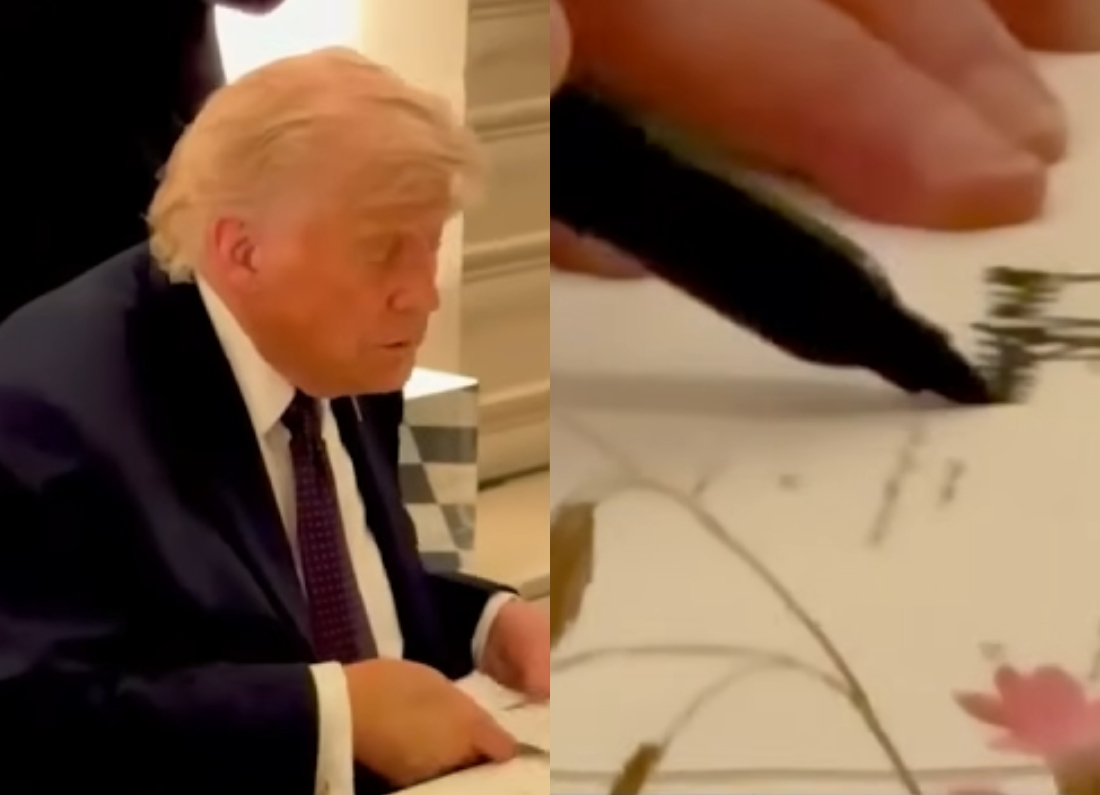
There are many grand buildings in France. Trump chose the one most associated with humiliation and punitive peace treaties.
The US President signed a 14-point memorandum with Iran at the Palace of Versailles on Wednesday, in the presence of Emmanuel Macron and alongside Iranian President Masoud Pezeshkian, committing both sides to a ceasefire extension and 60 days to negotiate a final settlement. “It’s signed,” Trump told reporters. “I signed it in Versailles. I just signed it.”
He may have wanted the venue to convey grandeur. What it conveyed, to the internet at least, was something rather different.
The Palace of Versailles is where the Treaty of Versailles was signed on 28 June 1919, formally ending the First World War. Germany was forced to accept responsibility for the entire war, disarm, surrender colonies, and pay reparations so enormous they were not fully paid off until 2010. The treaty’s Hall of Mirrors became shorthand for a peace deal designed to humiliate. Historians debate exactly how much blame Versailles deserves for what followed in Europe, but its role in German resentment – and the propaganda that ultimately fed the rise of the Nazi Party – is not seriously disputed.
“Versailles has always been the best place to surrender,” one person posted.
“Good place to sign a capitulation.”
“Signed a surrender document at Versailles…”
Michael A. Cohen, the political writer, kept it brief: “The 2026 Writer’s Room is undefeated.”
The terms of the agreement gave the jokes their teeth. The memorandum includes the immediate lifting of the US naval blockade on Iranian ports, oil export waivers, possible sanctions relief, the unfreezing of Iranian assets, and a $300 billion reconstruction and investment fund for Iran. Iran has agreed not to build nuclear weapons and to down-blend enriched uranium under international supervision – but crucially, the deal does not remove Iran’s existing nuclear stockpile from the country, which had been a stated US objective.
That gap matters. The White House will present the deal as a triumph – Trump stopped a dangerous war, reopened the Strait of Hormuz, avoided what he called a “worldwide depression,” and got Iran to commit to not building nuclear weapons. These are not nothing.
But Iran’s lead negotiator Mohammad Baqer Qalibaf described the agreement on state television as “a record of US failure.” And there is an obvious political problem for Trump that critics will spend weeks exploiting.
Trump spent years mocking Barack Obama over the 2015 Iran nuclear deal and the unfreezing of Iranian assets. He called it the worst deal ever made. He pulled out of it. He killed Qasem Soleimani. He oversaw a war with Iran. And he has now signed his own agreement that, depending on how the negotiations go over the next 60 days, also opens the door to billions flowing back towards Tehran.
Trump also said at Versailles that it would be “unfair” for Iran not to have ballistic missiles if other countries do – a striking position from a president who spent his first term threatening military escalation over precisely that issue.
The comparison critics reached for was not subtle, but it was hard to argue with. The original Versailles peace imposed crushing terms on the losing side. The Iran memorandum hands the other party a naval blockade lifted, sanctions relief, frozen assets and a reconstruction fund. Whether you think that is a pragmatic deal or a capitulation depends on your politics. But either way, the venue was doing enormous amounts of work in one direction.
Trump has spent his entire political career understanding performance better than almost any modern politician. He knows the power of the backdrop, the room, the image, the pen. The decision to sign at Versailles was presumably designed to evoke grandeur and history. Instead it produced a thousand “surrender” jokes and a question nobody in the White House probably wanted to answer: who exactly chose that building?
The 2026 writer’s room, as Cohen noted, is undefeated.




Leave a Reply