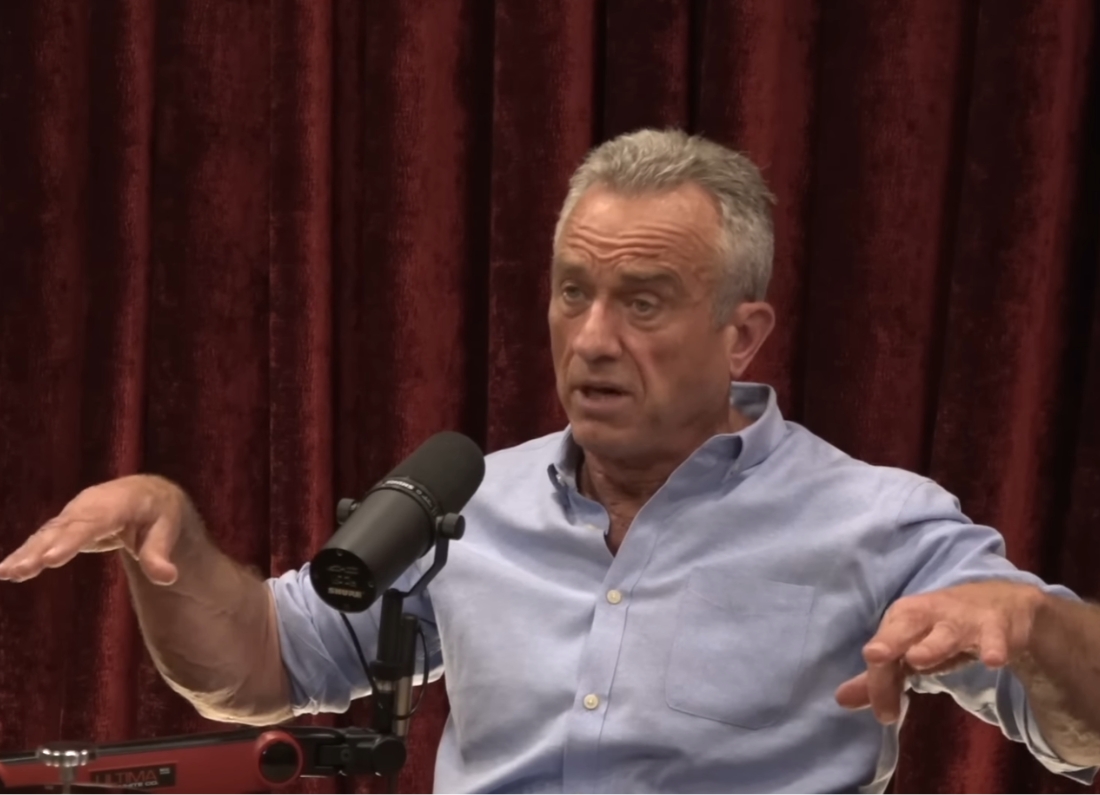
US Health Secretary Robert F Kennedy Jr has called the United Kingdom a “dictatorship” comparable to the Soviet Union in an appearance on the Joe Rogan Experience, claiming 12,000 people had been jailed for tweets – while Joe Rogan told his audience that Britain had scrapped jury trials. Both claims are false or substantially misleading.
Kennedy, who serves as Health Secretary in the Trump administration and has built a public profile on pushing debunked theories linking vaccines to autism, told Rogan: “You look what is happening in England right now. A lot of people are going to jail for Twitter posts. It’s just a dictatorship. It’s like the Soviets’ system. It’s like Kafka.”
Rogan replied: “Well they got rid of trial by jury. Now it’s just a judge. There’s no reasonable judge by jury for your peers.”
The exchange was widely shared in Britain and prompted immediate pushback. It also prompted some questions worth answering: where did the 12,000 figure come from, what do UK online communication laws actually say, and what did Lammy actually propose about jury trials?
Claim 1: ‘12,000 people went to jail for Twitter posts’
Verdict: False – arrests, not jailings, and most did not result in prosecution
The figure appears to originate from a Times report published last year, which found that approximately 12,000 people were arrested – not jailed – in 2023 by 37 police forces under UK communication laws.
These are different things. An arrest does not lead to a prosecution, let alone a conviction, let alone a prison sentence. The Times report itself noted that most arrests did not lead to a prosecution and that the number of arrests had decreased compared to 2022.
UK communication laws allow for arrest where online posts cause distress, are grossly offensive, or are of an indecent, obscene or menacing character. Critically – and this is detail neither Kennedy nor Rogan mentioned – the same laws cover “any form of communication” and can relate to “serious domestic abuse-related crimes.” The category is not limited to Twitter posts about immigration.
People convicted of serious online harassment, threatening messages, stalking and domestic abuse-related communications are included in these arrest figures alongside those who made inflammatory social media posts. Kennedy and Rogan described the entire category as people “going to jail for Twitter posts.” The overlap between the two populations is partial, not complete.
Claim 2: ‘Britain got rid of trial by jury’
Verdict: False – a specific and limited proposal is being dramatically misrepresented
Rogan told his audience that Britain had “got rid of trial by jury” and replaced it with judge-only trials. This is not true.
What Justice Secretary David Lammy has proposed – and this is a live debate within British politics – is removing jury trials for cases where the likely sentence is three years or less. The proposal is specifically designed to address the severe court backlog in England and Wales, where cases are waiting years for trial. The majority of serious criminal cases would continue to be tried before juries.
The proposal has drawn significant criticism within Britain. It is a contested policy with legitimate arguments on both sides. It is not, however, “they got rid of trial by jury.” Jury trial remains the cornerstone of serious criminal proceedings in England and Wales and there is no proposal to end that.
Who is making these claims
Robert F Kennedy Jr’s credibility as a source on legal and democratic norms is worth noting. He has spent years promoting the claim that vaccines cause autism – a theory that has been repeatedly and comprehensively debunked by the scientific consensus and which major scientific bodies including the NHS, the CDC and the WHO have examined and rejected. He has promoted conspiracy theories about water fluoridation, 5G and HIV. He is currently the United States Health Secretary.
Joe Rogan has an audience of tens of millions per episode. Both men are significant vectors for information in the current media environment. The specific claims made in this exchange – that 12,000 people were jailed for tweets and that Britain has ended jury trials – will reach people who will believe them because they trust the people saying them.
What UK online hate laws actually do
Britain’s approach to online communication and free speech is different from the United States. In the US, the First Amendment provides extremely broad protection for speech including speech that many would find offensive. In the UK, the legal framework balances free expression against harm – including the harm caused by targeted harassment, incitement to racial or religious hatred and threatening communications.
The Online Safety Act 2023 introduced new duties on social media platforms to address illegal content and harmful material. The Communications Act 2003 has long made it an offence to send messages that are grossly offensive, indecent or menacing. These laws have been used to prosecute people who sent threatening messages to MPs, who harassed private individuals, who sent racist abuse to public figures and who incited violence.
They have also, in specific cases, been used to prosecute people for social media posts about immigration and ethnicity that others consider legitimate expression. Those cases exist, are contested and are worth debating. They are not, however, evidence of a Soviet-style dictatorship.
Farage himself – as we reported in our piece on the Musk-Farage row – has complained about online abuse directed at his own ethnic minority candidates on X. The same platform whose owner called Farage a liar last week. The question of where the line between acceptable speech and harmful communication falls is genuinely complex. “Soviet dictatorship” is not a contribution to that complexity.
The broader context
Kennedy and Rogan’s exchange is part of a specific transatlantic information pattern that has accelerated since 2016. American political commentators – often with no particular knowledge of British law, British institutions or British political history – describe British democratic arrangements in terms calibrated for an American audience that already distrusts government, already believes that free speech is under existential threat and already has a template for understanding foreign countries as either free-market democracies or authoritarian regimes.
Britain is not a dictatorship. It has an independent judiciary. It has freedom of the press – imperfect, contested, but functioning. It has regular elections. It has parliamentary accountability. It has a rule of law that has survived attempts to subvert it by governments of both parties. Its online hate laws are debated, challenged and scrutinised in open court.
Whether those laws are correctly calibrated is a legitimate question. RFK Jr, who has built his career on claiming that scientific consensus is a form of oppression, is not the person best placed to answer it.