Durham County Council’s Reform administration has spent £12,000 transforming a grassed roundabout in the former mining town of Chilton into a St George’s Cross floral display – despite explicit opposition from Chilton Town Council, accusations of “pretend patriotism” from the local Labour MP and residents, and growing national attention about what Reform’s newly won councils are actually choosing to spend public money on.
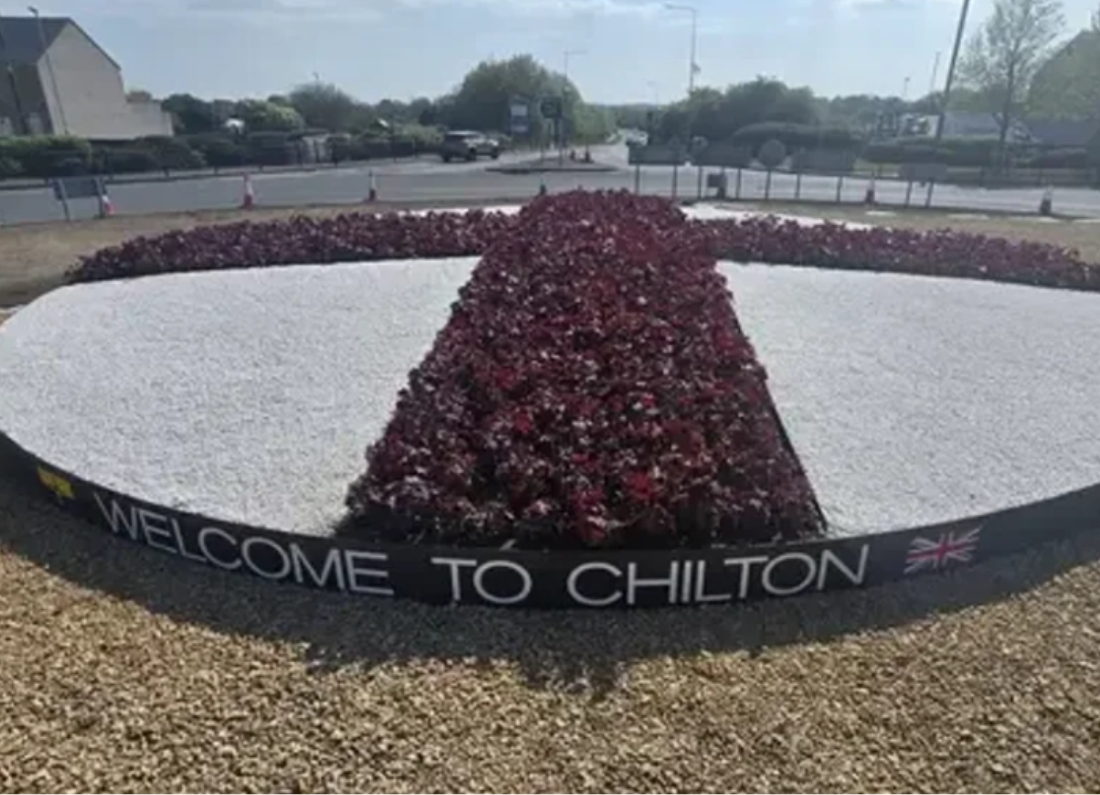
The roundabout on the A167 – a main road through Chilton, a community of approximately 4,500 people in County Durham – was previously a simple grass verge. It has been gravelled over with red plants and white stones arranged into the pattern of England’s national flag, surrounded by golden gravel. Work is still ongoing and the final cost will only be confirmed once complete. The council says it is expected to reach £12,000. Durham County Council was run by a coalition of Liberal Democrats, Conservatives and Independents until Reform stormed to victory at the county’s local elections last May.
What it looks like – and what residents think
The display replaces the original grass with a permanent gravelled design – meaning it is not a seasonal decoration but an ongoing feature of the road. The St George’s Cross is made from red plants forming the cross against white stone, with the surrounding area covered in golden gravel.
Local reactions have been sharply divided. Some residents have welcomed it. Others have been far more critical – with one describing it as an “abhorrent territory marker,” another calling it a “complete waste of money,” and a third saying it looks “cheap.” One resident characterised the whole project as “pretend patriotism.”
Sharon Goodchild, who has called Chilton home for 26 years, questioned the choice of national symbolism. She argued the theme appealed “only for a selected few” given that Chilton had evolved into what she described as a “multicultural” community. According to 2021 census data, the town is approximately 98% white British. Goodchild suggested that if funding became available it should instead reflect Chilton’s identity as a former mining community. “A massive stone carving saying ‘Welcome to Chilton’ or a miner’s carriage would be great,” she said – pointing to the rich coal mining history that shaped the town and the wider County Durham coalfield throughout the 19th and 20th centuries. She also proposed wildflowers as a more cost-effective and broadly appealing alternative.
What Reform says
Reform county councillor Stephen Bowron, who proposed the scheme, mounted a vigorous defence. He said he had consulted around 70 people through local resident groups, all of whom supported the proposal. He argued the roundabout would become a “recognised landmark” and demonstrate the passion Chilton locals feel for their country.
“Chilton has finally got a bit of a landmark to show our patriotic pride to follow up the fabulous mural we have in our village,” Bowron said. The town already features a mural depicting a soldier standing in a field of poppies – Chilton now has two patriotic visual features while the infrastructure challenges that residents and the town council have repeatedly cited remain unaddressed.
Fellow Reform county councillor Joe Quinn was equally enthusiastic. “It was a plain grassed roundabout and it’s now got a lovely St George’s Cross made out of poppies,” he told LBC. “To be perfectly honest with you, I live nearby and it looks absolutely fantastic. It will really put Chilton on the map.” Durham’s Reform UK party said the roundabout would become a local landmark and rejected accusations that it represented poor value for money.
The costs and how they were covered
The total project cost of approximately £12,000 comprises £9,540 from Section 106 developer contributions – funds legally ring-fenced for community benefit arising from nearby housing developments – and £2,460 in council labour costs.
Reform county councillor Bowron justified the use of Section 106 funds by noting the money faced a May deadline, after which it would have been returned to the developer. Durham County Council’s planning manager Stephen Reed confirmed that no alternative submissions had been received in time and that the project was allocated the funds to prevent them lapsing. Reed said the proposals were “found to meet the requirements of the Section 106 agreement and would, it was felt, deliver clear improvements to the open space provision in the area.”
That technical justification does not appear to have satisfied Chilton Town Council. The town council had explicitly opposed the proposal when consulted in November 2025, saying it would have preferred funding directed toward community projects addressing essential infrastructure and local challenges. In a statement, a town council member said: “We did not feel that it was a good use of S106 funding. Funding that could be better utilised to benefit Chilton residents. We would prefer to see this funding directed to community projects that improve essential infrastructure and address the current challenges our community faces.”
The town council has no formal power to block county council spending decisions – a constitutional reality that means local communities can express opposition and be formally overruled by their county administration regardless.
The Labour response
Labour MP Alan Strickland, who represents Newton Aycliffe and Spennymoor, described the project as emblematic of Reform’s approach to local governance.
“This is yet another sign that our Reform-led council are completely unserious about how they spend our money,” he said, accusing the council of failing to properly engage with local people before committing public funds to the makeover. He called it “pretend patriotism” – a characterisation that Reform has rejected.
The broader context – Reform and the flags
The Chilton roundabout did not emerge in isolation. It sits within a wider national phenomenon that has been building since summer 2025, when a campaign called Operation Raise the Colours began tying St George’s Cross and Union flags to lampposts across towns and cities in England without local authority permission.
The campaign has been supported by figures associated with Reform UK, Advance UK and the Conservative Party. It has also generated significant controversy – Derby City Council removed 950 flags. Bristol City Council voted to remove them gradually after a petition. A ward councillor in Darlington reported that lampposts had been structurally compromised by people climbing them to attach flags. In Shrewsbury, a mayor reported that women who witnessed a flagging event were threatened and abused by participants – something the flaggers denied. In Oxford, videos of a flagging operation showed what reporters described as “non-stop animosity” between the flag team and local residents.
The Chilton roundabout differs from Operation Raise the Colours in one important respect: it is an official council project, funded through developer contributions and delivered through the planning system rather than guerrilla decoration. But it emerges from the same political and cultural moment – and it reflects Nigel Farage’s stated ambition, if Reform takes national power, to require schools to fly the Union Jack and display the King’s portrait.
What this says about Reform in power
The Chilton roundabout sits alongside a growing body of evidence about what Reform councils actually do when they have public money to spend.
Every Reform council elected on a promise to “scrap net zero to cut your energy bills” has raised council tax – most by close to the legal limit. Seven out of ten have deleted their climate targets. Kent’s DOGE efficiency unit found nothing to cut. Durham’s first prominent locally covered spending story is a £12,000 St George’s Cross roundabout that the local town council explicitly did not want.
Whether £12,000 from a fund that would otherwise have been returned to a developer constitutes waste depends on your definition of waste and your view of what community benefit means in a former mining town with infrastructure needs. Bowron’s argument – that the money would have disappeared without the project – is technically accurate. The argument that a gravelled St George’s Cross constitutes a “clear improvement to open space provision” in a community whose own elected town council wanted infrastructure investment is one that residents and the local MP are less persuaded by.
Chilton’s mining heritage, its community challenges and the people who shaped the town across generations of industrial labour remain, for now, uncommemorated on the A167. The St George’s Cross, made of red plants and white stones surrounded by golden gravel, faces the traffic.
You may also like: Starmer’s niece selected for safe Croydon seat as two Black women councillors are deselected