

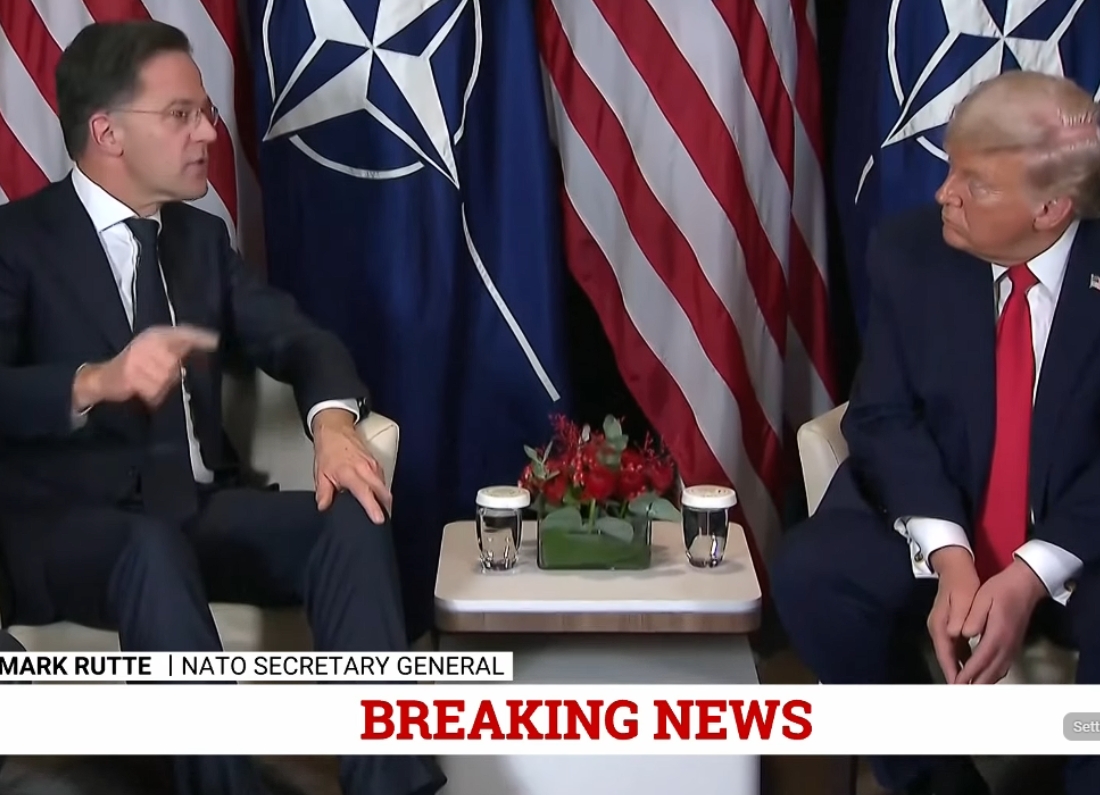
Donald Trump has been handed a public reality check by Nato secretary general Mark Rutte after the US president claimed he wasn’t sure Europe would defend America if it was attacked.
Trump made the remark while addressing the World Economic Forum in Davos, repeating a long-running complaint that the United States would always show up for allies, but might not get the same support in return.
Rutte, sitting alongside him, challenged that head-on and pointed to the war in Afghanistan – launched after the 11 September attacks and Nato’s only-ever activation of Article 5, the alliance’s mutual defence clause.
🇺🇸 Trump revives a familiar Nato grievance in Davos
Trump told the Davos audience he was “not absolutely sure” European allies would come to America’s aid if the US was attacked, despite insisting the US would be there for them.
It was a striking moment, not just because it landed in front of an audience of global leaders and CEOs, but because it came during a period of intense transatlantic tension over Trump’s threats around Greenland and trade tariffs.
🛡️ Rutte’s blunt correction: “They will – and they did”
Rutte responded directly, telling Trump that European allies would come to America’s defence – and reminding him that they already had.
“There’s one thing I heard you say… You were not absolutely sure Europeans would come to the rescue of the US if you will be attacked. Let me tell you, they will and they did in Afghanistan,” Rutte said.
He added that allied losses in Afghanistan were not symbolic.
“For every two Americans who paid the ultimate price, there was one soldier from another Nato country who did not come back to his family… So you can be assured, absolutely, if ever the United States was under attack, your allies will be with you.”
🪖 Why Afghanistan matters to Nato’s entire identity
After 9/11, Nato allies invoked Article 5 for the first time, treating the attack on the US as an attack on them all – a foundational moment for the alliance’s post-Cold War purpose.
That decision fed directly into a two-decade conflict where allies fought, spent, and lost personnel alongside US forces. The UK alone lost 457 service personnel in Afghanistan, while other European allies also suffered significant losses.
Rutte’s point was simple: whatever today’s political arguments, the record shows Europe did show up when the US called.
❄️ Greenland pressure sits in the background
Rutte’s intervention came as Trump’s Greenland campaign had already put Nato unity under strain, with European leaders pushing back against threats and tariff warnings.
In recent days, Trump had been threatening new tariffs aimed at countries resisting his approach to Greenland – a move that European leaders said risked destabilising relations and escalating tensions.
That context mattered because Trump’s “they won’t be there for us” line landed as part warning, part leverage – and Rutte’s response functioned as both a rebuttal and a public attempt to pull the conversation back toward alliance fundamentals.
🤝 The meeting that cooled the temperature, at least for now
Shortly after the exchange, Trump signalled a shift in tone, framing talks with Nato leadership as progress on a broader Arctic approach rather than an immediate confrontation.
Sky News reported Trump had agreed a “framework” with Rutte relating to Greenland and the Arctic and would not proceed with the previously threatened tariffs as things stood.
The Financial Times also reported Trump and Nato had reached a framework deal in the same Davos window, underscoring that the episode quickly moved from public sparring to negotiation choreography.
Even with that cooling-off period, European capitals remain wary. Trump has shown he can revive threats quickly, and his comments in Davos made clear he still sees territorial pressure and trade levers as legitimate tools.
🌍 What Rutte was really doing in front of the cameras
Rutte’s correction wasn’t only about Trump’s phrasing. It was about preserving the credibility of deterrence.
If a US president openly casts doubt on whether allies would support America, it creates a two-way problem: it alarms Europeans about Washington’s reliability, and it invites adversaries to test Nato’s unity.
That is why Rutte chose the sharpest available counterexample: Afghanistan, the one conflict where Nato’s mutual-defence promise moved from treaty language into lived reality.
And it’s why he ended with a line that sounded less like politics and more like reassurance – “It pains me if you think it is not.”
4 responses to “Nato chief Mark Rutte rebukes Trump over claim Europe would not defend US”
-
No trump is a danger to world peace
-
I believe what Trump does is he defers when us is face to face with strong leaders as seen in the clip above , where he can be immediately taken to task for inappropriate behaviour. When he is back in the US , safe away from the adults, “behind his mammy’s” skirts” as it were, he will resume his war of words and huffing and puffing. Anything he now says, therefore should be taken with a pinch of salt unless they can get him to sign documents, but even then he may go back on his word.
-
Trump has gone too far with his NATO comments. He needs to be removed from power, as is now a liability to Europe and the USA alike.
-
At least he could not remember, he has a very limited knowledge of the past on any subject and just adds his own phantasie and lies
-







Leave a Reply