

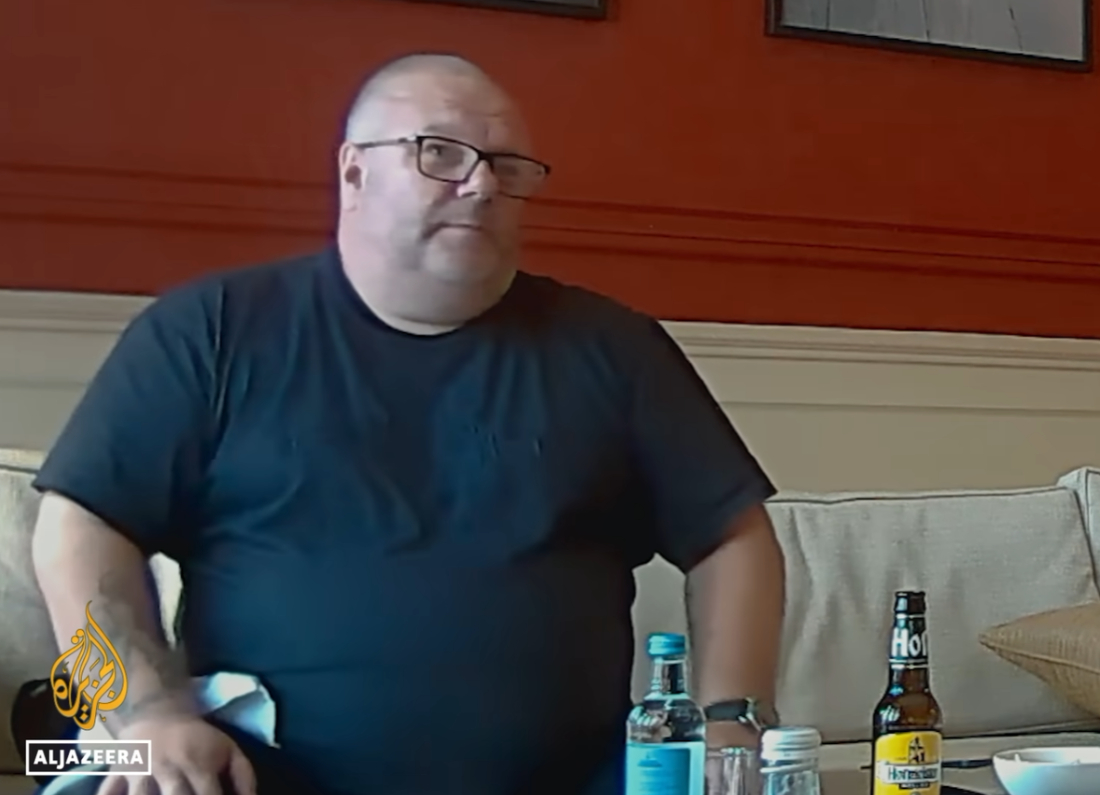
A former Conservative election candidate who leads a right-wing campaign organisation with connections to senior figures in British politics has been secretly filmed discussing how to arrange violent attacks, including murder, through a convicted criminal with alleged links to a banned terrorist organisation.
Jack Ross, chief executive of Turning Point UK, was recorded explaining how people could pay to have someone beaten, disfigured, stabbed or killed. He subsequently introduced an undercover journalist to Allan Nesbitt, a violent criminal from Glasgow who claimed to have connections to the Ulster Volunteer Force (UVF), a proscribed loyalist terrorist organisation responsible for hundreds of killings during the Troubles.
Nesbitt went on to discuss the murder of a fictitious business rival, describing how a killing could be arranged, how the perpetrators would operate and the financial arrangements involved. During a subsequent video call, he displayed firearms and ammunition.
The revelations form part of an extraordinary investigation by Al Jazeera, whose journalists spent years infiltrating Turning Point UK and examining the connections between mainstream right-wing politics, anti-immigration street movements and violent far-right organisations.
The documentary, Contract Killers and the Far Right, exposes a political network in which activists publicly condemn extremism while privately discussing cooperation with former football hooligans, individuals linked to neo-Nazi organisations and a man who claims to have access to paramilitary killers.
The fallout has already reached the Conservative Party, which suspended Ross’s membership on Wednesday following the broadcast. Police Scotland has confirmed that it is reviewing the documentary and assessing whether any criminal offences may have been committed.
Ross has denied Al Jazeera’s findings, maintaining that his remarks to the undercover journalist were not intended seriously.
But the recordings raise questions extending far beyond one man’s conduct. They expose the increasingly blurred boundaries between the respectable political right, groups seeking to mobilise anger on Britain’s streets and individuals with a history of serious violence.
‘They can stab someone. They can shoot someone. They can kill someone’
One of the most disturbing exchanges took place during the Conservative Party conference in 2022, where Ross was attending alongside Nick Tenconi, Turning Point UK’s chief operating officer and leader of the UK Independence Party.
Speaking privately to an undercover journalist, Ross discussed the services allegedly available through Nesbitt’s contacts.
“They’ll get someone to drive down from Scotland, or they’ve got locals in London who can help you out as well,” he explained, adding that those involved expected cash and deposits in advance.
When asked how much money would be required, Ross turned to the nature of the intended violence.
“What do you want done?” he asked.
He then described a range of attacks which, he claimed, could be arranged for different payments.
“They can stab someone. They can shoot someone. They can kill someone.”
His explanation was not presented as a vague political threat or an angry outburst during a demonstration. Ross appeared to be discussing violence as a service that could be purchased, with different levels of harm carrying different costs.
He told the undercover journalist to speak to him about the details, while advising that the intended outcome needed to be clear.
For an organisation which publicly condemns political violence and insists extremist groups are unwelcome at its events, the contrast is extraordinary.
Ross later claimed that his comments had not been serious. That denial matters, and the recordings alone do not establish that he commissioned a murder or that a real killing resulted from the conversation.
What they do establish is that the head of a politically connected campaign organisation was willing to describe how serious violence could supposedly be arranged and identify a contact through whom such services might be obtained.
The man with alleged UVF links who offered to arrange a killing
To test whether Ross’s claims amounted to anything more than boasting, undercover journalists approached him with a fabricated story about a family business dispute.
They claimed that a deceased relative’s business had been taken over by a violent rival and that they wanted somebody to resolve the problem.
Ross offered to facilitate an introduction to Nesbitt, while making clear that he wanted to understand what was being requested so that he could protect himself if there were repercussions.
Nesbitt subsequently agreed to meet the supposed clients.
Before the meeting, he instructed them to delete their WhatsApp conversation and avoid mentioning the purpose of the encounter in written messages.
At a London hotel, the discussion developed into negotiations over the killing of a person who did not exist.
Nesbitt claimed that the price would depend on the importance of the intended target and described a possible staged accident as one means of killing someone.
He also claimed to have participated in killings previously, although those assertions have not been independently established by the documentary.
Al Jazeera reported that Nesbitt has multiple criminal convictions, including two involving violent knife attacks. The documentary also cites intelligence connecting him to terrorism and organised crime.
Nesbitt claimed to have held a senior position in the UVF, describing involvement in the organisation from his teenage years.
The UVF is not an ordinary political movement. It is a proscribed terrorist organisation whose members carried out sectarian murders, bombings and other atrocities during the conflict in Northern Ireland.
Among the atrocities attributed to the organisation are the 1971 McGurk’s Bar bombing in Belfast, which killed 15 people, and the 1974 Dublin and Monaghan bombings, which killed 33.
The distinction between Nesbitt’s claims and proven facts is important. His assertions about his own role and access to killers cannot simply be accepted as established truth, and the undercover operation involved a fictitious target.
Nevertheless, the willingness to discuss murder, combined with Nesbitt’s documented history of violence and the weapons subsequently displayed, was sufficiently alarming for Al Jazeera to notify Police Scotland.
A fake political rally and thousands of pounds changing hands
The investigation also revealed that Ross and Nesbitt had worked together long before the murder-for-hire conversations.
In November 2021, as world leaders gathered in Glasgow for the COP26 climate summit, Ross was involved in organising a rally intended to demonstrate public support for lifting sanctions on Zimbabwe.
The event was being arranged for a Zimbabwean government delegation, but the appearance of spontaneous public enthusiasm concealed a rather different operation.
Ross had turned to Nesbitt to recruit people to attend, with money being offered to help fill the room and provide an audience for promotional filming.
Some attendees appeared to have little understanding of the political cause they were supposedly supporting.
During filming, one participant struggled to remember what he had been told to say about Zimbabwe, while another needed assistance repeating a message about future trade relations.
The exercise was designed to create the appearance of local support for a political campaign, even though people had been recruited and paid to participate.
Nesbitt demanded between £1,000 and £2,000 to cover the initial arrangements, with footage showing Ross subsequently passing him £2,000 after the Zimbabwean delegation provided the money.
What made the arrangement particularly troubling was Ross’s knowledge of Nesbitt’s alleged paramilitary connections.
Ross was recorded warning that Nesbitt’s tattoos should not be filmed because of their political associations. He also described Nesbitt as having links to a terrorist organisation and discussed the possibility of armed intimidation if there was a dispute over payment.
The incident shows that Nesbitt was not merely a name mentioned in passing during a private conversation. Ross had an established working relationship with him and had involved him in a political operation connected to a foreign government delegation.
It also raises uncomfortable questions about the overlap between political campaigning, manufactured public support and individuals who use the threat of violence to protect their financial interests.
‘We keep winning MPs over. Then we build an army’
Perhaps the most politically revealing part of the documentary concerns the wider ambitions of Turning Point UK’s leadership.
In secretly recorded conversations, Ross and Tenconi discussed building a new right-wing movement capable of combining parliamentary influence with organised activity on the streets.
Tenconi outlined a strategy that included winning over MPs while developing a second force built around demonstrations and protests.
“We keep winning MPs over. Then we build the second prong where we build an army,” he said.
He described that second element as involving street demonstrations and protests, with the stated objective of creating disruption.
The use of the word “army” does not itself establish that Turning Point UK was creating an armed organisation. In the recorded conversation, Tenconi was discussing political mobilisation and street activism.
But the language takes on a more concerning significance when considered alongside the group’s dealings with people linked to violent far-right networks.
The discussions also included references to generating revenue through memberships, merchandise and donations, suggesting that building a political movement and creating a financially sustainable organisation were closely connected.
The documentary revealed plans to mobilise groups with experience of confrontational street politics, including people associated with the Democratic Football Lads Alliance.
Rather than working openly with all such groups, the organisers discussed maintaining a degree of distance while encouraging their mobilisation.
That distinction matters because it offers a way of benefiting from the presence of aggressive street movements without formally accepting responsibility for their conduct.
Neo-Nazi links behind the public rejection of extremism
Turning Point UK’s public material has made clear that neo-Nazi organisations and violent extremists are not welcome at its events.
Yet the undercover investigation identified meetings and protest activity involving individuals with histories of association with the far right.
Ross was filmed meeting a figure introduced as Greg, a leader of an anti-immigration group, to discuss arrangements for a joint protest.
During the meeting, Greg explained how associates could provide a physical presence at demonstrations and recommended Patriots of Britain, a group that includes former football hooligans.
The investigation also identified Philip Curzon, linked to Combat 18, and Lance Wright, previously associated with the Blood and Honour network.
Both organisations have histories connected to violent neo-Nazism, making the presence of such figures around anti-immigration mobilisation a serious concern.
Ciaran O’Connor, a senior analyst at the Institute for Strategic Dialogue, argued that Turning Point UK appeared to admire the physical capabilities of more confrontational far-right activists while attempting to maintain a public distance from them.
The significance is not that everyone attending an anti-immigration demonstration shares extremist beliefs, nor that political opposition to immigration is inherently violent.
It is that groups seeking public legitimacy can benefit from the mobilisation, numbers and intimidation associated with extremist organisations while continuing to insist that those organisations have no formal place within their movement.
The documentary challenges the credibility of that separation.
From the Conservative conference to the anti-migrant street movement
Turning Point UK began as a British offshoot of Turning Point USA, the American conservative activist organisation founded by Charlie Kirk.
It has cultivated relationships with politicians on the British right, receiving support and endorsements from Conservative figures and developing connections with people associated with Reform UK.
Ross himself stood as a Conservative candidate in the 2023 local elections, while Tenconi has simultaneously occupied senior roles within Turning Point UK and UKIP.
Those connections do not mean the Conservative Party or Reform UK knew about or approved of the alleged murder-for-hire discussions. No evidence presented in the documentary establishes such involvement.
They do, however, make the political response impossible to separate from the broader question of how extremist movements seek respectability.
For years, figures on the British right have faced questions about their willingness to associate with organisations whose public language increasingly overlaps with more extreme nationalist movements.
The political vocabulary surrounding immigration has also changed, with ideas once largely confined to the far right becoming more prominent in mainstream debate.
Proposals involving mass deportations, the removal of legal protections for migrants and forms of so-called remigration have moved closer to the centre of national political arguments.
Not every politician advancing restrictive immigration policies supports extremism. But when campaign groups openly discuss recruiting parliamentary allies while mobilising aggressive street movements, the relationship between respectable politics and political intimidation deserves close examination.
The documentary shows how people operating in these different spaces can develop relationships that would once have been regarded as politically unacceptable.
The danger of connecting street anger with armed paramilitaries
The timing of the revelations is particularly disturbing given the violence Britain experienced during the summer of 2024.
Following the Southport killings, false claims about the identity and background of the attacker spread online, contributing to anti-Muslim and anti-migrant unrest across parts of the country.
Hotels housing asylum seekers were targeted, police officers were attacked and communities were left dealing with the consequences of racist intimidation and violence.
The unrest demonstrated how quickly political misinformation could move from social media into physical attacks.
Al Jazeera’s investigation suggests that the danger may become considerably greater when people involved in anti-migrant street movements develop relationships with individuals who have access to firearms, criminal networks and paramilitary experience.
Roy McComb, a former deputy director of the National Crime Agency, explained that loyalist networks have historically been involved in moving weapons, intelligence and personnel between Scotland and Northern Ireland.
He warned that those same routes could become dangerous if weapons intended for one criminal or paramilitary purpose became available to far-right activists hostile to migrants.
A former UVF member interviewed for the documentary made a similar point, warning that the ability of far-right protest movements to inflict harm changes dramatically when they establish connections with people experienced in organised terrorism.
The UVF’s record gives those warnings considerable weight.
The organisation’s campaign of sectarian violence continued for decades, leaving families and communities devastated. Elements of loyalist paramilitarism have subsequently become deeply entangled with organised crime, including drug dealing, extortion and weapons trafficking.
The fear raised by the investigation is not that every far-right demonstrator is preparing to commit terrorist violence.
It is that a comparatively small number of individuals with the means and willingness to use serious violence could dramatically increase the threat posed by an already volatile movement.
A conviction for assault and questions about political violence
The documentary also revealed that Ross had previously been convicted of assault by beating following an incident involving attempts to disrupt an anti-racism event at a church.
According to the investigation, Ross was convicted alongside three other men in April 2026 after joining Tenconi in an attempt to disrupt the gathering.
Footage from the confrontation showed an aggressive atmosphere, with accusations and shouting directed at people attending the event.
The conviction provides important context to Ross’s public position as a figure who condemns political violence while campaigning against what Turning Point UK describes as threats from the left.
It does not establish that he was involved in a genuine murder conspiracy, but it is another documented instance in which the conduct surrounding the organisation moved beyond ordinary political debate.
The wider investigation raises the issue of how increasingly confrontational activism is encouraged, normalised and sometimes rewarded in British politics.
There is an obvious difference between peaceful protest and physical intimidation. There is a still greater difference between heated political language and discussions about hiring people capable of committing murder.
The distance between those categories is precisely what makes the revelations so alarming.
Conservatives suspend Ross as police review the evidence
The political fallout began almost immediately after the documentary was broadcast.
On Wednesday 21 October, the Conservative Party confirmed that Ross had been suspended with immediate effect while an internal investigation takes place.
A party spokesperson said:
“Mr Ross’s membership of the Conservative party has been suspended with immediate effect pending an investigation. We cannot comment further while the investigation is ongoing.”
Police Scotland also confirmed that officers were aware of the documentary and would review its contents to determine whether any criminal offences may have been committed.
The involvement of police is significant, although it does not establish that Ross, Nesbitt or anyone else has committed the specific offences discussed during the undercover operation.
There was no real murder target, and the documentary does not establish that a contract killing was carried out.
Ross has denied Al Jazeera’s findings completely, saying that the remarks attributed to him were not intended seriously. Other individuals approached by the broadcaster did not respond to requests for comment.
Those responses should be considered alongside the recorded conversations, the established relationship between Ross and Nesbitt, and the documentary’s evidence concerning the Glasgow rally.
But the immediate questions for British politics are now unavoidable.
How did someone discussing the availability of contract killers operate within a campaign organisation with access to senior politicians? What scrutiny was applied to its leadership? And why were groups building relationships with violent far-right activists allowed to present themselves as ordinary participants in the country’s political debate?
The Conservative Party has now suspended Ross. Police Scotland is examining the evidence.
The recordings themselves show Ross describing how people could be beaten, stabbed or killed for money, before the journalists were introduced to a convicted violent criminal who claimed he could arrange exactly that.





Leave a Reply